
When your chads hang, that isn’t a good thing. Here’s a look back at Election Day 2000
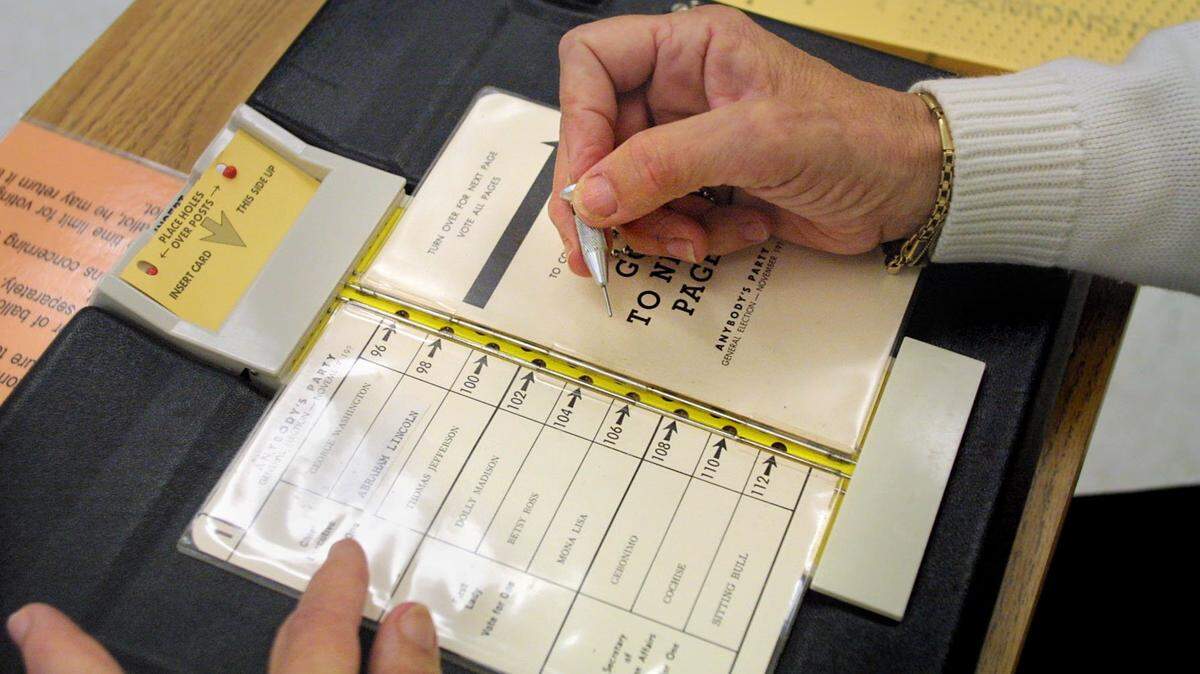
As the Miami Herald’s Mary Ellen Klas just reported, rejected mail-in ballots could be this year’s version of hanging chads.
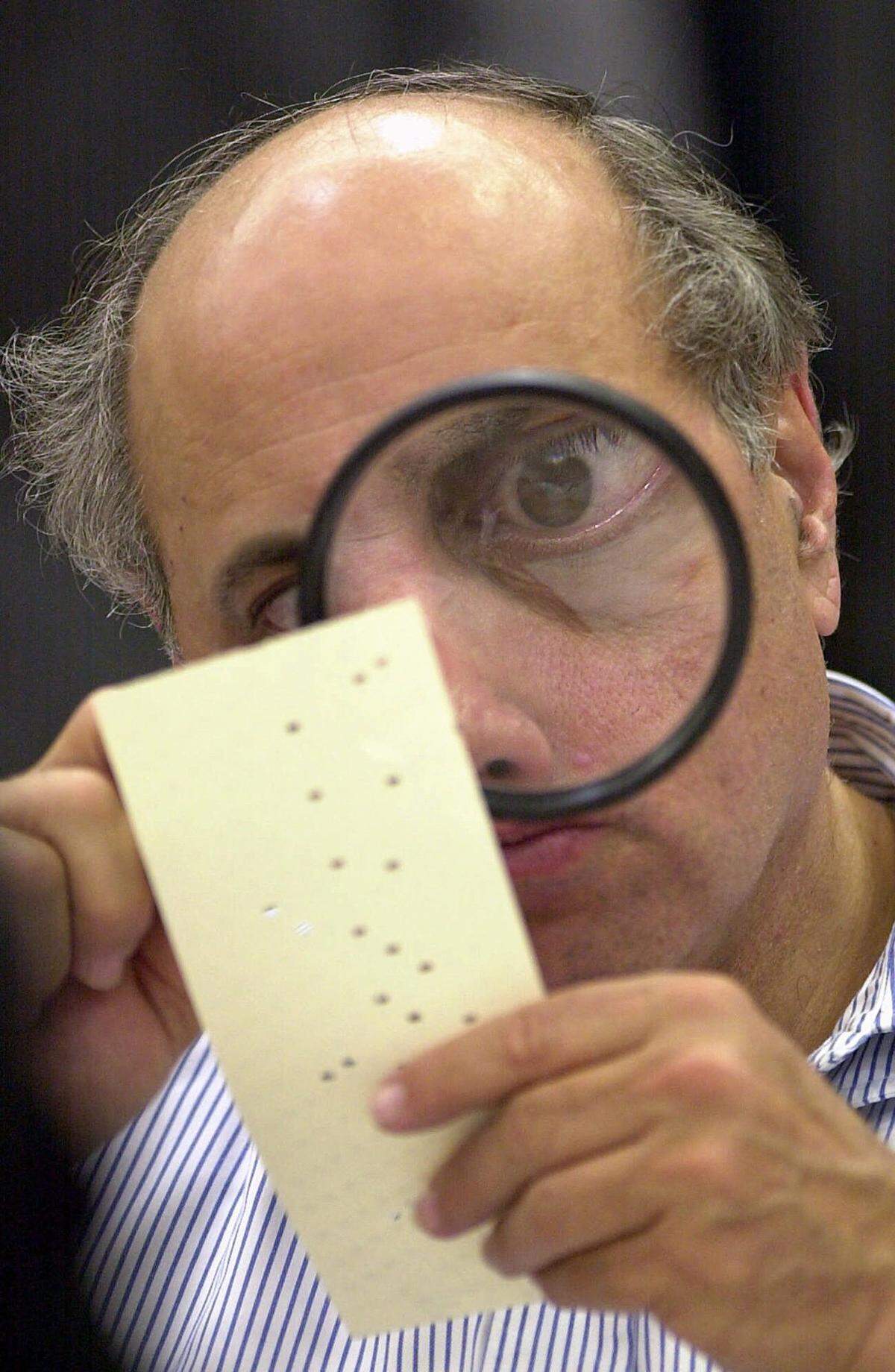
But what’s a hanging chad?
It’s a small piece of cardboard that added even more drama to the whisker-close race in 2000 between George W. Bush and Al Gore. It was a race that ended in recounts and court challenges, and yes, focus on the hanging chad, also known as a “dimpled ballot.”
Hanging chads won’t be involved in this 2020 race for president. Voters now mark their choices with a pen and the ballot is scanned for counting.
But in 2000, things were different.
Let’s take a look back at some of the original coverage of the hanging chad from the archives of the Miami Herald.
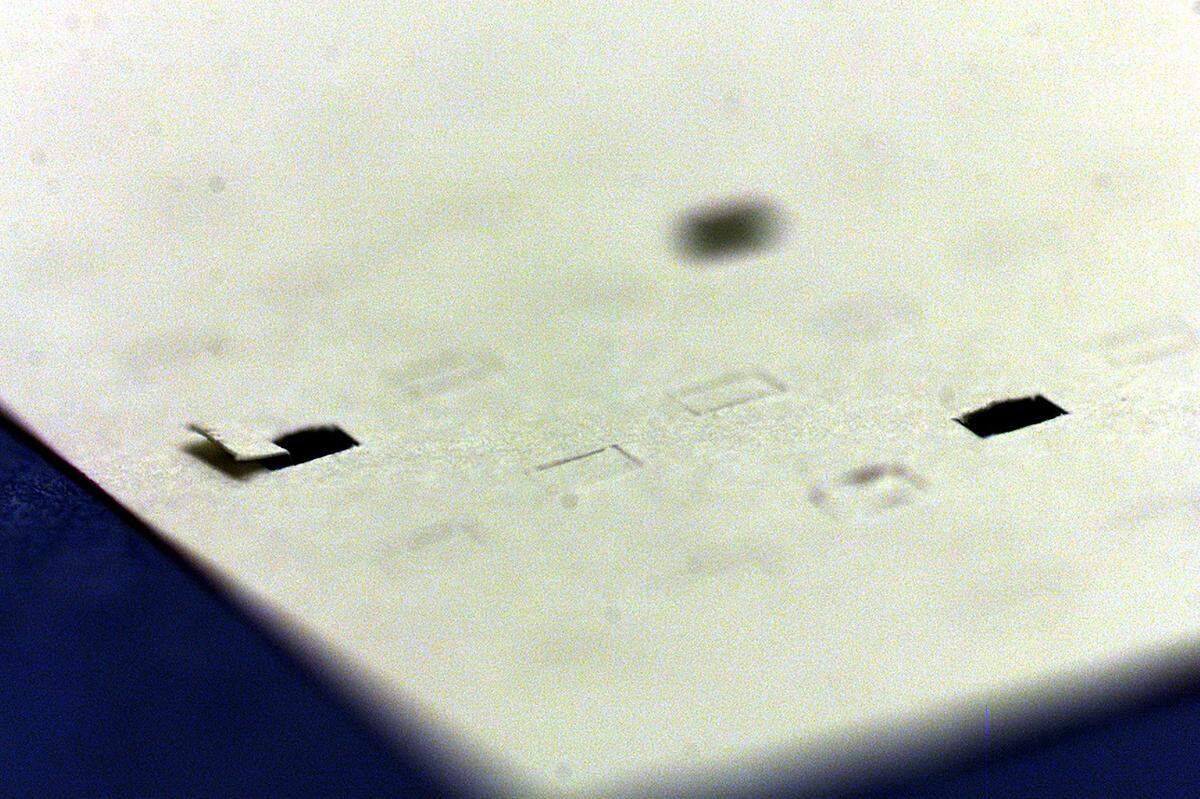
Meet the hanging chad
Published Nov. 11, 2000
A rock band? The title of Carl Hiaasen’s next novel? A country in Africa with gallows? A kid at the mall?
No, the main reason for discrepancies in the Florida vote for president.
From Bay County in the Panhandle to Miami-Dade, hanging chads - the pesky hanger-on paper on a punch card, which is supposed to fall off when punched - were the fall guys for the number differences in many counties.
Accessories to the crime: The Half-bubbled Ovals, The Errant Pencil Marks, That Florida Humidity and Machine Jam.
But the big-time bad guys were those troublesome chads.
“We were up to our knees in chad on election night, but some still hung on,” said Pat Johnson, deputy supervisor of elections in Collier County, where there was a 20-vote discrepancy.
But the biggest case of clingy, hanger-on chads occurred in Nassau County, where the number changed by 197 votes - 124 for Bush and 73 for Gore.
A Herald survey of 37 of Florida’s 67 counties put Miami-Dade County in third place for the largest change from first to second count, with a 98-vote discrepancy. Bush got 36 more votes, and Gore got 62 more - because of loitering chads.
In Hillsborough County, where there was a 75-vote differential between the original count and the recount - 47 votes for Bush and 28 for Gore - Chuck Smith, deputy elections supervisor, blamed it on a number of things: “Hanging chads, cards that jammed in the machine and cards that stuck together.”
Votes in Florida are counted in two ways: A data-processing machine reads holes on a punched card, made when chads do what they’re supposed to do - which is shed their codependent ways and take off on their own.
Or the data-processing machine reads oval-shaped pencil marks “bubbled in” on a card, instead of the holes.
Either way, things can go wrong, not only with the holes and the pencil marks, but with the cards themselves and even The Machine.
These are some of the counties where incorrectly marked ovals and errant pencil marks took the main rap: Hendry County where there was a five-vote differential; Clay County where there was an 11-vote differential and Gulf County where there was 12-vote differential.
Cards that jammed were listed as Enemy No. 1 in a few counties.
Citrus County Elections Supervisor Susan Gill reported a 46-vote discrepancy from first count to recount - 24 more votes for Gore and 22 more for Bush - caused by “ballots jammed in the machine.”
But the boldest explanation of all came from Elections Supervisor Marcia Wood of Liberty County, where there was a seven-vote discrepancy after the recount: “It may have been the machine, but it could have been human error.”
When do dimpled ballots count?
Published Nov. 22, 2000
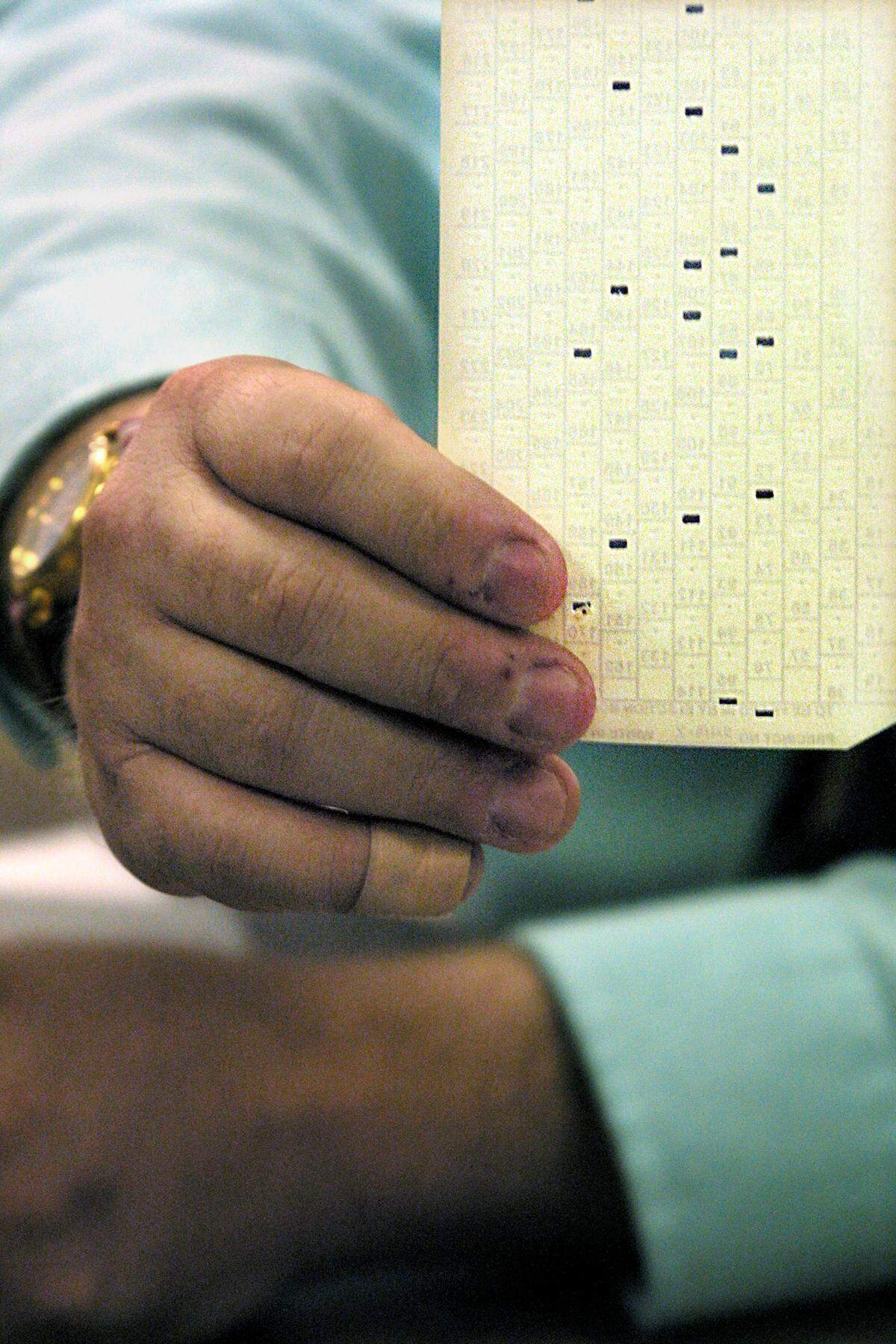
The Florida Supreme Court decision Tuesday leaves open one critical question that could determine the presidency: When do dimpled ballots count?
While the ruling referred to the problem of interpretation when a voter “dimples” but does not punch through the ballot, it did not set explicit standards for counting those ballots.
The method each county uses to count the much disputed ballots will play a crucial role in the outcome of the hand count, a Herald analysis shows. The methods, depending on which are used, could bring hundreds of new votes into play in an election separated by only 652 votes.
The Supreme Court cited an Illinois ruling that “where the intention of the voter can be ascertained with reasonable certainty .... that intention will be given effect even though the ballot is not strictly in conformity with the law.
“To invalidate a ballot which clearly reflects the voter’s intent, simply because a machine cannot read it, would subordinate substance to form.”
The Florida Supreme Court ruling does not, however, distinguish among the different methods of interpretation at work in South Florida.
In Miami-Dade, most dimpled ballots, seen as evidence of intent on the part of voters, are being counted as valid votes.
In Broward, they’re being set aside in a separate pile for reconsideration at the end of the recount.
And in Palm Beach, a narrower ruling: Dimpled ballots don’t count - unless the ballot shows a discernible pattern of dimpling, in which case the canvassing board has decided the vote does count.
The narrower interpretation used in Palm Beach, according to the Herald analysis, has been helping to preserve the lead of Texas governor George W. Bush.
The broader interpretation used in Miami-Dade is favoring Vice President Al Gore because it includes five times as many previously uncounted ballots.
The Herald examined the manual recounts underway in Palm Beach and Miami-Dade, and the varying interpretation of a dimple clearly swings the tally.
In Palm Beach County, where a narrower definition prevails, the manual counters have been finding new votes in about 5 percent of ballots that originally showed no presidential votes when counted by machine. Projected across Palm Beach County, this would add about 480 votes to its election results, with most going to Gore.
In Miami-Dade County, where a broader definition of a properly marked ballot is used, the manual counters have been finding new votes in about 25 percent of the ballots that originally showed no presidential votes when counted by machine.
Projected across Miami-Dade County, this would add more than 2,600 new votes, most of them for Gore. If the broader interpretation is used across all three counties, Gore could collect enough new votes to overcome Bush’s lead of 930 votes.
The fear that dimples might flip the numbers to favor Gore had Republicans in overdrive from Tallahassee to Miami.
“It’s just inconceivable that we can have three separate places with three different standards,” fumed Republican congressman Mark Foley, R-West Palm Beach. “A dimple is not a vote.”
Republicans went before Miami-Dade Circuit Judge David Tobin Tuesday, unsuccessfully arguing for standards for ballot review.
And in Tallahassee, Bush’s legal team filed a surprise brief in the Florida Supreme Court arguing that the justices had no legal authority to set standards for the counting of ballots by county canvassing boards.
“This is an intensely fact-bound question, and there is no existing Florida law on the question,” the Bush brief argued. “It would thus be particularly inappropriate to decide this question in this legal and evidentiary vacuum.”
In the absence of law, county canvassing boards have fashioned their own varying standards.
“The courts have not articulated any standards on this,” said First Assistant County Attorney Murray Greenberg, who advised the Miami-Dade canvassing board.
“The polestar here is the intention of the voter,” he said. “There is no hard and fast rule. We have to look at the totality of the circumstances with each ballot.”
Greenberg cited a 1975 Florida Supreme court case that offers some guidance to canvassing boards on the issue of voter intent. In Boardman v. Esteva, a case involving absentee ballots in Leon County, the court warned against disenfranchising voters on technical grounds.
“The right to vote is the right to participate; it is also the right to speak, but more importantly the right to be heard.”
In Miami-Dade, the canvassing board has interpreted that to mean dimples are usually valid votes.
“We have to try to interpret voter intent,” said a weary David Leahy, Miami-Dade elections supervisor. “It’s a very hard job.”
Even in Texas, Bush’s home state, the law requires that the voter-intent standard be used. Under Texas law, a ballot may be counted if “an indentation on the chad from the stylus or other object is present and indicates a clearly ascertainable intent of the voter to vote.”
In Palm Beach, Circuit Judge Jorge Labarga sent that same message to the canvassing board last week: Use voter intent as a guide.
Palm Beach County responded by counting dimpled ballots if the voter showed a clear trend of failing to punch clean through the vote card. A dimpled presidential vote on an otherwise fully punched ballot means no vote.
Republicans say the dimple dispute bares the flaws of manual vote-counting.
“You have ever-changing standards, unclear standards,” said Scott McClellan, a Bush campaign spokesman. “You should not be able to move the goalpost in the middle of the ballgame.”
In Broward, the canvassing board had not decided what standard to use when they revisit the stack of undervotes - more than 1,000 since the recount began a week ago.
On Friday, Broward Circuit Judge John Miller ruled that the board’s established standard - which required that two corners of a chad be hanging to be counted - was too strict. Miller said the board needed to reexamine ballots that met a less strict standard, though he stopped short of dictating what that would be.
The board decided to set aside the disputed ballots for review when all 609 precincts were completed. Broward Circuit Judge Robert Lee, who chaired the canvassing board until Tuesday, had hoped for direction from the Supreme Court. It was unclear Tuesday night how Broward would handle the dimpled ballots.
Drama over the chad
Published Nov. 21, 2000
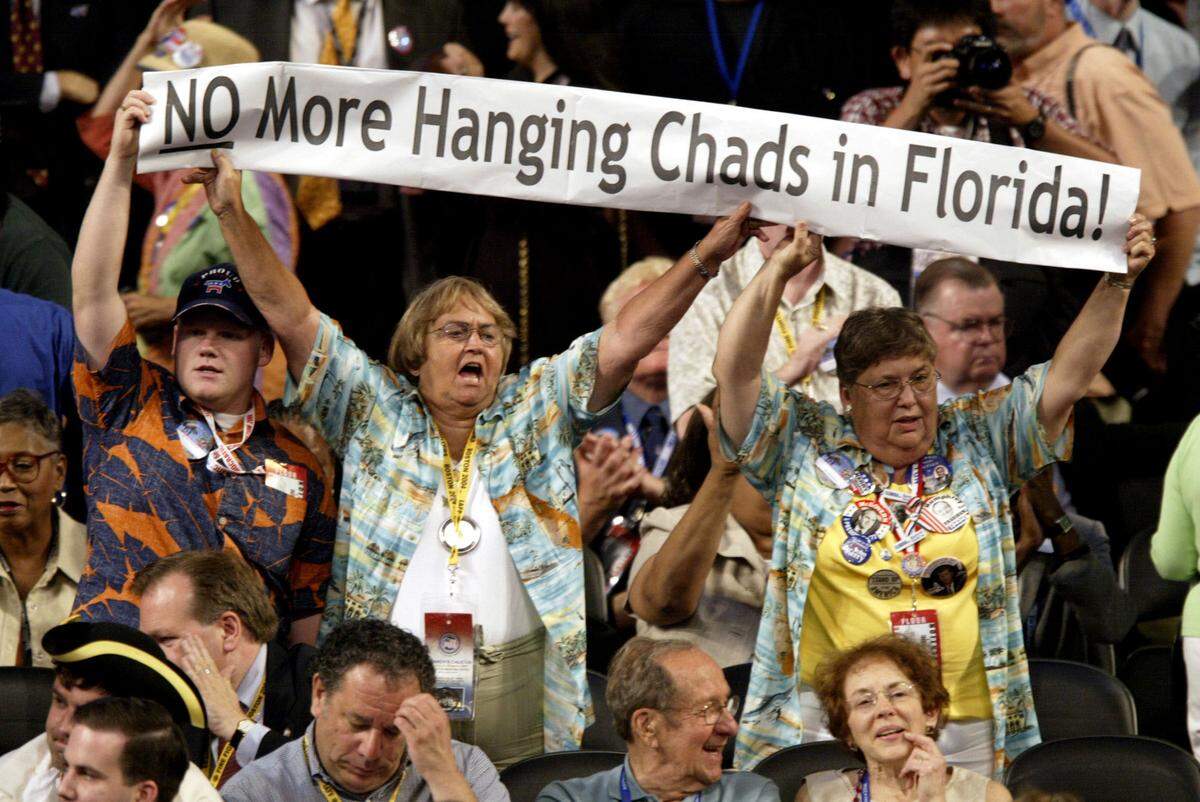
Poor chad.
He hangs. He dimples. He falls.
And, in the two weeks since the most contested election in decades, he has been the subject of endless debate and recrimination.
As election recounts continued Monday in Broward and Palm Beach counties, and as Miami-Dade County entered the recount fray, chad - the tiny cardboard punch hole whose complete or partial removal from a ballot circuit court judges have said signal a voter’s intent - has come under intense scrutiny. GOP ASSAULT
In the last few days, Republican Party leaders have stepped up their attacks on the recount procedures in Fort Lauderdale and West Palm Beach.
Ballot counters, the GOP alleges, are excessively handling questionable ballots - dropping and stepping on them and even using them as fans, causing the chads to dislodge and fall.
Republicans even say they have an affidavit signed by two witnesses who swear they saw a ballot counter eat a chad - despite the fact that counters are fed three meals per day, mostly sandwiches. ALLEGATIONS DENIED
U.S. Rep. Peter Deutsch, D-Pembroke Pines, said the GOP’s allegations are preposterous. County canvassing boards, he said, are doing their business in front of hordes of television and print reporters - not to mention “sheriff’s deputies in uniforms with guns.”
“If anyone sees anything nefarious going on, they could raise their hand or stand up,” Deutsch said.
“It hasn’t happened. . . . This is not rocket science. It is not brain surgery.”
GOP leaders denied allegations that Republicans are simply doing everything they can to slow down the hand tallies.
“There are a lot of political operatives of the Democratic Party out there counting and handling ballots,” said George LeMieux, vice chairman of the Republican Party of Broward County. “And that’s a reason for concern.”
Still, dropping chads have concerned the Republicans monitoring Palm Beach and Broward’s hand recounts from the get-go.
At one point last week, Palm Beach Circuit Judge Charles Burton, a member of Palm Beach County’s canvassing board, told counters to stop using ballots as fans.
Mike Limas, chief operating officer of the Omaha, Neb.-based company that produced the ballots used by Miami-Dade and Broward counties, said it’s certainly possible to dislodge a ballot hole through excessive handling - but not terribly likely.
“Depending on how it’s handled, it’s possible to cause a chad to come out of a card,” said Limas, head of Election Systems & Software. But, he added, “Ballots are designed to be handled without losing chads. It’s not likely that, through normal handling, chads will be doing that. A person intent on losing a chad can push a chad out. That’s certainly possible.”
Not only have the chads landed on the floor, Republicans contend, they have also, allegedly, ended up in the mouths of Democrats.
Jim Rowland, a legislative aide to U.S. Sen. Sam Brownback, R-North Carolina, who was volunteering as a Republican observer of the Broward hand tally Friday, said a Democrat helping to manage the recount walked over to a table where a pile of ballots had just been tallied.
The Democrat, according to Rowland, walked up to the table, licked his finger and put it in a pile of about 10 chads, then stuck it back in his mouth. “He said, ‘Mmmm look at these,’ “ Rowland said.
The man then took the rest of the chads off the table and put them in his pocket and walked away, refusing to give his name, said Rowland, who signed an sworn statement for the Republicans about the incident.
Each night, the Republicans have collected as many of the controversial cardboard chits as possible and each day carefully store them in a plastic bag.
As of Saturday, they had collected 872 such bits.
A lesson
Columnist Fred Grimm
Published Nov. 10, 2000
Florida’s Cyber Guv finds his well-cultivated image skewed by hanging chads.
Must be like pimples on prom night. Suddenly, the entire nation ponders those tiny cardboard fragments that tend to dangle from Cyber Guv’s punch cards.
They ruin Florida’s ballots. And they sabotage New Florida rhetoric. The same fellow who talked of this state as a “high-tech heaven” now finds himself regarded as governor of a low-tech haven, where antiquated technology and slouching returns distorted a presidential election.
It doesn’t help Cyber Guv that the candidate who seems to have benefited from Florida’s use of Industrial Age voting methods was the other Gov. Bush.
“Punch card technology” has emerged as the great oxymoron of the 2000 election. The method of counting heads by sticking little holes in precise locations on paper cards was first developed for the 1890 census. But at the dawn of the computer age, it was IBM, with that immortal admonition - “do not fold, bend, spindle” - that married punch cards to the computer.
IBM, you might have noticed, has since moved on to other, more reliable technologies. In fact, nearly everyone in the numbers crunching business has abandoned those quaint, troublesome punch cards. Everyone but election supervisors. Voters in 26 of Florida’s 67 counties still deal with punch cards, including those in Miami-Dade, Broward and, most famously, Palm Beach counties. These latter three counties, by the way, have dubbed themselves the Internet Coast.
And now the nation waits, smirking, as Florida counts and recounts the tiny holes next to George W. Bush and those next to Al Gore. Especially in Palm Beach County’s heavily Jewish precincts, where an inexplicable number of perforations appeared next to the name of a fellow who suggested that we rethink Adolf Hitler.
It seems all the odder that while we on the Internet Coast were clutching tiny pins and punching holes like Third World factory workers (often with aged eyes and arthritic fingers), folks in Cabell County, W.Va., were using electronic touch-screen voting.
After Florida’s laborious, late-night vote counts, and laggard recount, the Cyber Guv might consider placing a call to Piedmont, Calif., where last year touch-screen votes were tabulated and announced 29 minutes after the polls closed.
The machines resemble ATMs (particularly appropriate for some precincts). Voters swipe their magnetic-stripped cards, then vote by pressing a 17-inch screen. The 19,120 Palm Beach County residents who inadvertently punched two holes for prez, spoiled their ballots and lost their votes might like the notion that, if they make a mistake on the screen, they can fix it before sending on to the memory banks. In Dallas, which adopted touch-screen technology last year, election officials claim “the over-55 population liked it better than anybody.”
Of course, Jeb must first convince elected, independent and contrary county election supervisors (Thirty-eight already use a higher-tech mark-and-scan method. Two use lever machines. Union County counts paper ballots.) to join him in electoral High Tech Heaven.
Cyber Guv could portend a truly New Florida, unmarred by hanging chads.
This story was originally published October 18, 2020 at 10:47 AM.