
Sparks fly over ‘defund police,’ corruption accusations at Univision’s mayoral debate
Five candidates for Miami-Dade County mayor clashed at a Univision debate on Wednesday over several issues, including calls to “defund the police.”
“What we saw in Minnesota was an assassination, was a crime, but it’s not just to put these crimes on the Miami-Dade County police department,” County Commissioner Esteban “Steve” Bovo said. “These conversations that we are seeing at this moment, to take funding away from the police, is a colossal mistake.”
The candidates discussed the defunding and abolition movements as well as anti-racism protests. But the debate also featured more personal attacks, with front runner and former county mayor Alex Penelas and District 13 Commissioner Bovo battling it out over mutual accusations of corruption.
Participants included Penelas, Bovo, Commissioner Daniella Levine Cava, Commissioner Xavier Suarez and political newcomer Monique Nicole Barley. Ludmilla Domond, who was scheduled to appear, was unable to join the in-person, maskless event because she’s sick, said debate moderators. Write-in candidate Carlos Antonio de Armas did not participate.
All participants except Barley responded to questions in Spanish.
When asked, none of the candidates agreed to defund or abolish the police; calls to do so have erupted over the past couple of months, following anti-racism protests across the country after the death of George Floyd at the hands of police in Minneapolis.
Levine Cava used her experience as a social service worker to redirect the conversation to one about prevention. Activists say that calls to “defund the police” actually mean rerouting portions of police department budgets to social services and hiring non-police employees, such as mental health workers, to deal with issues such as mental health crises.
“We need other services, and at this time, people are asking for social services,” Levine Cava said. “I am the only social worker here. And I am ready to serve in that sense, always thinking about the needs of the community, which is prevention; with that, you can lower the crime. We need to solve the crimes that we have and also assist, help people so that they don’t enter a life of crime.”
When pushed on how much he would lower police funding, Penelas said he wouldn’t by any percentage; he said if there are other community needs, as Levine Cava pointed to, it’s the county’s responsibility to find the necessary funding.
“The problem is that [they] want, in one form or another, to say that if you need money for other services, you need to take it from the police. I don’t fall into that trap,” Penelas said. “I don’t think that you need to take money from the police to confront other social issues in the community.”
In some cases, the fights also included jabs at current Mayor Carlos Gimenez, who is being forced out of his post by term limits and running for Congress. Gimenez has faced criticism from local city mayors because of his recent handling of coronavirus restrictions, including attempted walk-backs of reopening provisions.
Bovo said that businesses are paying the price for Gimenez’s recent decisions, such as his choice to suspend indoor dining for restaurants in the county, when protests may have caused the recent spikes in coronavirus cases.
“We are seeing a higher level of the virus, and I think there’s a connection between what we are seeing and the demonstrations,” Bovo said. “Many people were going out not for one day, not for two days, but for two or three weeks to protest.”
Barley agreed, calling the protests “selfish.”
“Basically, right now the business owners are suffering because of the ones that went out and protested. I believe that was very selfish of them,” Barley said. “If they were to do any protests I think they should have thought about others and maybe, possibly done something online.”
A question about the half-cent transportation sales tax that Penelas championed as mayor prompted the sharpest confrontation of the night. Penelas’ rivals have used the tax as a hammer against him, because the Metrorail and bus expansion at the center of the 2002 referendum campaign he led never materialized. Penelas has blamed the sitting commissioners in the race for failing to properly spend the more than $2.5 billion generated after he left office.
A question about the funds was directed to Suarez, who argued he was the wrong person to ask.
“The question should be asked to Mr. Penelas, who invented the half-penny tax, or to the people at my left and my right, who wrongly spent the half-penny tax,” Suarez said.
Penelas, though prompted to respond by the moderators because of Suarez’s mention of his founding of the tax, took his response time to accuse Bovo and Levine Cava of misusing funds. The debate then escalated into a heated argument between Penelas and Bovo, who accused each other of corruption several times.
“Not only did you lie to the community with your half-penny tax, Alex, the level of corruption that you had in the county was basically disgusting,” Bovo said.
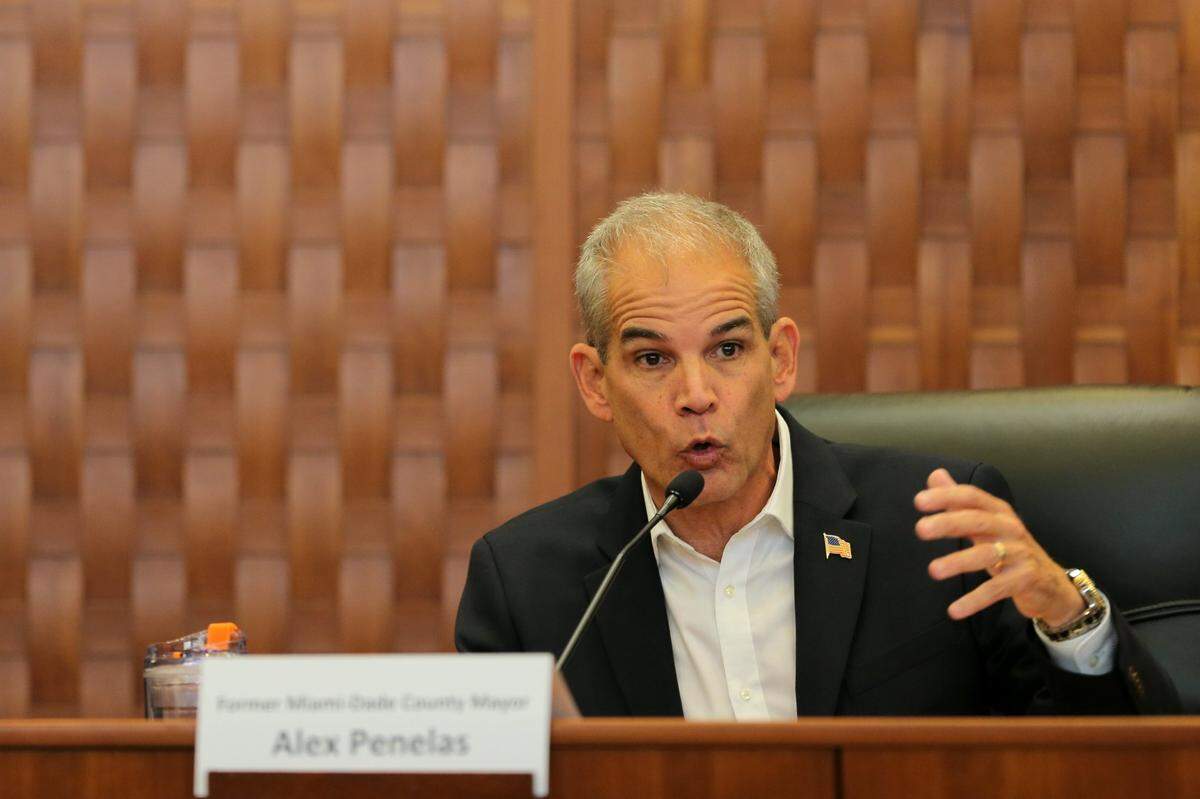
A conversation about the tax led to an intense back-and-forth between the two, with Penelas resurfacing a connection between the Bovo campaign and Venezuelan leader Nicolás Maduro. In May, Bovo fired a fundraiser for his mayoral campaign after the Miami Herald reported she was paid millions from the proceeds of a contract between a former Miami congressman and a subsidiary of a state-run Venezuelan oil company.
“You also need to talk about, for example, your confidant David Rivera, who received $15 million from Nicolás Maduro,” Penelas said. “The corrupt one here, Mr. Bovo, is you.”
Penelas also accused Bovo of election fraud, an allegation that surfaced again in a June ad put out by the group A Better Miami Dade. A former Bovo aide gathered at least 164 absentee ballots at his Hialeah office.
Both accusations angered Bovo, who threw corruption allegations back at Penelas and dismissed the idea that his campaign was influenced by the Venezuelan government.
”Careful, godfather of corruption. Careful with what you say,” Bovo said.
Penelas got the last word in, claiming Bovo never answered the questions asked of him before the moderators cut off the argument.
Throughout the rest of the debate, candidates touched on hot button issues such as immigration, environmental concerns and transportation.
The candidates will compete in an Aug. 18 primary. If one candidate receives more than 50% of the vote, the race will be over; if not, the two candidates with the most votes will face off again in November.
The debate was moderated by Ambrosio Hernández and Nelson Rubio.
This story was updated after it was originally published online to include more details from a heated exchange between Steve Bovo and Alex Penelas.
This story was originally published July 15, 2020 at 10:04 PM.