
Lots of legal arguments but no decision in Nelson’s suit over mismatched signatures
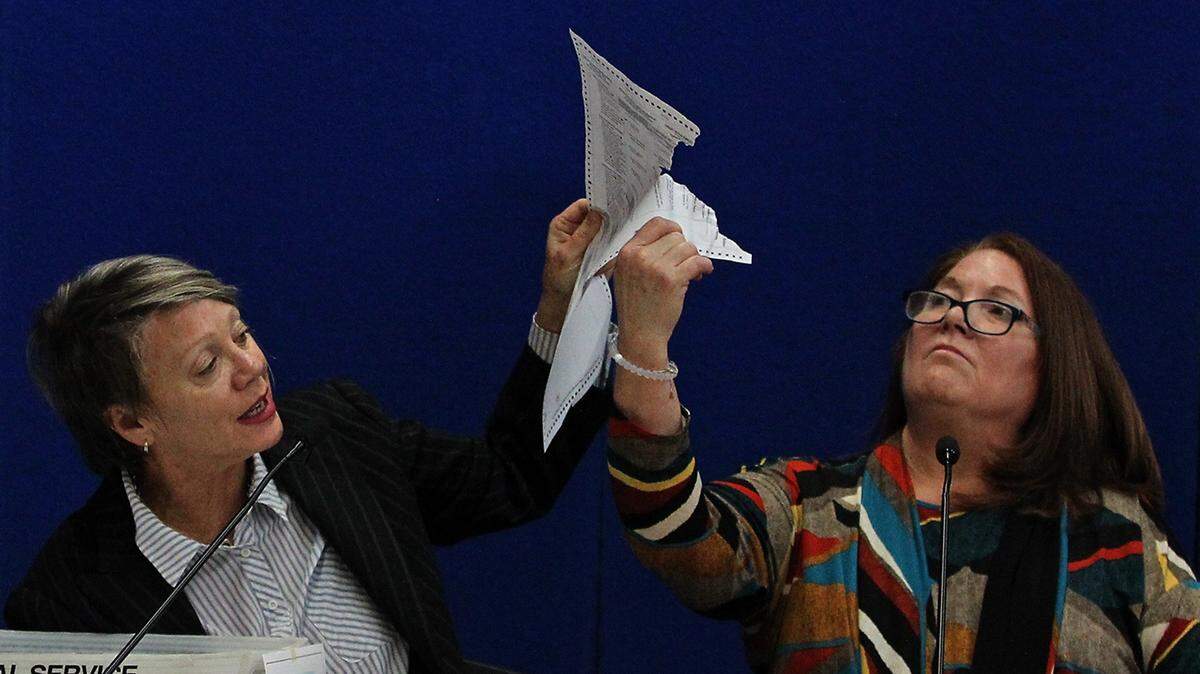
Florida’s system of reviewing voters’ signatures on mail ballots is on trial in a federal courtroom as Democrats and Sen. Bill Nelson try to expand the pool of ballots in his closely contested Senate race.
U.S. District Judge Mark Walker heard testimony and arguments for five hours Wednesday in Nelson’s lawsuit that seeks to validate thousands of mail and provisional ballots that have been disallowed because the voters’ signatures on ballot envelopes don’t match signatures on file.
Walker did not rule in the case, but a decision is imminent, as 67 county machine recounts must be completed by 3 p.m. Thursday.
As the hearing ended, Walker urged the state elections division to provide a detailed report on how many voters’ ballots have been rejected because of signature problems.
A report from 45 counties Wednesday showed 3,688 rejected mail ballots and 93 rejected provisional ballots, and Walker made it clear that that isn’t good enough.
“Let’s be as transparent as we can and provide as much information as we can,” Walker told attorneys for Gov. Rick Scott’s chief elections officer, Secretary of State Ken Detzner.
.JPG "IMG_IMG_0232_9_1_C5D7TCEA_L370582169 (1).JPG")
The names of the candidates — Nelson and Republican Scott, who holds a 12,562-vote lead — were barely mentioned, but the political stakes were obvious to everyone in Walker’s courtroom, including the judge.
“Apparently I’m supposed to re-evaluate the entire election code of the state of Florida, one piece at a time. I’ve got it,” Walker said. “This just seems like a really bad way to do this.”
The judge appeared to float a compromise that would allow any vote-by-mail voter whose ballot was rejected due to a signature mismatch to challenge that decision. At one point, Walker suggested a three-day challenge window, which Nelson’s lawyers said was too short.
State and county officials are working under extraordinarily tight time deadlines.
Manual recounts are expected to be ordered Thursday in the races for Senate and agriculture commissioner.
Manual recounts of hundreds of thousands of undervotes and overvotes must be completed by noon Sunday, and final results are expected to be certified next Tuesday.
Early on Wednesday, Walker sent a strong signal that he would not give Nelson the answer he was seeking.
“Why in the world would I say ‘Count them all,’ without regard for whether they are valid votes?” he asked Nelson’s team of dark-suited attorneys.
Walker then quoted an ancestor: “My grandfather would say that’s roughly akin to hunting squirrel with a bazooka.”
Nelson, playing catch-up against Scott in his final campaign of a four-decade career in politics, has filed a flurry of lawsuits.
They seek to include disputed mail and provisional ballots in vote tallies, extend vote-counting deadlines and invalidate the state’s definition of voter intent in deciding whether undervotes and overvotes are legitimate.
Walker has issued several rulings in elections cases that are on the side of expanding voting rights while critical of Scott’s administration.
There was more criticism Wednesday after lawyers for Scott’s elections division and for Attorney General Pam Bondi argued that Nelson had no legal case because he waited too long to file a lawsuit, and that voting by mail is not a constitutional right but a privilege.
Walker, his voice rising, told one of Bondi’s attorneys: “If that’s your theory, we’d still have segregated schools in Florida.”
The judge appeared swayed by Mark Earley, the elected supervisor of elections in Tallahassee’s Leon County, who testified about how the signature verification process really works.
Earley said canvassing boards review signatures closely, and rarely reject ballots. Of the 27,301 people who voted by mail in Tallahassee, he said, 38 ballots were rejected for mismatched signatures.
“We look at the signatures very carefully. We are trying to find matches,” Earley testified.
This story was originally published November 14, 2018 at 7:48 PM.