
In New Hampshire, signs of strain emerge between Jeb Bush and Marco Rubio
That Jeb Bush’s surprise decision in December to explore a 2016 Republican presidential run would complicate the ambitions of his erstwhile Florida protégé Marco Rubio seemed a given.
That Rubio’s now-declared candidacy might also make things a little problematic on a personal level for Bush didn’t become clear until this weekend in New Hampshire.
Mentor and mentee missed each other as they both held meet-and-greet gatherings with voters in Manchester and spoke to GOP activists in Nashua. What they couldn’t avoid were questions at every stop from the news media probing their relationship.
Bush, as he did when he was Florida governor, deplored inquiries about political strategy — “That’s a process question!” he chided a reporter at Saint Anselm College’s “Politics and Eggs” breakfast — and sounded less than thrilled to discuss Rubio.
“He’s a good, close friend, and it is what it is,” Bush said Friday, after scrunching his face at the suggestion that the man who once deferred to him before running for U.S. Senate had now betrayed him.
Rubio took the question in stride, embracing the role of insurgent, over a blitz of national interviews in the week since his campaign launch.
On CBS’ Face the Nation on Sunday, Rubio said entering the race was “an opportunity I had to take seriously. And I did. At the end of the day it won’t change how I feel about Governor Bush. He’ll remain my friend, and someone I admire, both personally and politically.”
Last week, appearing on NBC’s Today show, Rubio said: “Jeb Bush is my friend, and I think he would tell you the exact same thing But ultimately I feel at this moment that I’m best positioned to help lead this country into the 21st century. We’ll remain friends throughout this process.”
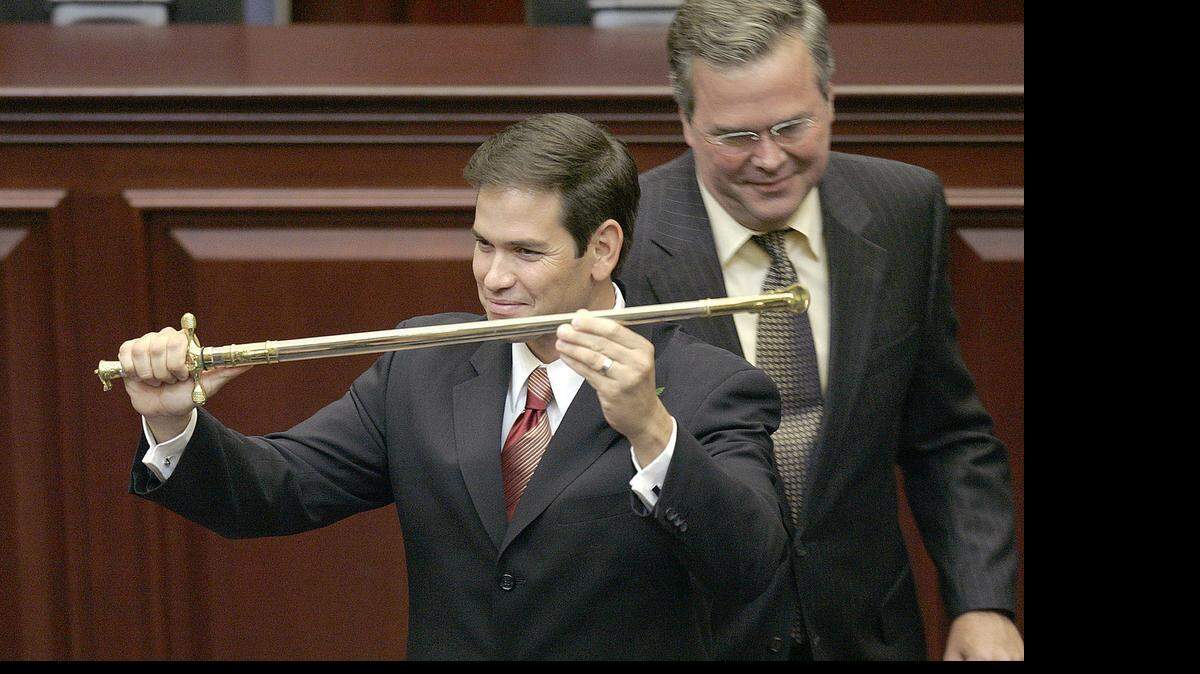
Both men, who shared a plane ride to Miami from Nashville three days before Rubio’s campaign kickoff, said they intend to remain close. They live about three miles apart, Rubio in West Miami and Bush in Coral Gables. When Rubio became speaker of the Florida House of Representatives, Bush presented him with a commemorative sword, which Rubio said he has “somewhere at home” away from his young kids.
Despite the cordial, all-is-well remarks, there are early, subtle signs of strain.
Rubio, 43, began his campaign by defying critics who think he should “wait his turn” and by dismissing unnamed candidates of “yesterday.” At Manchester Community College, he was asked if Bush, 62, who left the governor’s mansion in 2006, is one of them.
“It’s not about biological age, or how long someone’s been in politics,” Rubio said. “It has more to do with the age of your ideas. Do you have ideas about how to move America into the 21st century? Jeb, if he announces for president, he’s going to be a very strong candidate. I imagine he’ll put forth a policy agenda that outlines his position on various issues. And then we can make that judgment, as voters will make that judgment.”
Now, listen to Bush in his speech to activists at the “First in the Nation” summit in Nashua where he said conservatives shouldn’t elect another President Obama — code for a promising prospect lacking the necessary experience.
“We’ve elected a president who was a phenomenal speaker,” Bush said in response to a voter’s question about his executive record. “But he was two years as a United States senator and had no record of accomplishment, and before that was a state senator with very little record of accomplishment, and what did we get? We got the most liberal president in modern history.”
He concluded by emphasizing the point: “Who sits behind the big desk as it relates to the presidency is perhaps different than United States senator or another job.”
That jab could have been directed at any of the three announced Republican candidates, Rubio and fellow first-term senators Ted Cruz of Texas and Rand Paul of Kentucky. But coming from Bush, the contrast felt particularly aimed at Rubio, who received renewed political buzz following his Miami kickoff and who shares many of Bush’s policy positions.
Over the weekend, both men endorsed gradually raising the retirement age before workers become eligible for Social Security benefits. They said many of the nearly 11 million people living in the country illegally should earn lawful status. And they criticized the higher education system for being stuck in the past — even making similar quips about it.
“The Number One degree program for public universities is psychology,” Bush said at a town hall-style meeting in Concord. “Maybe there is a shortage of psychologists. I don’t believe there is. But there’s three million jobs that could be filled if you’re [an] IT worker, an engineer, accounting, nursing, welding.”
Here’s Rubio speaking to the Nashua activists: “Before you take out a student loan, your school has to tell you how much you can expect to make when you graduate from that school with that degree, so you can decide whether that basket-weaving degree that you are seeking...” He was interrupted by laughter. “I used to always cite some major — Greek philosophy — but groups of people would get offended.” (“Greek philosophy is good, by the way,” he added.)
With so many Republicans running or thinking of running in the race, the GOP primary is hardly shaping up to be the Jeb-vs.-Marco show. Yet for two men whose political careers have crossed paths before, there is no bigger stage to figure out the new contours of their friendship.
“We’ll all sort out — look, this is — I’m not a candidate,” Bush told reporters. “And if I am a candidate, this is a long journey. And one of my objectives would be to maintain the friendships I have with the people that may be aspiring to the same thing. I think it’s possible.”
So maybe Bush and Rubio are, for now, just “frenemies.”
This story was originally published April 19, 2015 at 12:01 PM with the headline "In New Hampshire, signs of strain emerge between Jeb Bush and Marco Rubio."