
Knowing Charlie Crist as manager and as politician
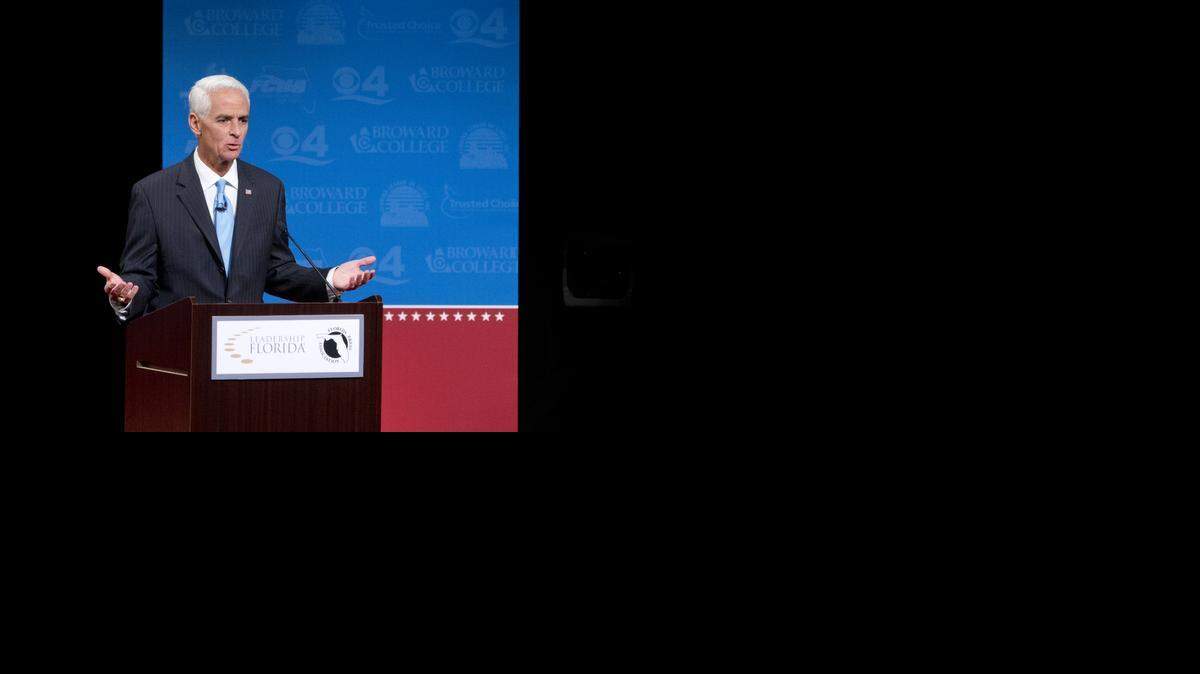
In his long history as a politician, Charlie Crist excelled at two things: making news and running for other offices.
Crist’s political biography is a chronicle of campaigning for: state Senate (1986 and 1992), U.S. Senate (1998), education commissioner (2000), attorney general (2002), governor (2006), U.S. Senate again (2010) and, now, governor again.
“The campaigning has always had more allure to him than the governing,” said George LeMieux, Crist’s former top political advisor who was appointed to an interim U.S. Senate post by the former governor.
Crist in 2010 sought that senate post LeMieux seat-warmed, making the governor the first in modern times to not seek reelection. It also marked the beginning of a stark political transformation that led Crist to flee the GOP, become estranged with LeMieux and ultimately become an independent and then a Democrat seeking his old job back under a new party banner.
In numerous interviews with the Tampa Bay Times, current and former advisors of Crist’s say they worked for an always-candidate, one who wasn’t so much obsessed with policy details as with poll numbers.
“I am,” he often reminded his advisers, “the most popular governor in America.”
Part of Crist’s popularity was also rooted in his ability to seize populist issues and drag lawmakers along with him.
Immediately after he was sworn in, for instance, Crist got his then-fellow Republicans in 2007 to agree to a special lawmaking session on property insurance to lower rates and increase the role of government in the market — something that was anathema to conservatives. He also successfully pushed for property-tax cuts he campaigned on the year before.
Now that he faces a tough opponent in Gov. Rick Scott, who has made much of Crist’s flip flops, the Democrat points to his successes with a ready-made line: “Judge me by my record.”
But his former aides and advisers — many of whom are Republicans supporting Scott — also judge Crist by the man they saw behind closed doors.
More than anything, they say, leaving the office to mingle with people — press present, cameras rolling — is what motivated the governor. He assiduously courted reporters and focused on his office’s media coverage. What drove almost every decision he made was a simple calculation: If I do this, what will the headline be, and will that headline earn me more approval?
Before running for office this year, Crist took care to write his own headlines and explain himself in his own terms by penning an autobiography, The Party’s Over. The title refers to his decision to leave the GOP, which he said had grown too extreme. But Crist only came to that conclusion out of political necessity, when his standing fell in the Senate GOP primary against Marco Rubio.
Behind-the-scenes
Crist’s recollections in his book conflict with the behind-the-scenes recollections of his aides.
For instance, in his book, Crist recounts the “all-consuming” BP oil spill crisis of 2010 and the regular White House conference calls with Gulf state governors.
Here’s how others remember those calls with governors Bobby Jindal of Louisiana and Haley Barbour of Mississippi:
Gov. Jindal? Here.
Gov. Barbour? Here.
Gov. Crist? Uh, this is Eric Eikenberg, Gov. Crist’s chief of staff....
“I’m not trying to be critical of Gov. Crist, but I don’t remember him being on those calls,” former Mississippi Gov. Haley Barbour said.
While he might not have been on the phone, Crist certainly spent plenty of time inspecting the beaches in and around Pensacola and meeting with President Barack Obama and other administration officials with gaggles of reporters in tow.
At that point, Crist was in the midst of his losing campaign for Senate.
But that campaign effort was really the second of Crist’s term as governor. Soon after he assumed office in 2007, Crist joined with then-House Speaker Rubio to move Florida’s presidential primary to January 2008 — making the nation’s largest swing state more crucial than ever to the candidates. And to Crist, who would use his endorsement to position himself in the center of national GOP politics.
Rudy Giuliani thought he and Crist had a firm handshake deal that Crist would endorse him. The governor backed off as Giuliani’s poll numbers slipped. Crist then promised the leading candidates he would stay neutral but ultimately he couldn’t help himself.
Three days before the primary, Crist endorsed John McCain and immediately positioned himself to become McCain’s running mate (McCain chose Alaska Gov. Sarah Palin). McCain was thankful to Crist for the endorsement, though he was nearly as surprised as Giuliani and Mitt Romney were apoplectic.
Crist shrugged off their anger.
“People hear what they want to hear,” he would say. Or, “I meant it when I said it.”
It was characteristic of a man who would lead several prominent Republicans to believe he was about to appoint them U.S. senator in 2009 before he picked LeMieux. Crist was known to routinely let lawmakers, lobbyists and allies think he supported their bills only to veto them later.
Political promises broken
Crist also reneged on his promise to make former House Speaker Alan Bense the state GOP chairman. Instead, before he took office, Crist chose Jim Greer, a little-known activist from Seminole County, a sycophantic Crist backer and standout fundraiser.
Crist made the decision after discussing several possibilities with LeMieux and lobbyist Brian Ballard while flying on a private plane loaned by one of his top fundraisers, Wellcare CEO Todd Farha.
No one knew then how close Crist and Greer would become, let alone that Greer within six years would be in prison for stealing from the party. And no one knew Greer wouldn’t be the only major Crist fundraiser to wind up incarcerated. Farha is serving 36 months for defrauding Florida’s Medicaid system; Broward County lawyer Scott Rothstein is serving 50 years for running a $1.2 billion Ponzi scheme; Broward ophthalmologist Alan Mendelsohn served 2-1/2 years for public corruption; and Cape Coral real estate investor Greg Eagle, a Crist adviser and donor, is serving six years for bank fraud.
Today, some of those associations have come to haunt Crist as Scott has featured Greer, Mendelsohn and Rothstein in an ad that seeks to paint the challenger as “corrupt.”
Before Greer’s downfall, he was emblematic of the yes-people Crist surrounded himself with. Greer was among the first to learn quickly that the governor did not appreciate second-guessing or encourage free-flowing, two-way policy talk. No question Crist loved having the job. Did he love doing it? Allergic to arguments, he had risen to a position where he couldn’t avoid tough decisions.
Crist as governor
The Herald/Times talked to more than a dozen people who worked under Crist in the governor’s office. The say Crist is the nicest man you’ll ever meet, but behind the scenes he’s frequently icy and dismissive. No one would speak publicly about that side of Crist, mindful he could be elected in November.
If an aide suggested to the governor that he lacked the legal authority to do this or that, he would snap, mockingly: “How many Supreme Court justices have you appointed?”
Staffers might spend hours prepping for key policy or budget presentations, and Crist would show up 30 minutes late, without apology or explanation, and then spend just five minutes giving orders for what he wanted. If anybody tried to raise a counterpoint, the governor, more than once, abruptly stood up and left the room without saying a word, leaving his aides staring at each other and wondering what to do next.
He had little interest in meeting with mid-level staffers with issue-specific expertise, either, preferring quick, broad-brush explanations from his most senior advisers. If an explanation went too long or involved too much detail or nuance, Crist was known to cut the staffer short, unleashing expletives. “I don’t care about those f------ details! This is the way I want it done!”
Where his predecessor, Jeb Bush, periodically spent hours surrounded by staffers debating and discussing the implications of major decisions, it was rare for Crist to carve out even half an hour for briefings. Crist’s aides often lacked sufficient time to give him basic pros and cons. If he wasn’t travelling, Crist typically showed up at the office after 11 a.m.and left before 3 p.m.
But Crist was always on the move.
He could, and would, hop on the private jet of an oil industry billionaire to join rocker and environmental activist Sheryl Crow at an anti-global warming rally in Gainesville.
On a trade mission to Europe, he racked up $1,300 in room service and mini-bar charges and spent $320 just for portable electric fans. Fans are a staple at public appearances for Crist, who is conscious of not letting people see him sweat. A dispute over Crist’s fan initially led Scott to not be on stage at last week’s debate.
“He was always a humble and respectful guy, but the attention that comes with being elected governor is powerful and can change anyone,” said Jim Rimes, a Republican operative who has known Crist most of his political career. “I was surprised that he went from a humble guy to a rock star.”
PARTY LIKE A ROCK STAR
And he partied like one, aides said.
During a trade mission to South America, Crist brough along fiance Carole Rome and her friend. Crist horrified staffers, who say he acted on the trip more like an entitled frat boy on spring break - skipping meetings with dignitaries, showing up late to scheduled events and berating aides for failing to put Rome with him in first class. Somebody got bumped to make room.
The aerospace conglomerate Embraer, a major employer in South Florida, laid out a fancy lunch spread for the governor and his delegation at its headquarters in Brazil. Crist stunned attendees when he suddenly excused himself barely 10 minutes into the meeting, telling LeMieux he was bored.
That night in Rio de Janeiro, Crist left early from a dinner with business executives so he could meet Rome in a hotel lobby. They ran into the actor William Hurt and spent an hour drinking with him in the bar.
Members of the delegation buzzed about whether Crist might be drinking excessively on the trip, particularly after a reception in Sao Paulo for Crist and "Team Florida" hosted by the U.S. Consul General. Crist often ignored speeches and talking points from his staff in favor of quick, unscripted remarks laden with platitudes. That night, he gushed to 400 Brazilian executives gathered at the Casa da Fazenda restaurant about the pretty name of his state, saying "Florida" really means flowery Easter. The long-winded speech left some baffled.
“I recall having a rather uncomfortable conversation with Brazilian leaders at that reception who were wondering, 'Who is this guy? Is this the governor of Florida?' given his incoherent and rambling remarks,” said Jorge Arrizurieta, a trade expert from Miami who has known Crist since they both worked for Sen. Mack. He supported his campaign for governor, though he knew Crist had never been an especially prepared or thoughtful leader - but Crist's behavior in South America shocked him.
“I always believed he would grow into the job as we all do in any job,” he said. “Regrettably, Charlie grew worse. Arrogance and ill preparation are a horrible combination.”
By the end of nine days in Brazil, Argentina and Chile, the governor's deputy chief of staff, Arlene DiBenigno, vented to senior Republicans that the governor had embarrassed himself and Florida. LeMieux had to dissuade Erin Isaac, Crist's communications director and a true believer in the governor, from resigning.
In Santiago, Chile, the room Crist stayed in at the Grand Hyatt was left with red wine stains on the carpet, cigarette burns on a bed spread and a sturdy metal trash can crushed as if someone had turned it upside down and jumped on it.
Enterprise Florida, the state's public-private economic development arm, cut a check for $503 to cover damage - to "the room of Mr. Charlie Crist," it said on the invoice.
Few friends
Crist had many political allies, but no friends. And many, like LeMieux, abandoned him when he abandoned his party.
Asked about his former friends, Crist chalked it up to politics.
“Probably because I’m in government,” he said, talking as if it were an occupational hazard. “You know, it just takes so much time — it takes time away from my family, the same way. And you have to be able to — you know, this is a big state, and there’s a lot of people in it, like 20 million. And, you know, when you’re involved in this kind of endeavor, it’s hard to spend a lot of time with as many people as you’d like to do that with. I mean, you have to keep expanding in order to succeed.”
Crist was also asked if he felt like he had sacrificed long-term relationships to advance his political career. Had that been a trade-off?
“There’s sacrifice to anything,” he said. “I remember my dad used to tell me the number of close friends you should have in your life are less than the number of fingers on one hand.... I mean, I have a lot of friends, and then there are close friends, and then there are real close friends. But the busier you are, the harder it is.”
Editor’s Note
This story is in part an abridgment of a story by Adam C. Smith and Michael Kruse of the Tampa Bay Times called “Knowing Charlie.” Read the full story at http://tbtim.es/knowingcharlie.
This story was originally published October 20, 2014 at 5:28 PM with the headline "Knowing Charlie Crist as manager and as politician."