
Florida’s high court stacked with DeSantis picks as governor names new justice
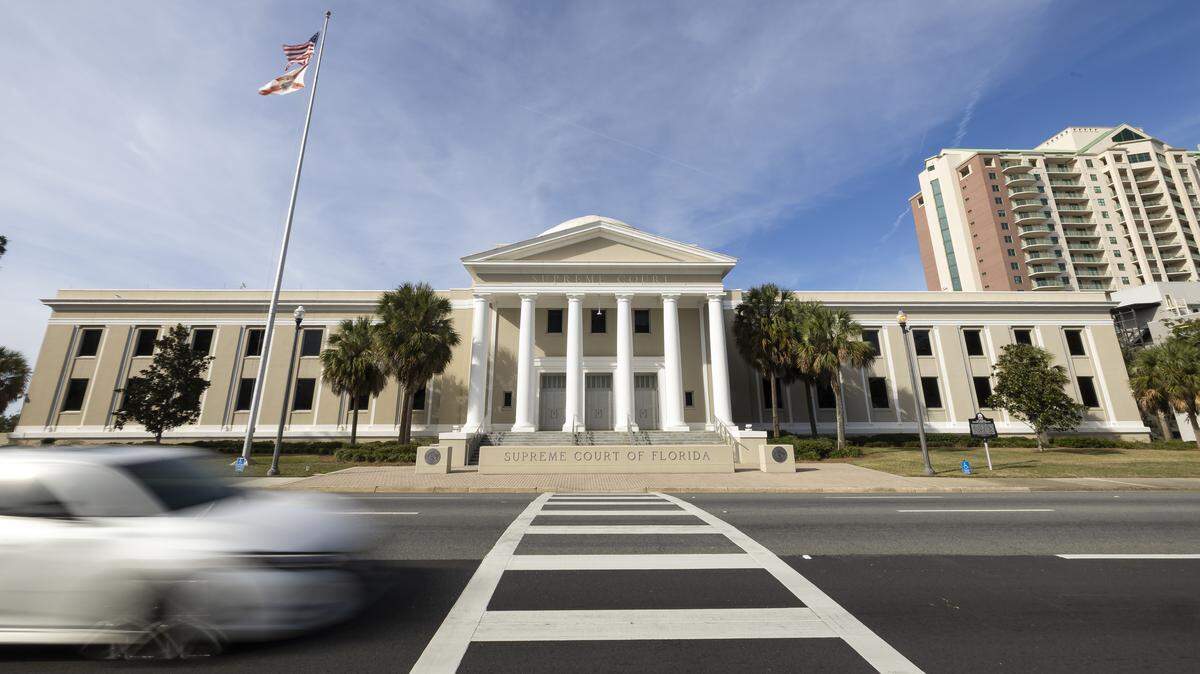
Gov. Ron DeSantis on Wednesday appointed Adam Tanenbaum, a judge for the 1st District Court of Appeal, to the Florida Supreme Court.
DeSantis announced the appointment at Tanenbaum’s alma mater: Seminole High School in Pinellas County, where he graduated first in his class in 1989 — the same year as the kids in “Stranger Things,” Tannenbaum joked to students.
Tanenbaum’s placement means the state’s high court will be overwhelmingly represented by DeSantis appointees. Already, five of the seven justices have been seated by DeSantis since he took office in 2019.
Tanenbaum will replace Justice Charles Canady, who stepped down to lead the University of Florida’s Hamilton School for Classical and Civic Education.
Only Justice Jorge Labarga, who will hit the court’s mandatory retirement age in October 2027, was appointed by another governor, Charlie Crist.
Tanenbaum, who graduated from the University of Florida and Georgetown Law, has experience that includes stints as an assistant federal public defender, and as a general counsel for Florida’s Department of State and House of Representatives. In the latter, he served under the speakership of Richard Corcoran, which he called one of his favorite jobs.
In 2019, DeSantis appointed him to the Tallahassee-based 1st District Court of Appeal. In 2023, Tannenbaum was part of the appeals court that upheld DeSantis’ Congressional redistricting map.
Tanenbaum described himself as an originalist — a reference to a judicial philosophy often associated with conservative jurisprudence, which calls for the constitution to be interpreted the way its framers would have understood it. Tanenbaum also said he believes in “judicial humility.”
“I subscribe to the fixation thesis and the constraint principle,” he said at the news conference Wednesday. “The meaning of the text is fixed at the time of its ratification or enactment, and that original meaning does not change over time.”
Still, he said, a conservative approach does not mean timidity and sometimes “circumstances require boldness to restore our jurisprudence to its historical roots.
“The centuries of history, custom and tradition come to us through the Anglo American legal system as our inheritance, and we constantly must be studying, studying all of that and the context in which the law we are applying was adopted,” he said. “If in the process, we discover through additional evidence that our predecessors have missed the mark, we are duty bound to say so.”
In his Judicial Nominations Commission interview, Tanenbaum said he first became “a political junkie” in high school.
He recalled reading “The Tempting of America,” a book by the American conservative legal scholar and onetime Supreme Court nominee Robert Bork. He spoke of being in an “intellectual battle” while attending law school at Georgetown, which he described as “one of the most liberal law schools.”
He said that the battle continues, but that it has “had a lot of success.” He noted that Canady and former Justice Ricky Polston used to be the Florida high court’s frequent dissenting voices, whereas in more recent years they are in the majority.
“God bless them for sticking with it,” he said.
In the Commission interviews, Tanenbaum expressed a willingness to overturn legal precedent.
He referenced U.S. Supreme Court Justice Samuel Alito’s majority opinion in the Dobbs case, which struck down the 50-year precedent that guaranteed the right to abortion. He said judges are “finders of the law” not “declarers of the law.”
DeSantis said he believed his appointments have helped shape the state’s courts to keep them in “a limited role when it comes to what they’re doing as matter of constitutional or statutory law,” exercising judgment instead of will.
“I think pretty much anybody who believes in that traditional understanding of the role of the courts would say that the appointees I’ve had have improved the court, improved their product, and certainly the predictability,” he said.
But DeSantis also said there’s room “to be really, really bold.” He pointed to the Texas Supreme Court, which he said “recently nuked basically any involvement in the American Bar Association,” which he called a “very, very partisan activist organization.” DeSantis has been a longtime critic of accrediting bodies.
“So there’s actually a lot of ability, I think, to make some really positive changes within that somewhat narrow window that Florida’s Constitution has given to the Florida Supreme Court, probably in a way that the U.S. Constitution does not give to the U.S. Supreme Court,” he said.
Tannenbaum has three children, one who attends New College, one who attends the University of Central Florida and one who is in high school.
He said Wednesday he hoped Florida’s judiciary would become “a national model for excellence.”
This story was originally published January 14, 2026 at 10:24 AM.