
New Epstein emails claim Trump ‘spent hours’ with victim
Jeffrey Epstein’s emails tell a story of power, influence, money, politics – and what Epstein and his friends liked to refer to as “fun.”
Fun with girls in bikinis, fun with girls at “Hawaiian Tropic” parties, fun with the men whom Epstein cultivated in a world where he fancied himself as the ringmaster of political, financial and sexual connections.
Frequently at the center of that world, referenced in thousands of emails and documents, was Donald Trump.
A trove of more than 20,000 of the late sex trafficker’s papers were released Wednesday by the House Oversight Committee investigating Epstein’s crimes. The emails show a host of characters trying to pry information about Trump from Epstein, as Epstein led them to believe he was part of Trump’s inner circle – both before and after he became president.
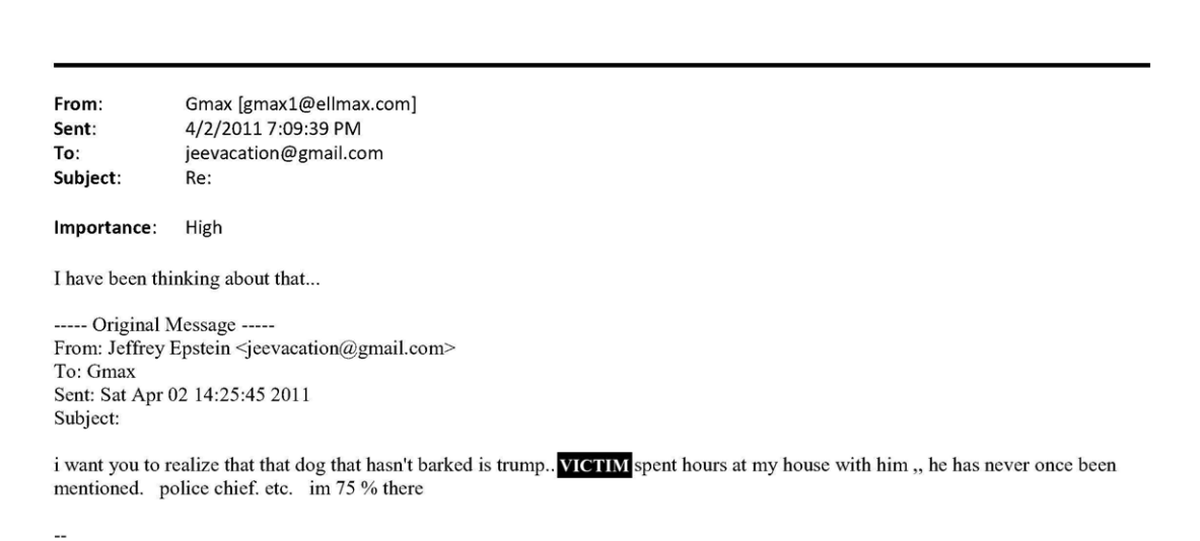
In one email, Epstein wrote that Trump not only knew he was trafficking girls – but that in one case, Trump had “spent hours” with one of the sex trafficking victims at Epstein’s house.
“I want you to realize that that dog that hasn’t barked is Trump,” Epstein wrote to his now-convicted accomplice, Ghislaine Maxwell, in 2011, two years after Epstein had received a lenient plea deal on charges of sexually abusing and raping dozens of middle and high school girls in Palm Beach.
Trump has long denied he was involved with Epstein’s crimes. The President has said he broke off his friendship with the New York financier years ago, after learning that Epstein had been recruiting some of his female employees from his Mar-a-Lago spa. Epstein had a waterfront home less than a mile from Mar-a-lago. Epstein and Maxwell had been recruiting girls from spas and gyms around the area for “massages” – a ruse to sexually exploit them.
Trump on Wednesday reiterated that the Epstein controversy is “a hoax” being used by Democrats to smear him, posting on his social media platform, Truth Social, that “Only a very bad, or stupid, Republican would fall into that trap” of supporting further inquiries into the Epstein files.
“The Democrats are trying to bring up the Jeffrey Epstein Hoax again because they’ll do anything at all to deflect on how badly they’ve done on the Shutdown, and so many other subjects,” he wrote, referring to the shutdown that ended Wednesday.
The statement came as bipartisan lawmakers in the House secured the necessary signatures to force a vote on a bill to release all the Epstein files held by the Department of Justice and the FBI. Wednesday’s emails, however, did not come from the DOJ – but from a batch of records subpoenaed from the Epstein estate by Democrats on the House Oversight Committee.
“The more Donald Trump tries to cover up the Epstein files, the more we uncover,” Democrat Rep. Robert Garcia of California, ranking member of the Committee, said in a statement. “These latest emails and correspondence raise glaring questions about what else the White House is hiding and the nature of the relationship between Epstein and the President.”
Three emails – one of them the 2011 email between Epstein and Maxwell – were first released publicly by Democrats on Wednesday morning. The Republicans on the Committee later released the rest of the documents.
In a statement, White House Press Secretary Karoline Leavitt accused the Democrats of “selectively” leaking emails to “the liberal media” to create a “fake narrative to smear President Trump.”
She also said the unnamed victim that Epstein referred to – whose name is redacted – is the late Virginia Giuffre, who had previously said that, to her knowledge, she never saw Trump do anything inappropriate with girls or women.
Asked if the woman was Giuffre, Sara Guerrero, the communications director for Garcia, declined to comment, saying “We don’t disclose the names of victims.”
Still, Trump was mentioned in hundreds of other emails and documents. Epstein often disparaged Trump, calling him “borderline insane,” a “con man,” and “stupid.”
On Dec. 31, 2015, when CNN moderated the Republican presidential debate in Las Vegas, author Michael Wolff in an email told Epstein that CNN planned to ask Trump about their relationship. Epstein asked: “if we were able to craft an answer for him, what do you think it should be?”
Wolff replied: “You can hang him in a way that potentially generates a positive benefit for you, or, if it really looks like he could win, you could save him, generating a debt.”
The following year, in October right before the election, and in the midst of other sexual accusations surfacing against Trump, Wolff wrote Epstein: “There’s an opportunity to come forward this week and talk about Trump in such a way that could garner you great sympathy and help finish him.”
Wolff, who claims to have hours of interviews with Epstein, often offered him advice on how to deal with the backlash following his 2008 arrest in Florida. Wolff recently filed a civil lawsuit against Trump’s wife, First Lady Melania Trump, after he said her legal team threatened to sue him over comments he made linking her to Epstein.
In 2019, Epstein told Wolff that Trump “of course knew about the girls as he asked Ghislaine to stop.”
The January 2019 exchange came less than a month after the Miami Herald published an investigation into Epstein’s crimes. The series “Perversion of Justice,” detailed how federal prosecutors negotiated a “sweetheart deal” that gave Epstein and others federal immunity for sex trafficking of dozens of underage girls. It showed how federal prosecutors – under former Miami US Attorney Alexander Acosta – sealed the agreement so that no one would know, and led to widespread outrage over the case.
The emails illustrated Epstein’s wide and influential orbit, even as the extent of his sex trafficking became public, and more victims came forward. Epstein reached out to a Russian diplomat to offer insight on Trump; regularly corresponded with politicians, businessmen and academics; and offered a New York Times reporter photos of Trump with young women.
Included in the documents are book manuscripts written by world leaders and articles about actors and artists. Larry Summers, the former treasury secretary and president of Harvard, asked Epstein whether the Russians had “stuff” on Trump. Epstein didn’t answer.
In a 2015 email exchange with former New York Times reporter Landon Thomas, Epstein offered to send him photos of Trump posing with girls in bikinis in his kitchen. Landon often reached out to Epstein for information and offered to connect him with other people in the financial world.
Epstein’s brother, Mark, is also in the tranche of emails. In March 2018, Mark told his brother to ask Steve Bannon if Russian President Vladimir Putin has “the photos of Trump blowing Bubba.” It is unclear what “Bubba” refers to, but it was a nickname for former President Bill Clinton. “You and your boy Donnie can make a remake of the movie Get Hard,” Mark Epstein wrote.
Kathryn Ruemmler, former White House Counsel under President Barack Obama, was also frequently in touch with Epstein. On Aug. 23, 2018, she emailed Epstein a New York Times op-ed debating whether Trump should be impeached. “you see i know how dirty donald is,” Epstein replied.
After the Herald’s series, Epstein asked Wolff’s advice on how to handle the backlash. Wolff advises that they should set up an interview with Epstein and Thomas from the New York Times. At one point, Epstein writes: “im thinking what would trump do.”
Epstein’s victims on Wednesday said the emails showed that the Government continues to cover-up and protect those who were involved and helped enable Epstein and Maxwell.
“We applaud the bipartisan leaders demanding full transparency by signing the discharge petition to force a vote on releasing all the Epstein files,” said Lauren Hersh, executive director of World Without Exploitation, a group representing human trafficking survivors and victims of sexual abuse. “Ending sexual exploitation and standing with survivors is not a partisan issue; it is our shared responsibility to uphold justice.”
Trump and his acolytes promised transparency of Epstein’s crimes and his accomplices, and said he would release all the government files on the various investigations conducted over the years prior to his election. However, shortly after he was elected, Trump’s attorney general, Pam Bondi, and his FBI director, Kash Patel, abruptly changed their minds – effectively closing the files. They claimed there was no “credible” evidence that other people were involved in Epstein’s crimes.
Epstein’s victims have mobilized in recent months, appearing in private before members of Congress to urge them to release all records held by the Department of Justice and the FBI. In September, as many as 100 victims gathered in the capitol to attend a rally. Their effort has been stymied by Congressional Republicans, who have voted not to release the files.
In August 2019, while he awaited trial, Epstein was found dead in his Manhattan federal jail cell. His death was ruled a suicide by hanging, although a subsequent investigation by the Federal Bureau of Prisons noted that cameras in the unit were not working properly and that guards had fabricated their reports. Epstein’s brother, Mark, believes his brother was killed because he had damaging information on powerful people.
“As time goes on, and more and more things come to light, it’s pretty obvious that it wasn’t a suicide,” Mark Epstein told Don Lemon in July.
Staff writers Emily Goodin, Ben Wieder and Shirsho Dasgupta contributed to this report.
This story was originally published November 12, 2025 at 12:04 PM.