
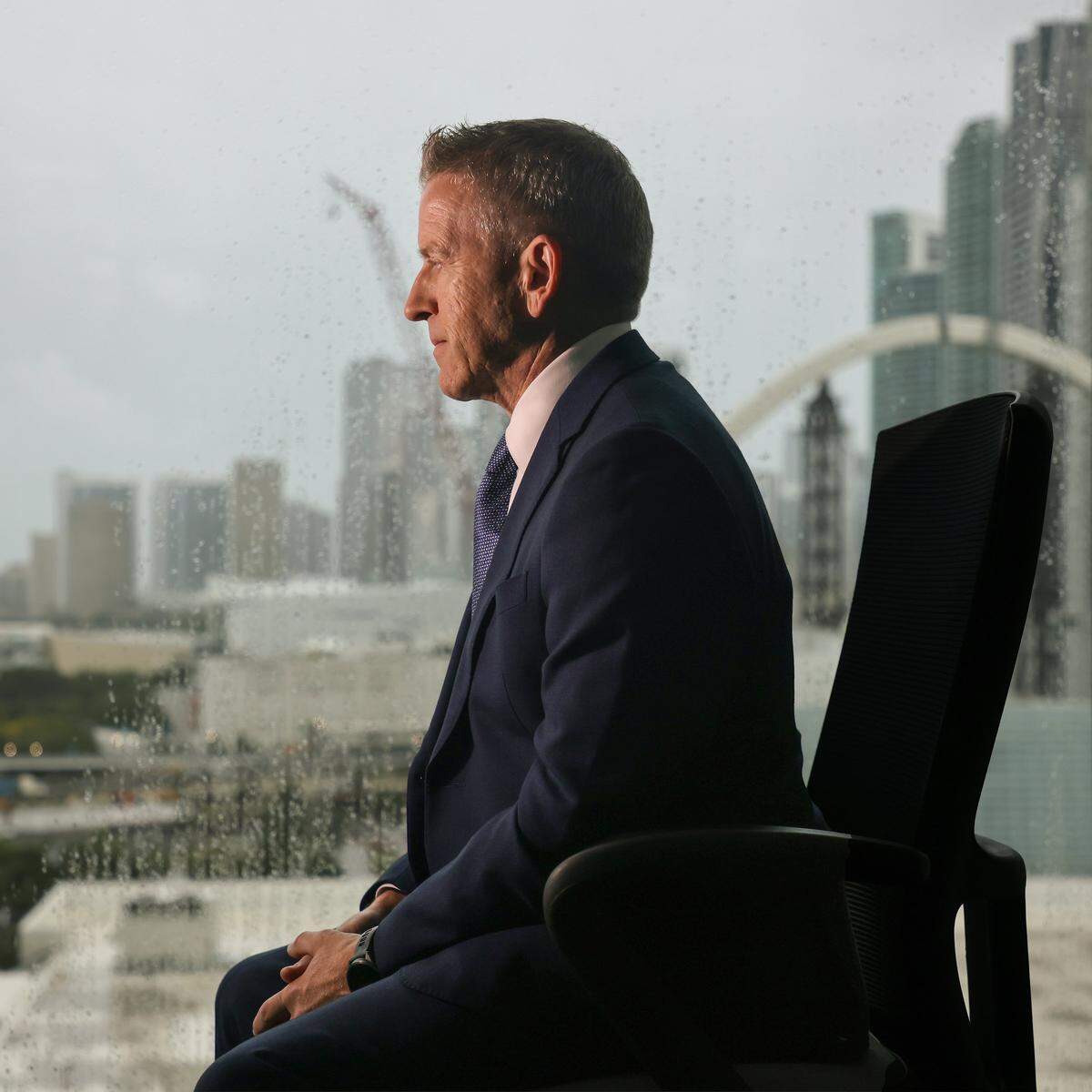
Paul Renner helped DeSantis mold Florida. Can he be governor without his support?
AI-generated summary reviewed by our newsroom.
- Renner supports immigration crackdowns, vaccine mandate rollbacks and tax cuts.
- Renner supports immigration crackdowns, vaccine mandate rollbacks and tax cuts.
Since launching a campaign for governor this month, former Speaker of the House Paul Renner’s pitch to Florida voters is that he “stood shoulder to shoulder” with Governor Ron DeSantis in building the “Free State of Florida.”
Want more of the same? He says he’s the safest bet.
“If you like the way Florida’s been run, you’ll like the way it’s run under Governor Renner,” he told the Miami Herald during a 30-minute interview in downtown. “Who’s got the leadership experience to actually be governor of the state of Florida? You can look at my record.”
As speaker between 2022 and 2024 — the critical, national headline-grabbing years DeSantis was mounting in his presidential campaign — Renner helped push through universal private school vouchers; rules barring certain content about race, gender and sexuality from classrooms; and a six-week abortion ban.
But he’s also running a Republican campaign for governor without the backing of either of the two biggest names in Florida politics: DeSantis or Donald Trump.
After Renner jumped in the race earlier this month, DeSantis called the run “ill-advised.” It’s a key tension Renner has to navigate in a race that will likely be determined in the Republican primary, as Democrats have been unable to win a statewide race in seven years. He’s running against Trump-endorsed Congressman Byron Donalds. All signs also point to Lt. Gov. Jay Collins joining the race with DeSantis’ support. Former Congressman and ex-Republican David Jolly is the only high-profile Democrat in the race so far.
A Navy veteran, former state prosecutor and father of two young kids, Renner promises little difference from DeSantis on policy — despite the cold shoulder from DeSantis on his campaign.
He supports rolling back vaccine mandates, DeSantis’ use of emergency funds to facilitate mass deportations and implementing property tax cuts. In a few small departures, however, he said wants to have greater focus on Latin America from the governor’s mansion and is interested in reigning in future governors’ ability to use emergency authority.
What follows are exchanges from Renner’s interview with the Herald, edited for brevity and clarity.
Q: You don’t have the endorsement of Trump or DeSantis. You say you’re aligned with them. What do you say to voters about why they’re not backing you?
A: I would say that eventually, the governor would back me because I was a key architect in the legacy that he talks about … I’ve been an architect in the Florida that many voters, certainly Republican voters, love about Florida.
I think voters are going to look at three things. They’re going to look at who do you trust, who do you most trust; who’s got actual leadership experience, which you should have in a job as important as governor of the third largest state in the country; and who’s delivered results.
If you look at those three things, throughout my entire life, I’ve had 20 years in the military, served in two wars, was a state attorney — just up the road here in Broward County — and as a Speaker of the House during two of the most consequential years really in Florida’s history, most people would say. If you want to preserve what we have, I helped build it. If you want to solve problems tomorrow, then you go to a guy who’s already solved problems and knows what they are and how to fix them in the future.
Q: Governor DeSantis called your run ill-advised. What do you say to the naysayers?
A: That’s a question for him. That’s a question for him to separate the legacy that we had in two years in the Legislature from his own.
Q: Most of your career has been in central and northeast Florida. What is your message to voters in Miami?
A: As a reservist, I spent several years going down to South America, working through the embassies there, and so I’ve been all over, Venezuela, Brazil, Uruguay, Peru, Chile, and so I understand the challenges and the opportunities that we have with our friends in Latin America. It would be a greater focus if I were governor.
I do speak a decent amount of Spanish. My wife’s Colombian and I lived in Venezuela for a period of time as well, separate from the military. And so those countries are important to our national security. They’re important in the economy of Florida, and so I would have a greater focus on the Americas, on a recurring basis as Governor.
Q: What do you think, from your vantage point of having lived in Venezuela, of Trump’s foreign policy actions in Venezuela lately?
A: As far as the actions to sink ships that are carrying drugs, I’m all for it. Unfortunately, [Nicolás] Maduro is leading a nation of narco terrorists, and he’s the chief in charge of it. And so his government is running drugs, and so it’s absolutely appropriate for us to take strong action. He has destroyed democracy in Venezuela.
Q: We’ve seen some local Republicans, including our South Florida members of Congress, push back against the Trump administration on [Temporary Protected Status] policies … What do you think of the decision to roll back TPS?
A: I’ll speak broadly to immigration. We have allowed the immigration situation to become a complete disaster. And so I would say if the pendulum is swung out this way, we’re gonna get some emergency measures to get our arms around that and at some point then we will return to some immigration policy that looks more like the normal immigration policy. But we need to fix our immigration policy. We have a broken immigration policy.
Q: On TPS specifically, we have a lot of residents here that came, seeking political asylum, came legally with TPS, that are at risk of losing their status overnight. Do you support Trump’s decision specifically on TPS?
A: The president has, first of all, the primary responsibility of the federal government in immigration, he has the comprehensive view on immigration that I don’t have, so I don’t know what all the reasonings are, but I support the president’s efforts to get control of something that no one has controlled for decades, frankly, including Republicans, to a sufficient extent.
I think the President will also probably propose something going forward that makes sense for our legal immigration because that as well is broken, because you try to do it the right way and you wait a decade to get into the country. And so, I trust the president’s efforts. I think he’s doing a good job on immigration and I support it.
Q: This state has spent hundreds of millions of dollars building deportation centers. I know they’re expecting federal reimbursement, but do you think that’s been a good use of emergency funds? And is that something you’d prioritize?
A: Whatever the cost is, is far exceeded nationally and even in our state by the cost of years and years of doing absolutely nothing, but allowing anybody in without any kind of vetting and that’s no way to maintain a country’s sovereignty or to protect its citizens.
Q: If the federal reimbursement doesn’t happen, should that still be a priority for Florida taxpayers?
A: Yes, because you’re talking about free healthcare, free education. I mentioned gang violence, human trafficking. Some of those human trafficking victims are people who came across the border, kids who are being treated horribly. And so all of it needs to end, we need to make sure that immigration comes through legal channels and doesn’t take forever and ever to do and figure out what as a country we want in terms of legal immigration and what we don’t want. And that’s a decision that voters and leadership have to make.
Q: Do you think there should be limits to a governor’s ability to use emergency authority? What sort of limits would you put on yourself in using emergency powers?
A: Where I think there needs to be some reform is in the statute. I think there’s some potential for mischief if someone were to declare a climate emergency or a gun-crisis emergency, you can’t just name an emergency and make it so. In the case of immigration, I do think we have an emergency. I think it’s been so mishandled for so long that the governor was right to initiate it. Whether having it today or not is appropriate — I think it is today. Whether it is this time next year or the following year, it depends on how successful we are in reigning in the problem. As I said, I think at some point then it kind of starts to return to some degree of normality.
Q: You’d be open to some kind of legislation around emergency authority for governors generally in Florida?
A: Yes. In fact, I was going to propose that. It never got off the ground.
Q: Do you think the Florida Legislature should roll back vaccine mandates that are already in state law, like, polio, measles, tetanus — should those roll back?
A: I want parents to have full information, I want them to be able to participate with their pediatrician and have that dialogue, and I think most parents, like me, I have a five year old and a three year old, are going to look at vaccines like polio and measles and say, ‘That’s an important vaccine for me to take.’ That’s a choice for a parent to make with their physician. And I think physicians will point out the benefits of vaccines, which have saved millions of lives, and so I’m in no way, shape or form anti-vaccine. My kids have been vaccinated. But I think it’s more important that parents are in that driver’s seat with pediatricians rather than the CDC or the government dictating what they will or won’t have.
Q: So that’s a yes, you would sign a law that removes the mandates?
A: Yeah, I don’t want the government making that decision for parents or doctors, for that matter. … People should use vaccines to save their kid’s life and avoid any problems, but the question is whether the government should mandate that and how many your child gets and how soon, and those kinds of things that a parent may say, ‘Look, I want the vaccine, but I want to spread them out.’ That would be an example of where avoiding mandates could be beneficial.
But I think once you put the pediatrician in the room — and this is the argument that is made on issues like abortion — that it’s up to a woman and her physician. Well, isn’t that true for vaccines? Many people forget that when they make that argument for a mandate.
Q: I know one of your biggest priorities in the Legislature was the social media bill. What do you see is the future of state-level regulation of big tech?
A: We’ve done it. We should move [the minimum age] to 16. We have 14 and 15, parental consent. I’m a big proponent of parental rights. The issue here is, if it’s a static thing like a book or a movie, that’s a parental right, you decide whether your child is going to watch that movie or part of it or none of it. With social media, you have algorithms that are always one step ahead of children, always one step ahead of parents, addictive features that are being purposely used to hack the human brain and keep people on for six, eight hours a day.
Politicians overuse the word crisis, but this is an absolute crisis and simply put: young children don’t have the mental development to stand up against what Big Tech is throwing at them in the way of using addiction as a business model, and that is exactly what they’re doing.
Q: As governor, for legislation that you’d like to sign, you mentioned the age 16. Are there any specific benchmarks that you’d want to prioritize?
A: There needs to be some controls, and the social media platforms have consciously chosen not to do the easy fix, which is to end the addiction, end that as their business model — which it is, and they know it is — and instead to hide behind the First Amendment. I don’t believe the First Amendment protects addictive features being used, addictive technology being used by Big Tech. It does protect content and our bill doesn’t speak at all to good content or bad content. You can say whatever you want, you can be in group chats, you can be on platforms that are not addictive and speak your positions, and your whatever you want to speak to your heart’s content, the bill doesn’t cover content or the First Amendment protections at all, because I’m the big proponent and big defender of the First Amendment.
Q: On higher education, you are on the Board [of Governors]. There’s also been some turmoil over the high cost of the transformation of New College and the failed presidential search that brought a lot of national attention and headlines to [University of Florida]. What do you see as the future of higher education here in this state as governor?
A: We are the number one state for higher education, and have been for multiple years running and so I’m proud of that as a member of the Board of Governors. With respect to the failed search, I think you’re talking about UF’s, that search needed to fail. This guy was a cultural Marxist and not a good fit for our flagship university. People said, ‘Oh, you no one’s going to want to apply.’ Well we just got a guy from Columbia who is a leader in his field in medicine and neuroscience and is also a great proponent for free speech. And that’s what we need, not conservative speech or liberal speech, all speech. We need to hear from people on the left, people on the right, people in the middle, and that’s just simply not happening in higher education across the country.
Q: Let’s talk about the campaign landscape a little bit. We’re seeing this like competing potential Trump-DeSantis ticket, maybe even down-ballot, potential Trump endorsement in the [Attorney General] race. What sort of lane does that give you as you’re campaigning over the next year if we have this Trump-DeSantis proxy battle on the Republican primary ticket?
A: I’m going to put Florida first and so that’s what I’ll say and that’s going to be my focus. There’s a lot of issues that voters really care about that are maybe not being talked about, but I’m proud of the time that Governor DeSantis has had. If you like the way Florida’s been run, you’ll like the way it’s run under Governor Renner. But I also support the president and I want to make sure that I help him as his best trusted partner among the governors in the states and you’ll see that as well. So you’ll see a very pro-Trump governor and Governor Renner.
Q: At the end of the day, politicos always say it’s about the economy at the ballot box. What is your message to the South Florida, Miami voters, who feel they’re getting priced out — rising rent, property insurance. Especially here, what are you going to do to make Florida affordable?
A: As governor, I want to bring down insurance rates further through home-hardening programs like My Safe Florida Home. I want to bring down property taxes, that has to be brought down substantially. I’m concerned here in Miami, as well as the rest of the state, that the elderly — people on fixed income — could lose their homes because, even though we have “Save Our Homes” at a 3% cap, over 10 years, that’s a 30% increase. Well, ‘My Social Security hasn’t gone up 30%. ’ And so it’s very important and as governor, I will fight to make sure we have some limit, a cap on when in your life, whether that’s 70 or 75, at some point when you’ve been a long-term resident of Florida and you’re in your home, you should no longer see increases in your property taxes. And I believe that’s something that you’ll see me introduce certainly in the coming weeks, but that’s something that needs to be part of this property-tax reform discussion.
Beyond that, I think continuing to work on workforce and making sure we find ways to, in an AI world with a lot of additional AI coming in that may disrupt jobs, that we’re making sure people can go back and recertify in something new so they can continue to have jobs that give them prosperity and a good life here.
.jpg)