
Among Florida’s Hispanic voters, Trump emerging as the clear favorite for president
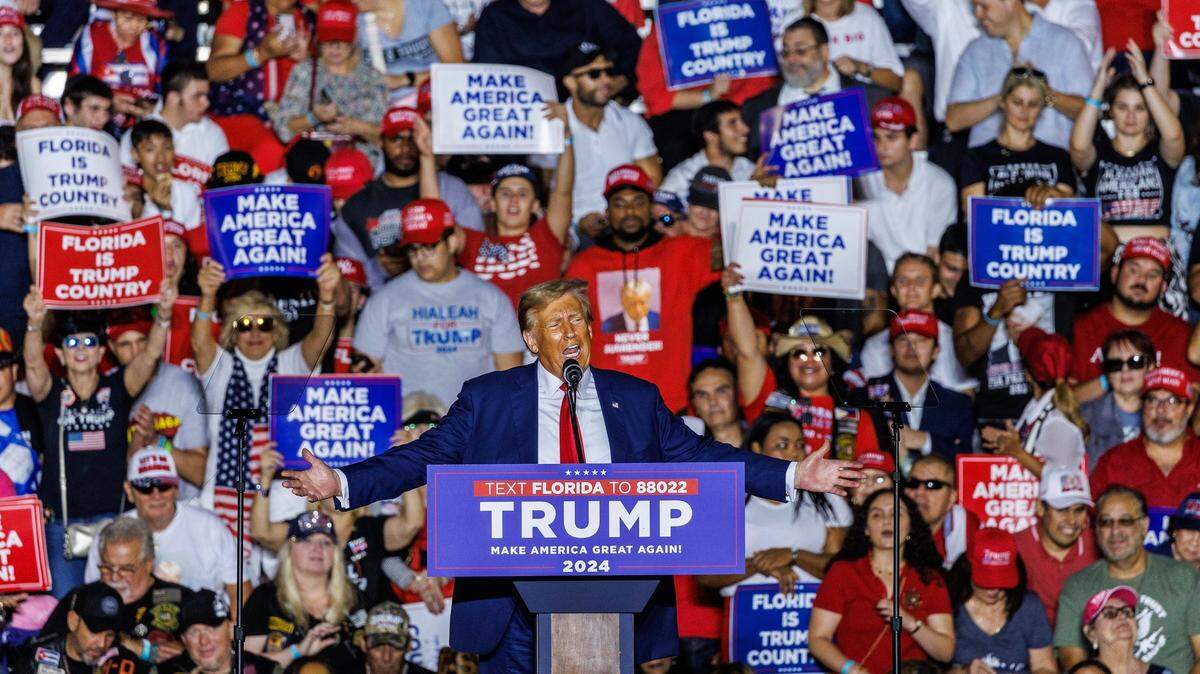
As Donald Trump prepares to sit for a town hall with Hispanic voters in Doral on Wednesday, the former president appears on track to carry the Hispanic vote in Florida, according to a spate of recent polls that show his rival, Vice President Kamala Harris, underperforming past Democratic presidential candidates among Florida Hispanics.
Trump’s lead is glaring. A survey from Marist College released last week found Trump with 58% support among Hispanic voters in his home state, while Harris trailed at 40%. That advantage isn’t far off from an internal poll commissioned by the Republican Party of Florida and conducted by the polling firm The Tarrance Group that, according to the Florida GOP, shows Trump leading Harris 56% to 40% among the state’s Hispanic voters.
Another poll from NBC6 and Telemundo 51 out on Sunday showed Trump running 5 percentage points ahead of Harris among Florida Hispanic voters.
The spate of recent polling suggests that Trump — who has vowed to deport millions of undocumented immigrants from the U.S. and repeatedly claimed that migrants are stealing American jobs — has gained a foothold on a crucial electorate in a state that only few years ago stood as one of the most closely divided and hotly contested political battlegrounds in the country.
Trump, according to a person familiar with his plans, eagerly agreed to Wednesday’s Univision town hall in Doral, in part because of his perceived popularity among Florida Hispanics.
If the polling offers any hint at what’s to come on Election Day, Trump could become the first Republican presidential candidate in two decades to beat out his Democratic opponent among Hispanic voters in Florida.
“It just doesn’t look like Florida is in play, and the reason Florida isn’t in play this year is because of the collapse of Hispanic voters supporting Democrats,” said Fernand Amandi, a Miami-based Democratic pollster who worked for former President Barack Obama’s 2008 and 2012 campaigns in Florida.
Trump’s lead isn’t entirely surprising, Amandi said. In past presidential races, both Democrats and Republicans spent heavily to persuade and mobilize Florida’s Hispanic voters, who now make up about 20% of the state’s electorate. But the Sunshine State has largely fallen off the battleground map in recent years, as Republicans racked up a long list of political wins and Democrats reasoned that they no longer needed to win Florida to get to the White House.
The Harris campaign, Amandi said, “made the correct assumption that Florida isn’t in play right now” and chose to spend its time and money in more competitive states like Arizona, where a new Telemundo poll released on Tuesday showed the vice president leading Trump among Latinos 52% to 35%.
“The good news for Democrats is this seems to be mostly a Florida problem,” Amandi said.
“But until they’re serious about fixing their Florida problem, they can keep expecting Republican victories in Florida.”
Harris’ campaign has also made clear that it’s focusing elsewhere in its bid against Trump. Harris sat for her own Univision town hall with Hispanic voters last week, but unlike Wednesday’s forum in Miami-Dade County — which has a large, influential population of Republican-leaning Cuban-American voters — her event took place in Las Vegas, where Latino voters tend to lean more Democratic.
Politico reported last week that Univision had initially proposed holding both Harris and Trump’s town halls at the company’s studios in Doral, but Harris’ campaign pushed to do it in Nevada. Spokespeople for Univision and Harris’ campaign did not respond to the Miami Herald’s request for comment on that claim.
In a recent interview with New York Magazine, David Plouffe, a senior adviser to Harris’ campaign, suggested that polling out of Florida doesn’t represent the attitudes of Hispanic voters in battleground states where Harris has campaigned more aggressively.
“[W]hat matters is Western Hispanic voters, in Nevada and Arizona, and the Puerto Rican community in Pennsylvania,” said Plouffe, who served as campaign manager for Obama’s successful 2008 presidential bid
Harris’ campaign did not respond to the Herald’s request for comment for this story.
Still, Trump’s lead among Florida’s Hispanic voters is striking compared to just a few years ago. In 2020, President Joe Biden won 53% of Hispanic voters in Florida despite losing the state to Trump overall, according to exit polls. Before that, in 2016, Hillary Clinton carried 62% of the Hispanic vote in Florida.
While Trump has stepped up his outreach to Hispanic voters in recent years — both in Florida and nationwide — he has also continued to campaign heavily on an anti-immigrant platform, especially in the closing weeks of his third presidential bid.
But that message — which has included attacks on Haitian migrants in Ohio and promises of mass deportations — hasn’t deterred a significant slice of Hispanic voters, many of whom are immigrants themselves.
A New York Times/Siena College poll released on Sunday found that more than one-third of Hispanic voters nationwide support building a wall along the U.S. southern border — something Trump has long promised to complete — and deporting those living in the country illegally.
Nearly two-thirds of Latinos surveyed in the New York Times poll said that they don’t believe Trump is talking about people like them when he speaks about immigration.
Jaime Florez, the Hispanic communications director for the Republican National Committee and the Trump campaign, attributed Trump’s growing support among Hispanic voters, especially in Florida, to his policy positions.
“We didn’t have any wars, we had a great economy, we had prices under control, we had the border controlled, we had crime under control,” said Florez, who emigrated to the U.S. from Colombia more than two decades ago. “All the things people are looking for were here when Donald Trump was in the White House.”
Like Harris’ campaign, Trump’s team has largely refrained from investing too heavily in Florida in this year’s presidential race. Instead, Florez said, Trump’s support among Florida Hispanic voters has grown “organically.”
“We’re not going to use our resources heavily in Florida when we know that it’s not a battleground,” Florez said. “We have the message and the messenger that is giving us very good results here.”
This story was originally published October 16, 2024 at 5:30 AM.