Miami debate protected against WMD threats by federal office that may soon disappear
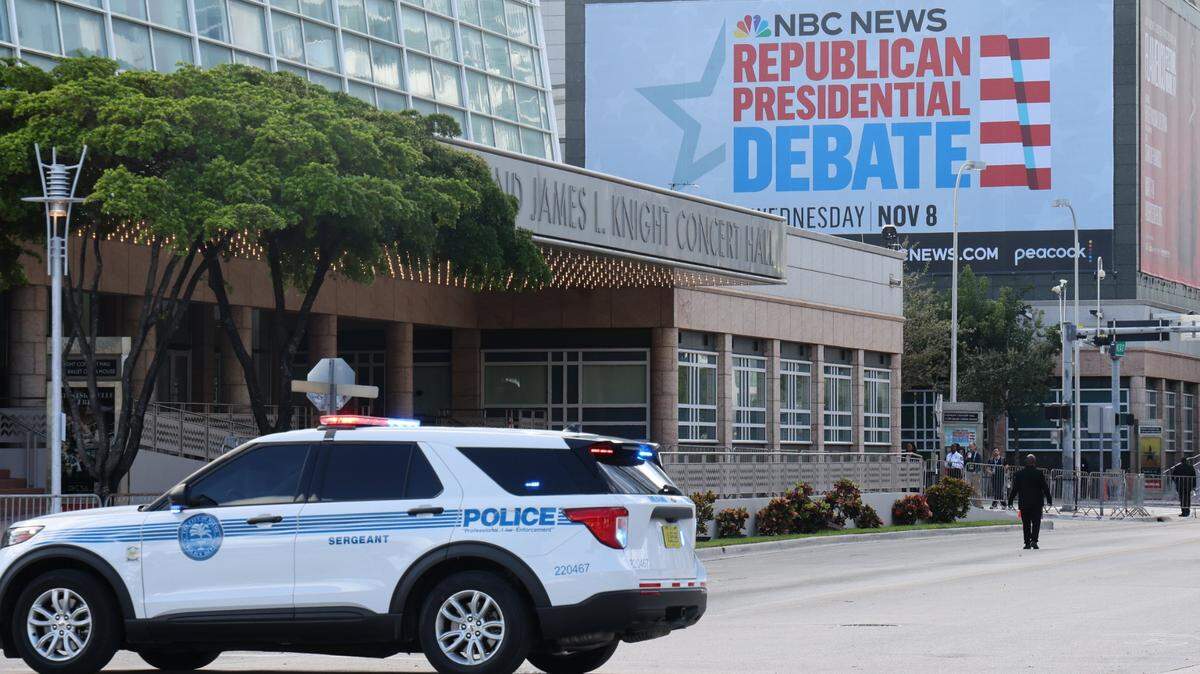
In and around the Knight Concert Hall in downtown Miami on Wednesday night, where five Republican presidential hopefuls gathered to debate, nearly 200 devices were deployed by federal authorities to detect threats from biological, chemical and nuclear weapons, ranging from handheld devices like portable radiation monitors to aerosol detectors and nuclear detection backpacks.
The security service is offered to communities across the country by a little-known program called the Countering Weapons of Mass Destruction Office, run out of the Department of Homeland Security. Ahead of a major event — like the Republican primary debate this week, or Florida Gov. Ron DeSantis’ gubernatorial inauguration earlier this year — a city or state can request federal assistance from the office to secure a specific target such as a stadium, or an entire metropolitan area, against the threat of a weapons-of-mass-destruction attack.
In a matter of weeks, on Dec. 21 at midnight, that office is scheduled to disappear barring reauthorization from a debilitated Congress.
“This is a black swan situation, but if it goes badly, it goes badly quickly,” said Mary Ellen Callahan, assistant secretary of the DHS Countering Weapons of Mass Destruction Office, discussing the potential for weapons-of-mass-destruction attacks on U.S. soil. “Our fear is if we’re allowed to atrophy away, that there are going to be gaps and unintended consequences.”
“We are the only office that actually looks at the state, local, tribal, territorial aspect of the response to nuclear threats,” Callahan added. “That would go away.”
Bipartisan support for renewing the office is robust across both chambers of Congress, Callahan said. What is missing is a legislative vehicle making its way to passage before Dec. 21 in which they can add reauthorization language. Weeks of debate over a government shutdown, followed by weeks of Republican infighting over the selection of a new speaker of the House, all but froze efforts to renew the office. The threat of a shutdown looms again just over a week away.
Two offices designed to counter weapons of mass destruction were created after the Sept. 11 attacks, but were merged five years ago to centralize authority and decision-making. The legislation that designated that change included a provision stating the office “shall terminate five years after it was created.”
“I don’t know why it was put in there,” she said. “I wasn’t here at the time. It is a stark statement — plain reading of the law is that we cannot continue to operate and can’t transfer those assets to other parts of the department.”
The office works closest with 14 cities designated as high-risk urban areas, including Miami, Houston, Seattle, Atlanta, San Francisco and New York. But it also runs a program called BioWatch that monitors for biological threats in 30 cities across the country. Last year, CWMD helped protect 180 events across 42 different states, a DHS official told McClatchy.
It also offers training to state and local law enforcement on counterterrorism equipment, as well as equipment to the Secret Service, Coast Guard, and Transportation Security Administration to monitor for threats at ports of entry and against high-value targets.
Their devices include a range of equipment. The office has nuclear detection devices mounted to Tahoe pickup trucks that can pick up radiological material across the range of an interstate highway. They have gamma detectors attached to drones that can oversee an event site for roughly three hours at a time. They have smaller, mobile systems that law enforcement can use to monitor entryways of major event spaces in real time.
Many major cities have their own law enforcement divisions designed to counter terrorist threats. But Callahan notes that the resources of each individual city are dwarfed by the capabilities of the federal government.
“We bought 56,000 of those devices,” Callahan said, referring to the total range of devices in the office’s toolkit. “If each of those jurisdictions bought 100, they’re not going to be able to get the scale, they’re not going to be able to support it, they’re not going to be able to know what’s best-in-breed. And candidly, they also have budgetary risks and other financial problems. If we’re not there to bolster their law enforcement, that may go away as well.”
Ahead of the deadline, top scientists and technical experts in the office — ranging from veterinarians to nuclear physicists — are already beginning to leave, fearing the department will struggle to find them other permanent positions with their unique skill sets, Callahan said. She also said that morale has taken a hit among her 234 employees without a clear path to reauthorization. The office has drawn up contingency plans to temporarily reassign remaining staff to other parts of the department in the weeks leading up to the December deadline.
“I think people aren’t recognizing the loss of this,” Callahan said. “This isn’t a conscious choice by Congress. It’s just they have to take an action, and they have a lot of priorities. It’s a complicated congressional environment.”
This story was originally published November 9, 2023 at 12:07 PM.