State education official says teachers can use the word ‘reparations’ but won’t say how
As confusion lingers over what parts of Black history will be off limits and what parts accepted in Florida classrooms, the Florida Department of Education this week clarified that the topic of reparations — offering financial restitution to the descendants of enslaved people — will not be banned.
“We are not banning the word ‘reparation,’ ’’ said Alex Lanfranconi, spokesperson for the Florida Department of Education in response to an article published by the Herald/Times.
He said the discussion about banning the discussion of reparations came about as part of the department’s objections to the Advanced Placement African-American Studies course, in which the agency listed several reasons for rejecting the course that was being offered in 12 Florida schools.
READ MORE: Florida’s struggle to teach Black history has become a battle over who controls the past
The department announced last month that it objected to the topic related to the reparations movement because “all points and resources in this study advocate for reparations. There is no critical perspective or balancing opinion in this lesson.”
Lanfranconi said Wednesday the course syllabus “only included documents and studies for pro-reparations authors and not a critical evaluation of reparations at all.”
So what can Florida teachers include about the issue of reparations?
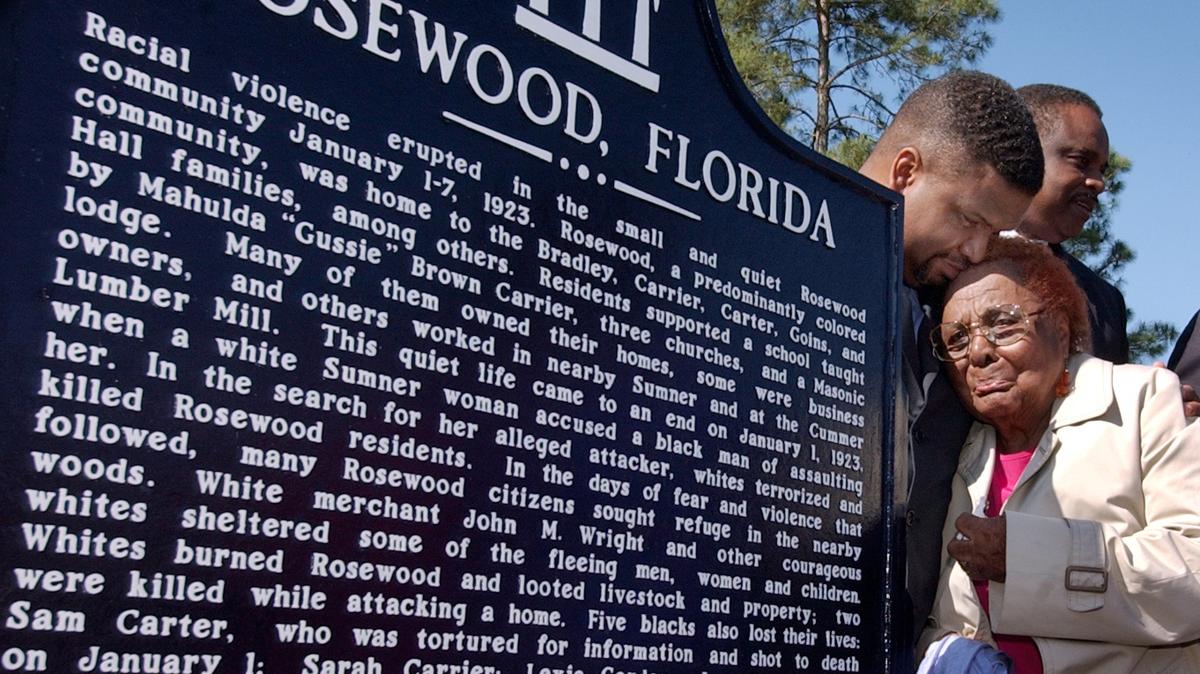
Florida was the first state in the nation to pay reparations to survivors of racial violence. In 1994, legislators passed and Gov. Lawton Chiles signed into law a measure to set aside $2.1 million for Rosewood’s 11 known survivors and descendants of the Rosewood massacre in 1923. Following a rumor that a Black man had assaulted a white woman, an angry white mob torched and completely destroyed the Black town in Levy County.
New AP class is a bigger issue, official says
Lanfranconi said that if the story of Rosewood is told in Florida classrooms, teachers may use the word “reparations.” But he also said he could not say what would be considered an acceptable discussion of the term or the reparations movement.
“Nobody is saying that the term ‘reparation’ is or isn’t allowed,’’ he said. “We have not rejected the discussion of reparations. We have rejected the African American Studies course.”
Lanfranconi added that “what people can say about the subject in the classroom is a different topic from AP African American Studies.”
The debate over the AP course has seeped into the debate over what’s acceptable in K-12 classrooms because of an evolving policy at the Department of Education, and a law passed last year that allows parents who believe their student has been left to feel “guilt, anguish, or other forms of psychological distress” as a result of any classroom instruction to file a complaint.
Any teacher found in violation of the law “will have their certification sanctioned,” Lanfranconi said.
Also last year, DOE instructed textbook companies that “critical race theory, social justice, culturally responsive teaching, social and emotional learning, and any other unsolicited theories that may lead to student indoctrination are prohibited.”
Educators and Black history advocates say there remains great uncertainty about what teachers are allowed to say.
“Right now, the Department of Education is so confused and educators in general are so confused by the stance of the governor and the crazy legislative posture that we find ourselves in that nobody knows what to do. It is confusing to everybody,’’ said Leon Russell, chairman of the board of the NAACP of Florida on Thursday.
He said that by suggesting the topic of reparations was not off limits for Florida’s K-12 classrooms but failing to provide a framework for what is now acceptable, “It puts teachers in a posture of being afraid to teach the truth.”
They can only ask, he said, “How do we teach it?”
On Thursday, the College Board released a Feb. 8 letter written to DOE challenging its review and its claims that the board had changed the AP African American studies course in response to Florida’s opposition. It also offered a counterpoint to the claim that the reparations discussion was one-sided and said that topic was intended as an optional course of study for student projects.
“Further, through the required project component, contemporary topics like the Movement for Black Lives and debates over incarceration and reparations can play a more significant role in earning college credit than in the pilot, where they were also elective but did not contribute to the exam score,’’ the board wrote.
It said that students may “select a contemporary topic and earn up to 20% of their exam score” and, as part of that work, “we require students to analyze and present evidence on all sides of a topic or debate for the project they select. To be clear, while a project is required, no specific topic is mandated.”
Lanfranconi said the department “is still reviewing the course as a whole and determining whether it is applicable by Florida law.”
This story was originally published February 10, 2023 at 5:30 AM.