Former county commissioner Sharief gives state Sen. Book her first campaign test
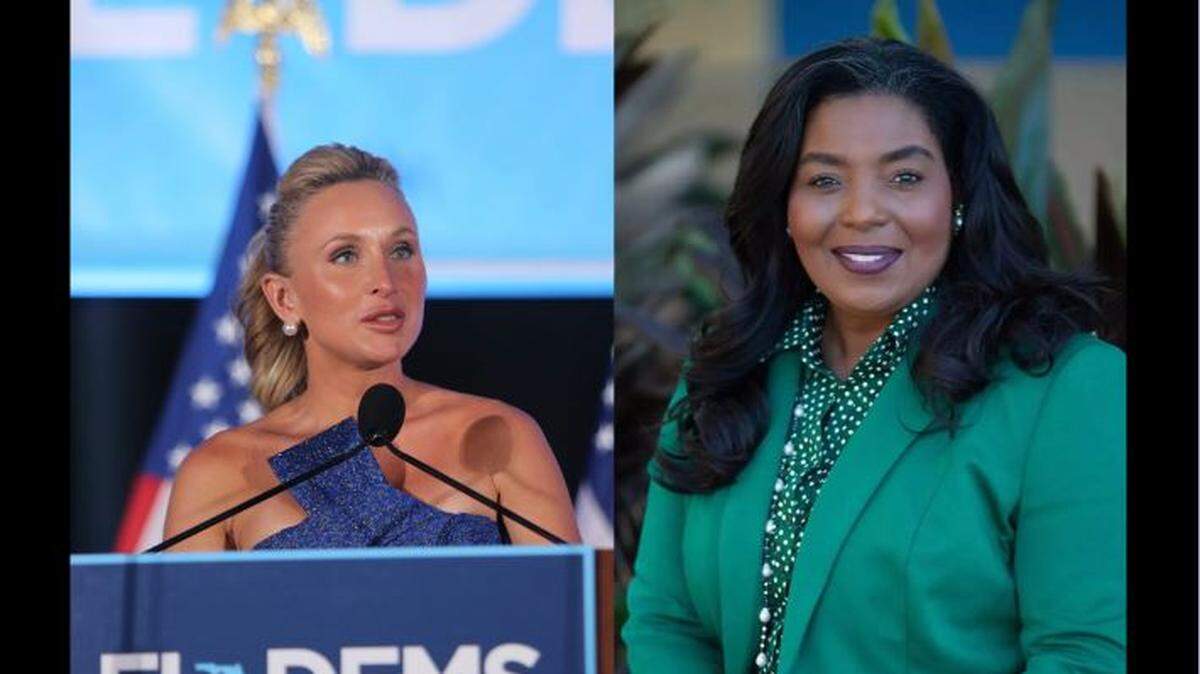
Broward County is home to one of the most closely watched state Senate elections with Democrats’ leader in the Senate, Lauren Book, facing her first opponent since she first entered the Legislature.
The race for Senate District 35 — a newly drawn district that includes Weston, Miramar, Pembroke Pines, Southwest Ranches, Cooper City and parts of Davie and Hollywood — has become a competitive open primary thanks to former Broward Commissioner Barbara Sharief, who, after unsuccessfully running for Congress in a crowded 11-person race, filed to challenge Book. She was third in the 2021 special election primary for Florida’s 20th Congressional District, winning about 17% of the vote.
Book, 37, was first elected in 2016 and won her seat for the former Senate District 32 unopposed. She ran in 2018 and again won unopposed, with no primary or Republican challenger in the general election. A Hollywood native, Book is the founder and CEO of Lauren’s Kids, a nonprofit that seeks to prevent child sex abuse through education.
Sharief, 50, is the first Black woman to be Broward County mayor, a position that rotates among the county commissioners and is not an elected office. She is also Book’s first primary challenger. She is a former nurse and founder of South Florida Pediatric Home Care, Inc., a home-care company that services adults and children with complex conditions.
Book is getting the first challenge of her political career during what some of her peers have argued is an inconvenient time for the party: Republicans have overtaken Democrats in statewide voter registration for the first time, the GOP is expected to benefit in the midterms due to what has been historical backlash against the party in the White House and redistricting is forcing all legislators to get back on the campaign trail.
But in a race that has featured personal attacks from both candidates, Sharief has argued she has a better chance to win over voters in SD 35 because she is deeply familiar with Miramar and all of southern Broward. She was a county commissioner on and off from 2010 to 2021, served as county mayor in 2013 and 2016, and was briefly on Miramar’s city commission. She currently lives in Miramar.
“I didn’t decide to run against Lauren Book,” Sharief said during a press conference in May, months after announcing she would challenge Book in late March. “Lauren Book decided to come down here and run against me. This is a district that I’ve lived in for 21 years, and that I represented the people for 13 years.”
One poll from late June by SEA Polling & Strategic Design suggests Book still holds a strong lead over Sharief, who has also been significantly out-raised by Book. Sharief declined to speak to the Miami Herald for this story.
Because of the once-in-a-decade redistricting process, the cyclical redrawing of legislative and Congressional districts by the Florida Legislature, Book was drawn out of the new SD 35 and fell in the new SD 32, a Black-majority district currently represented by incumbent Sen. Rosalind Osgood. In January, Book filed to run in SD 35 and moved from her home in Plantation to neighboring Davie.
“This is historically unprecedented when you have two significant former elected officials” running against each other, said Mitch Caesar, former state Democratic chairman and longtime Broward Democrat. “I don’t remember the last time this happened.”
The district
The district is not geographically dissimilar to Book’s old district, but it lost Plantation, Coral Springs and parts of Sunrise. According to Matthew Isbell, a Democratic redistricting expert who has been closely tracking the district, SD 35’s Hispanic population has grown significantly in the past 10 years, with comparable numbers in the Black and white communities. But because there is no Republican or third-party candidate in the race, all voters will be able to cast a ballot on Aug. 23 regardless of party affiliation, in what would otherwise be a race just for Democrats.
“Because it’s opened up — I’m not saying it takes this district entirely off the chess board — but that change really alters the dynamic,” Isbell said. “It moves the tilt of the district more into the northern community, more into the suburbs… These tend to be your more moderate, suburban Republicans.”
Isbell, who grew up in Cooper City and Davie and has family all over the district, can attest to the changes the district has had in the past several years, becoming a more diverse but still Democratic stronghold.
“To me, this district is in many ways shape and forms, it’s a microcosm of the Democratic Party’s base of support right now,” Isbell said. “I do think Sharief would have support…. But there’s no denying that Sharief just ran in a special election that covered some of the Miramar portions.”
The primary has gotten undoubtedly ugly.
In the latest back and forth, Book released an ad blasting Sharief for defrauding Medicaid for thousands of dollars, in reference to a settlement Sharief’s company reached for overbilling Medicaid on two separate occasions. Another mailer funded by a PAC, which Book denied knowledge of, painted Sharief as having a “shameful record of guns,” an allegation that Sharief — whose dad was killed in a shooting — denied in a TV ad. Sharief has also tried to paint Book, the daughter of influential Florida lobbyist Ronald Book, as fiscally irresponsible, using footage from an early 2000s wedding reality show that featured Book’s lavish wedding.
The candidates
Book, who is white and Jewish, said she does not think her race is going to be a factor in the election against Sharief, who is Black and Muslim.
Book said her campaign has set up a door-to-door operation specifically targeting Miramar voters and she has attended cultural events for the district’s sizable Caribbean communities. She said that during a meeting with the Miramar Democratic Club earlier this year, she met a woman who told her she was initially voting for Sharief, but later changed her mind after hearing Book speak.
“My opponent has tried to talk about the fact that I don’t look like the district therefore I can’t represent the district,” Book told the Herald. “But again, when we talk about the things that are important to people, it cuts through all of it. I don’t represent a select few.”
Book said the most important issues in her district reflect those of voters around the state: affordability and housing costs, rising property insurance rates, access to healthcare and abortions and safety. She said she’s met with mothers who’ve lost children to gun violence but their cases have gone unsolved, something she hopes to address by increasing money rewards for information.
Sharief has previously attacked Book, suggesting she has “bowed down” to Republican leaders in the Legislature to get “small wins.” “We need Democrats in there that are going to say, ‘If you don’t help me to represent my people, I’m going to make sure that they go to the polls and vote you out.’ And that’s the message here, that’s the movement that we need to start,” Sharief said in May.
Book said she was most proud of a recently-passed bill that she sponsored to expand mental health benefits to first responders with PTSD symptoms without needing a physical injury to receive worker’s compensation.
“You had to have a co-occurring physical injury to get psychological coverage,” Book said. “It was a tough issue at the time.”
The accompanying House Bill 689 was passed by the Republican-led House and signed by Gov. Ron DeSantis in May.
Book said she was also proud of working with Republicans this year to pass a bill she had tried to pass before, which allowed the state’s Agency for Health Care Administration to pay for donated breast milk with Medicaid funds as an option for babies who have certain medical conditions or are low weight.
Still, Sharief has said that Book’s working relationship with Republicans has become too close. She pointed to Book’s decision in the 2022 legislative session not to press her Democratic colleagues to force Republicans to record their position on including exemptions for rape, incest and human-trafficking victims in debating the new state law that bans most abortions after 15 weeks.
“When we got down to the floor, we had some Republican female say, ‘We will be with you on the ... voice vote, but we will not be with you on a board vote,’ ” Book explained.
Under Senate rules, bill amendments are voted on by a voice vote, the result of which is determined by the senator presiding over the chamber. If the voice vote is in doubt, and five senators challenge the result by raising a hand, lawmakers must record their vote.
Senate President Wilton Simpson, a Trilby Republican and supporter of the abortion bill, ruled that senators voted down the rape and incest amendment. Democrats did not challenge the ruling in the moment, letting their Republican colleagues’ stances on including rape and incest exceptions go unrecorded.
“They [Republicans] were afraid of Wilton Simpson. My job was to pull as many as I could to get people to vote” against the amendment, Book said. “It didn’t happen. My colleagues did not hold [up] hands because I believe they knew it wasn’t happening.”
This story was originally published July 27, 2022 at 3:59 PM.