From Miami Beach to Miramar, here’s a look at how congressional districts may change
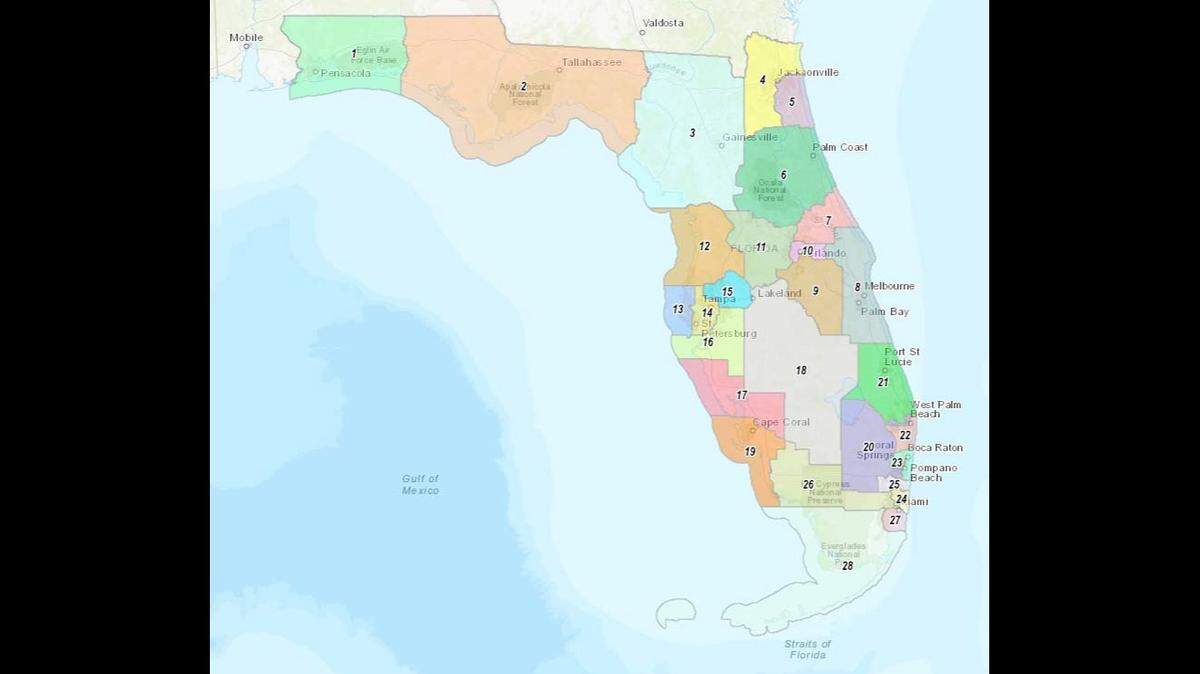
From Miami Beach to Allapattah and Wynwood, several South Florida communities are set to live in newly redrawn congressional districts for at least this year’s midterm election, as the Florida Legislature prepares to vote Gov. Ron DeSantis’ proposed map of U.S. House seats.
State lawmakers head to Tallahassee next week to vote on the new map as part of this year’s once-in-a-decade redistricting, a process that has been fraught with Republican infighting, a gubernatorial veto and is likely to spur lawsuits from civil rights organizations that argue DeSantis’ map violates the Voting Rights Act.
Under the proposal, Republicans would have the voting advantage in 20 districts, up from the current 16, and Democrats would have the advantage in eight: one district in the Tampa Bay region, two in the Orlando area and five in South Florida. Florida gained an additional, 28th seat as a result of population growth.
While DeSantis’ proposal dilutes Black-access seats in North and Central Florida to create what he calls “race-neutral” districts, the current demographics in South Florida’s Black-majority seats — Florida’s 20th and 24th Congressional Districts — could still allow for Black candidates to run and win.
The biggest change in Miami-Dade County is the district boundary of Florida’s 27th Congressional District, currently represented by U.S. Rep. Maria Elvira Salazar. Her new district drops all of Miami Beach and the wealthy private enclave of Fisher Island, a change that MCI Maps’ redistricting expert Matthew Isbell says would give Republicans an edge in a district that voted for President Joe Biden by just three percentage points over former President Donald Trump in 2020.
Miami Beach, a majority white Hispanic city that leans Democrat, becomes part of U.S. Rep. Frederica Wilson’s Florida’s 24th Congressional District. Isbell said that while Wilson’s new seat would no longer be a Black-majority district, it still would perform well for Black candidates.
“In terms of performance, there’s no real risk that it won’t perform as a Black district,” Isbell said, “but it does scream of partisan intent.”
Here’s what else would change for South Florida:
▪ District 25 – U.S. Rep. Debbie Wasserman Schultz: Under the proposed map, this district now runs along the Broward border and loses all of its Miami-Dade territory including Surfside, Bal Harbor, parts of Sunny Isles Beach and Aventura. It does gain Miramar and new parts of Hollywood Blvd that connect west to Pembroke Pines. In 2020, the district voted for Biden by 17 points, and Wasserman Schultz won by a margin of 16 percentage points.
Wasserman Schultz didn’t comment on the changes to her specific district, but she criticized the statewide impact to minority voters with the proposed rearrangement of North and Central Florida.
“Beginning with his push for voter suppression laws that limit minorities’ access to the polls, it’s unacceptable that the governor continues his attack on minority voters and the Fair Districts Amendments, which 63% of Florida voters demanded. These pillars of redistricting deserve more respect in this process,” Wasserman Schultz said in a statement.
▪ District 20 – U.S. Rep. Sheila Cherfilus-McCormick: Cherfilus-McCormick won her primary in a 2021 special election by just five votes in this Black-majority district that runs through parts of Palm Beach County and circles around Broward to include Lauderhill, Lauderdale Lakes and western parts of Fort Lauderdale. It also now snakes up I-95 from Pompano Beach to include neighborhoods along the interstate up to Deerfield Beach. The district loses the diverse city of Miramar and gains parts of Plantation, which is a majority white city.
Cherfilus-McCormick performed better in Palm Beach than her main opponent, Dale Holness, who did better in the Broward parts of the district. Because the district loses parts of Broward, Cherfilus-McCormick is likely to benefit from the new map in the Aug. 23 primary. In an interview with the Herald, Holness said he wasn’t too worried about the changes.
“The area that is expanded in central Broward County is areas that I’m very, very familiar with,” said Holness, former commissioner and mayor of Broward County. “More people know me in Broward than in Palm Beach, and it showed in the last election cycle.”
Mitch Caesar, campaign counsel for Cherfilus-McCormick, cautioned that DeSantis’ proposed changes are likely to be the subject of litigation and won’t necessarily be the final map.
“It’s no question that it seems Miramar will be lost, but again I think there’s going to be litigation on these maps, anyway,” he said.
▪ District 23 – U.S. Rep. Ted Deutch: There aren’t major changes to this Palm Beach-Broward district. In Palm Beach, it now expands west into Mission Bay and gains some parts of Boca Raton that were included in U.S. Rep. Lois Frankel’s district to the north. In Broward, it loses southern parts of Fort Lauderdale including the neighborhoods of Edgewood and Broadview Park that will now be part of Wasserman Schultz’s district. While Deutch announced his retirement, the seat, which voted for Biden by 14 percentage points, would remain Democratic.
▪ District 26 – U.S. Rep. Mario Diaz-Balart: This majority-Hispanic district that runs from West Miami-Dade to Collier County and borders Naples and Marco Island lost all of its Hendry County territory, confining it to two South Florida counties. It now loses most of rural Immokalee, a farming city that is overwhelmingly Hispanic, and gains growing neighborhoods in Miami like Allapattah and the trendy arts district of Wynwood.
This Congressional district highlights the rightward trend Miami-Dade has seen in the past few years, led primarily by Hispanic communities. In 2016, the district voted for Hillary Clinton with 52% of the vote, but it shifted dramatically for Trump in 2020, with a 31% swing to the right, according to Isbell’s analysis. An earlier draft of the proposed congressional map would have given this most of coastal Collier County, changing the district’s demographics to make it more white. DeSantis’ latest proposal keeps it largely intact.
Diaz-Balart did not immediately respond to a request for comment for this story.
▪ District 24 – U.S. Rep. Frederica Wilson: This Black-majority Miami-Dade district’s most notable change is it now will include all of Miami Beach, a move that dilutes its percentage of Black residents. It loses Hollywood to the north, and parts of Miami that were split between Salazar and Diaz-Balart, the two neighboring districts. It now ends along the Airport Expressway to the south and circles east of Wynwood to include parts of Edgewater. The district could still perform well for Black candidates, Isbell said, even if it’s no longer majority Black.
Wilson’s office did not immediately comment on the map.
▪ District 27 – U.S. Rep. Maria Elvira Salazar: Salazar stands to gain the most politically in Miami-Dade from the proposed map, benefiting from both the Republican trends in Miami-Dade and losing a major Democratic-leaning part of the district: Miami Beach. The district gains some parts of Sweetwater to the west and shifts north slightly to include all of Downtown Miami south of the Dolphin Expressway and the MacArthur Causeway. The district keeps Virginia Key and Key Biscayne.
Salazar’s spokeswoman declined to comment for this story.
▪ Florida’s Congressional District 28 – U.S. Rep. Carlos Gimenez: Florida’s southernmost congressional district, which incumbent Gimenez won by less than three percentage points, is left mostly intact from its current makeup. There are some minor changes in Miami-Dade’s Sweetwater area, which now include the Dolphin Mall to the north and it will border Fontainebleau along NW 97th Avenue to the east and SW 8th Street to the south. This district had a 25% shift for Republicans in 2020 from 2016, Trump winning with about 52% of the vote, Isbell’s analysis shows.
Gimenez did not immediately comment on the map.
You can view the full proposed map for Florida’s Congressional district here.
This story was originally published April 14, 2022 at 5:25 PM.