From deal-seeker to hawk. Mayor’s ‘awkward’ China politics began on trip to Hong Kong
When Miami-Dade Mayor Carlos Gimenez delivered a luncheon address to Miami’s Chamber of Commerce in the fall of 2017, he brought with him a gleaming vision of the future of transit — an automated, electric and rubber-wheeled passenger carrier made in China.
“It looks like a train,” Gimenez said, after showing a promotional video by Chinese train maker CRRC of the experimental vehicle that can follow a painted path on asphalt roads. “I hope to go to China to see that, and other technologies they have out there that may be able to solve our transportation issues.”
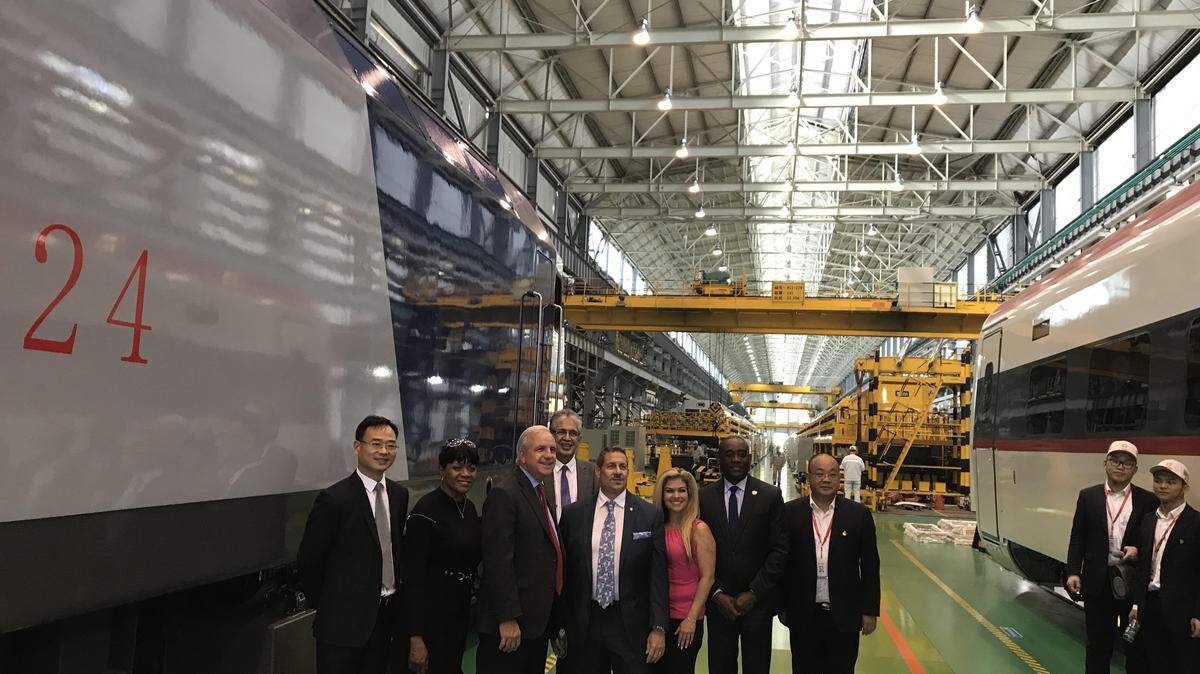
Gimenez did make the trip the following year. He toured a state-owned factory and met with Malaysian casino executives in Hong Kong who’d ultimately pitch Gimenez’s administration on a downtown-to-South Beach rail line using Chinese trains.
But when other Republicans raised alarm at the proposal, Gimenez moved to block Chinese investment in Miami-Dade’s mass transit system. Now running for Congress, the mayor points to the 2018 trip as opening his eyes to the pitfalls of doing business with a dictatorship — a stance that better aligns Gimenez with the White House amid escalating tensions with China.
“It’s awkward,” said Michael Hernandez, a former Gimenez spokesman and past adviser to Gimenez’s likely November opponent, Democratic Rep. Debbie Mucarsel-Powell. “The mayor was interested in a proposal from a Chinese company at the same time Donald Trump was preparing to launch a trade war against that country, and with several of his colleagues on the county commission speaking against it.”
The details around Gimenez’s public evolution on China were resurrected this month with the May 22 release of a two-year ethics investigation into his efforts in early 2018 to find a transit partner in the Far East.
At the time the mayor left Miami for Hong Kong in March 2018, Trump was already launching a trade war with China, and Republican Florida U.S. Sen. Marco Rubio was warning about the nation’s rise as a global threat to the U.S. But Gimenez led a county delegation that March in search of multiple deals to improve Miami-Dade’s mass transit system.
After the ethics report’s release, the mayor said the trip helped him see “first-hand the reasons why the county should not get involved” with China.
“I came in thinking, ‘Hey, maybe they could invest in Miami-Dade,’” Gimenez, a candidate in Florida’s Westchester-to-Key-West 26th district, said in an online press conference Wednesday. “I came back with a completely different opinion.”
But as detailed in newly released reports by the Miami-Dade Commission on Ethics, the much-publicized trip to Beijing, Qingdao, Shanghai, Hong Kong and Tokyo included a tour of China’s state-owned CRRC’s trackless trains, as well as meetings with executives of the Malaysian casino conglomerate Genting aboard a company yacht and cruise ship, get-togethers that were initially kept from the public.
The county’s decision to leave the Genting meetings off itineraries provided to the Miami Herald and Univision and, later, to wipe burner cell phones used on the trip by county officials led to the recently closed ethics investigation. No charges were filed.
Gimenez did tell reporters upon his return two years ago that he was underwhelmed with the CRRC vehicles, but that didn’t kill the prospect of Chinese trains coming to Miami.
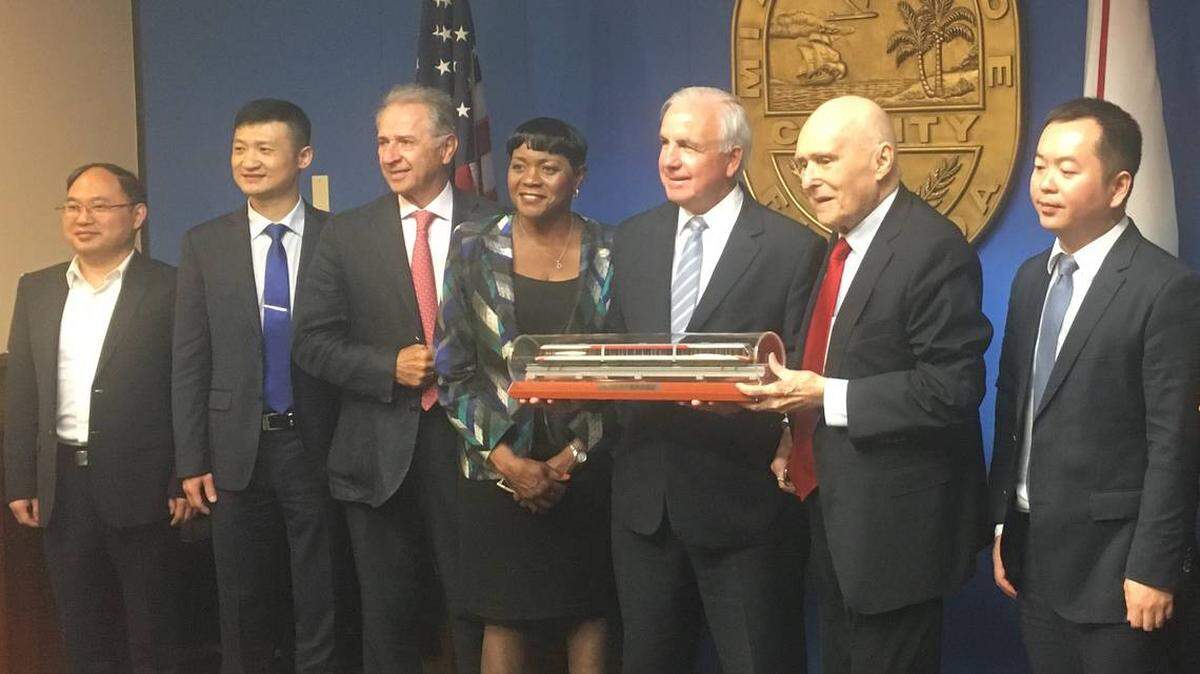
On April 23, 2019, the mayor met in his 29th floor offices with representatives of the Hunan Maglev Group so they could pitch their trains that ride above tracks using magnetic levitation, a possible substitute for expanding Metrorail. A brochure circulated at the meeting — which included Commission Chairwoman Audrey Edmonson — described maglev technology as the “pride of China,” and Gimenez’s office released a photo of the mayor posing with the company’s delegation, holding a model train. The group hasn’t submitted a transit proposal to the county.
Eight days later, Genting and partners submitted a sealed, “unsolicited” proposal that offered to use trains by Chinese company BYD for a monorail line that would run from mainland Miami to South Beach. Genting said the partners would contribute $150 million toward a development cost estimated at $400 million.
Gimenez recommended commissioners consider the proposal. Under Florida law, that triggers a formal bidding process allowing Genting and other would-be transit developers to compete for a county contract worth hundreds of millions of dollars to build and operate a transit system over the MacArthur Causeway commonly called Baylink.
“There’s obviously a very attractive merit to this proposal, which is there is a private company willing to invest over $150 million to this project,” Gimenez told commissioners July 10. “It does have merit... It doesn’t mean that’s what we’re going to choose in the end.”
Two lobbyists who served key roles on the mayor’s 2016 reelection campaign and attended the China trip are partners in the Genting consortium. And in early 2019, Gimenez, his wife, Lourdes, and Edmonson agreed to appear in a promotional video for Genting’s proposal. Genting has declined to release the video, even though county lawyers have declared it a public record.
After Gimenez received criticism from other Republicans last July for entertaining Genting’s bid in cooperation with the Shenzhen-based BYD, he began to publicly speak out against using Chinese trains.
Florida’s Republican U.S. Sens. Marco Rubio and Rick Scott authored a July 15 letter to Gimenez along with U.S. Rep. Mario Diaz-Balart warning the mayor to “keep China out of our critical infrastructure.”
“Contracting with Chinese entities not only puts our critical infrastructure at risk for security vulnerabilities, but also undermines U.S. manufacturing and jobs in the process,” they wrote.
After the letter, the county crafted the procurement rules for Baylink solicitations to prevent bids that included Chinese trains or buses. Then, in a letter responding to Rubio, Scott and Diaz-Balart, Gimenez suggested that the South Florida members of Congress consider legislation closing a “loophole” allowing municipalities to contract with Chinese state companies on transportation projects as long as federal funding wasn’t included.
“I do share your concerns with regard to the potential economic and national security threats associated with the use of Chinese technologies in transportation infrastructure projects,” Gimenez wrote in response to Rubio, Scott and Diaz-Balart.
In March, when new bids for Baylink came due, Genting was the only company to respond, pitching a $770 million privately-run monorail system funded by taxpayers and using trains from Canada’s Bombardier manufacturer instead of BYD. Commissioners voted May 19 to allow Gimenez’s administration to begin formal discussion about the project.
As the November election approaches, Republicans and President Donald Trump have increasingly targeted China as a 2020 foil. The Trump and Biden campaigns have produced ads hitting the other for being too soft on the rival nation. And this week, Florida Republicans increasingly heaped criticism on China’s government as it cracked down on freedoms in Hong Kong.
Gimenez has joined in. Last month, he warned in a letter to Trump that an offshoring of U.S. manufacturing to China was hurting efforts to combat and prevent the coronavirus pandemic in Miami by making it difficult to obtain protective equipment and medicine produced overseas. Gimenez privately shared negative reactions to China after the trip, and recently added that he suspected he was followed throughout his trade mission to the dictatorship.
“I felt I was being surveilled the whole time,” Gimenez told reporters this week.
His new stance on China has won over former critics within his own party as he takes on a first-term Democrat in a South Florida district that’s switched between parties three times this decade.
“He moved quickly to change and adapt,” said Miami Young Republicans President Armando Ibarra, who last year commissioned a poll showing that a “Chinese monorail” was largely opposed by likely voters. “I think that events since then have validated the mayor’s actions.”
But Hernandez, a Telemundo 51 political analyst and former Gimenez spokesman, who left his county job weeks before the China trip, believes the mayor’s courtship of Chinese business could come back to haunt him.
“Could it hurt him in a Republican primary? Probably not, because Trump endorsed him,” said Hernandez. “Could it hurt him with [no-party-affilation voters] in a congressional race that he needs them to win? Oh, yeah.”
This story was originally published May 29, 2020 at 7:11 PM.