
Only two Democrats want to be Miami’s top prosecutor. Republican votes may sway the race
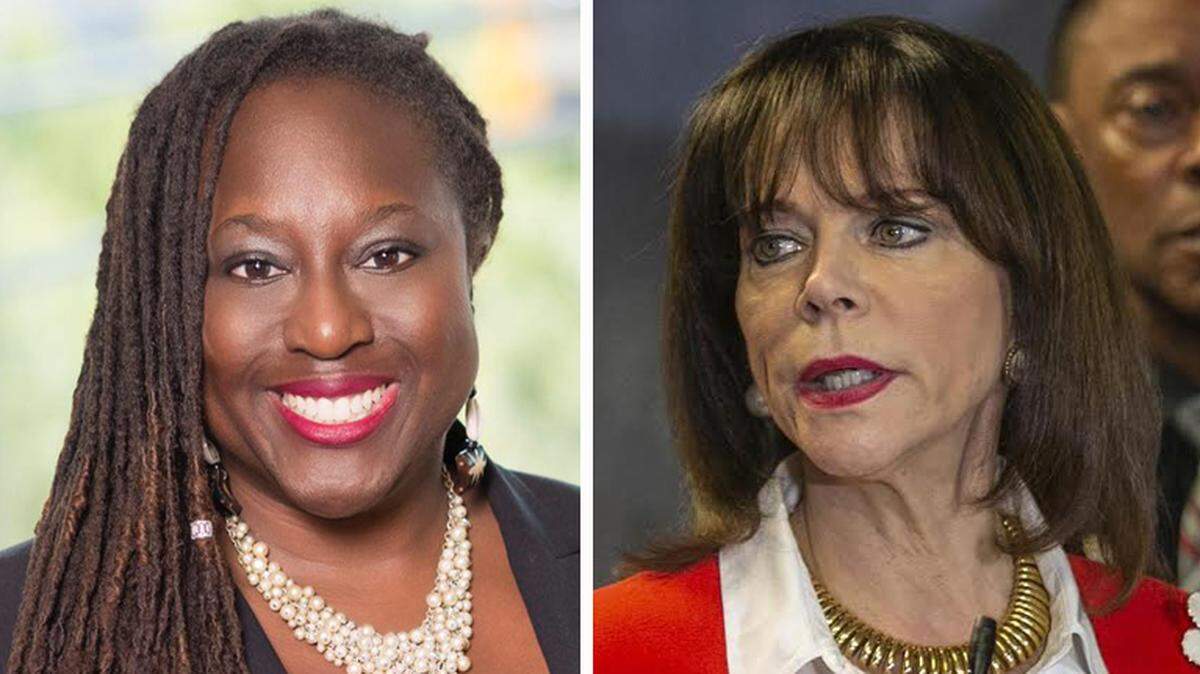
It’s now set in stone: The ballot for Miami-Dade State Attorney will feature only two Democrats, which means Republicans, third-party members and independents will be able to select the county’s top prosecutor during the August primary election.
And that was a bit of a surprise.
Political observers had long expected a “write-in” candidate — some obscure lawyer whose name wouldn’t actually appear on a ballot — to jump in the race, a move that would have closed the primary to just Democrats. That would have dramatically narrowed the voter pool and boosted the odds for Melba Pearson, who is campaigning as a reform candidate in challenging longtime incumbent Katherine Fernández Rundle.
But unlike eight years ago in the same race, Friday’s candidate-qualifying deadline passed with no write-in candidates officially applying. Pearson and Fernández Rundle qualified to run on Friday, the same day Miami-Dade Public Defender Carlos Martinez and 30 incumbent circuit judges were re-elected when no one filed to run against them.
Pearson, a former prosecutor under Fernández Rundle who went on to become the deputy director of Miami’s American Civil Liberties Union, says she’s confident she can appeal to voters from outside the ranks of the Democratic party. “Criminal-justice reform has proven to be a bipartisan issue,” Pearson said.
Political analysts, however, believe a larger voter pool favors Fernández Rundle, the State Attorney since 1993 who has wide name recognition, particularly among Republican Hispanics who can now vote.
“It’s kind of startling that there wasn’t a write-in candidate,” said Miami Democratic consultant Keith Donner, who is not involved in the race. “People don’t like it, but it’s legal and it’s a common tactic.”
Pearson’s campaign says it did not try recruit anyone to run as a write-in candidate.
Of the 1.4 million active registered voters in Miami-Dade County, 616,553 are Democrats. Republicans make up over 388,000 voters, with the rest belonging to other parties or independents. Only 16 percent of total voters are listed as African American, although the group makes up about 40 percent of the Democratic party.
“Our campaign has been focused on engaging with voters and discussing Kathy’s commitment to public safety, as well as her championing important reforms to our system,” her campaign said in a statement on Tuesday. “The open primary now gives every voter in Miami-Dade County, regardless of political party, the ability to have a voice in this race.”
(Friday’s qualifying deadline also meant automatic re-election for Miami-Dade Public Defender Carlos Martinez and 30 incumbent circuit judges who drew no opposition. Three current circuit judges drew an opponent, and two open seats will feature two-person races).
No write-in candidate in Florida has ever come close to winning an election, and critics say such candidates are almost always run by political operatives seeking to limit the numbers of voters who can cast ballots. A much-derided 2000 advisory opinion from the secretary of state said that just one write-in candidate was enough to close a primary.
The tactic was used eight years ago by Democrat defense lawyer Rod Vereen, who hoped to capture enough of the black Democrat vote in Miami-Dade to beat Fernandez Rundle.
Today, Vereen openly admits he recruited lawyers Michele Samaroo and T. Omar Malone to run as write-in candidates. At the time, neither write-in candidate campaigned, received donations or returned phone calls or e-mails from the press.
“I knew the Hispanic Republicans would be more likely to go for Kathy, so it was an opportunity to cut down on her fan base,” said Vereen, who this year is supporting his former opponent in the race.
The presence of write-ins in the 2012 race sparked a federal lawsuit, supported by Fernandez Rundle, from Republican and independent voters who claimed they were being disenfranchised by “gimmick” candidates. A federal judge, however, threw out the lawsuit.
Vereen, hoping to become Miami-Dade’s first black State Attorney, showed well, garnering 40,653 votes. But Fernandez Rundle still garnered more than 60 percent of the over 102,000 voters who cast ballots. He added that Fernandez Rundle traditionally has maintained a strong presence with Miami’s black voters. “Melba has an uphill battle,” Vereen said.
For its part, Pearson’s campaign says it believes it can pull voters of all stripes by attacking Fernandez Rundle’s long tenure as the top law-enforcement official.
“Kathy has been there 27 years,” said Ben Pollara, who works on Pearson’s campaign and also started a political committee to raise money on her behalf. “She’s got a lot to answer for. The way criminal justice is viewed by voters has changed a lot since the early 1990s. There’s is broad bipartisan acknowledgment that the policies of the ‘80s and ‘90s have destroyed a lot of lives and crowded our prisons.”