
Cuban president's defiant response to US threats: ‘Willing to give my life'
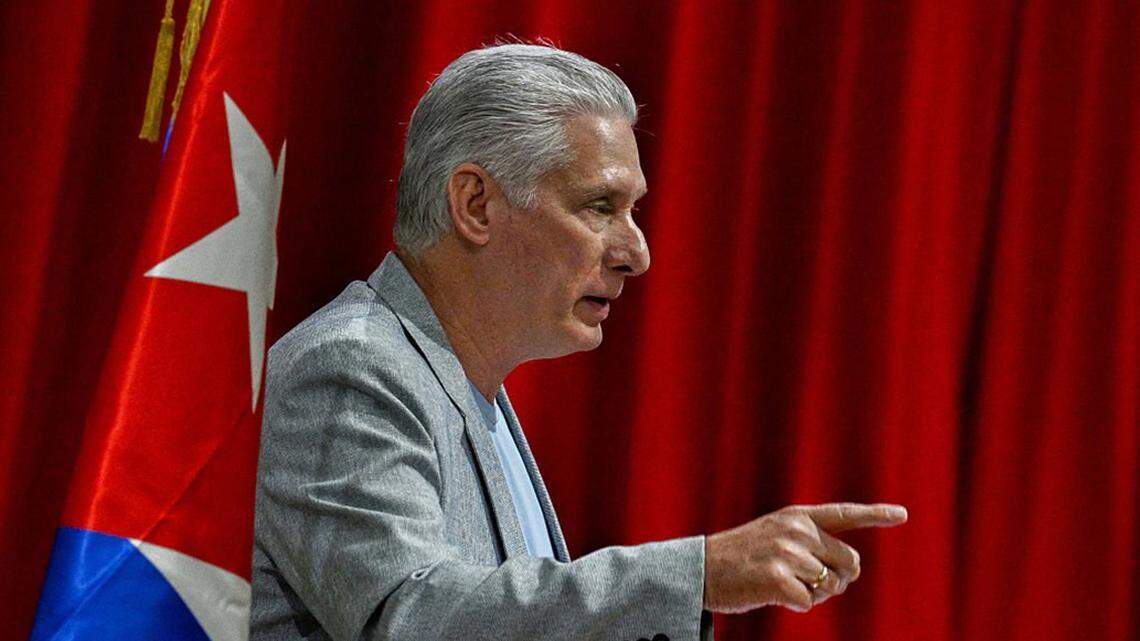
Cuban President Miguel Díaz-Canel on Sunday underscored the lengths he’s willing to go to in order to preserve “the revolution” in his country following several threats by the United States that the Caribbean island could be next on President Donald Trump’s international agenda.
“I have no fear,” Díaz-Canel told NBC‘s Meet the Press host Kristen Welker. “I am willing to give my life for the revolution. Of course, I wouldn’t like that to be the attitude of the U.S. government.”
He added: “Like I’ve always said in previous meetings and previous interviews, and when I also address the Cuban people, it is evident that there are threats out there. It is part of the rhetoric of the U.S. government.”
Why it matters
Last month, Trump asserted “Cuba is next” during a speech at an investment forum in Miami, echoing his sentiment that the U.S could shift its attention back to its own hemisphere following operations in Iran.
The administration has already taken aggressive steps in several other countries, and even vague suggestions of military involvement could increase instability in the region and strain diplomatic efforts currently underway.
Cuba, a communist country, continues to sink into a humanitarian crisis as the U.S. blockade on the island nation intensifies, with Díaz-Canel telling Newsweek last week that any attempt to launch an operation against Cuba would lead to “immense losses” on both sides. He has suggested proposals for working with Washington, but it remains unclear whether these approaches would satisfy Trump.
What to know
Díaz-Canel spoke with Welker on Sunday, almost a week after he spoke with Newsweek in his first interview with U.S. media in three years.
The embattled Cuban leader echoed his message that his country would defend itself, previously saying the nation is prepared “not to attack, but to defend,” but went a step further and said he would “give my life for the revolution.”
When Welker asked him about stepping down as a condition to avoid conflict, he joked, asking if it was “a question from you or is it coming from the State Department?” and then asked if she had “ever asked that question to any other president in the world.”
Díaz-Canel regularly framed the tensions between the U.S. and Cuba as unique compared to that of almost any other nation with which the U.S. has dealings, and stressed that “the people who are in leadership position [in Cuba] is not elected by the U.S. government, and they don’t have a mandate from the U.S. government.”
“Cuba has never said about attacking the United States or interfering with the United States affairs,” Díaz-Canel said. “However, you hear that Cuba is next, that Cuba is going to be next, there’s a way out, that they’re going to take over Cuba. So, from the position of responsibility within the leadership of the country, that is a warning. And we need to responsibly protect our people, protect our project and protect our country. So, we are preparing ourselves for defense.”
He told Welker that “the Cuban people is suffering” as they suffer “a number of restrictions which are not applied to any other country in the world.”
“We lack financing in order to buy food, to buy supplies for our main productions and services, in order to have the medicines that we need and to carry out the repairs that we need for our national energy system and our industrial factories,” he said. “How does that reflect on our people now?”
While Díaz-Canel remains open to discussions with the U.S., he is cautious about progress with the current administration, accusing some elements in the Trump administration of trying to “undercut and boycott” the possibility of meaningful diplomatic progress.
“I think we can have an approach in terms of what is possible and what is difficult. I think dialogue and deals with the U.S. government are possible, but they’re difficult. Cuba has always stood by its commitments, and the United States (has) not fulfilled its part of the deal,” he said.
“The U.S. has been engaged in talks with other countries, and while these negotiations are underway, they have attacked those countries, and all of this creates a lot of distrust, and we know that inside the United States, there are forces that whenever they see that there’s a possibility to engage in discussions, to engage in a dialogue, they try to undercut and boycott those talks,” the Cuban president added.
2026 NEWSWEEK DIGITAL LLC.
This story was originally published April 12, 2026 at 1:01 PM.