
The reality of medical care on the front lines in Ukraine
Editor’s note: The authors, Stolar and Yastreba, are Ukrainian students who now attend Florida International University.
Maxim Rud’s transition from intern to orthopedic traumatologist wasn’t smooth or gradual. It began with putting together bones fractured by explosions and patching up artillery wounds of Ukrainian soldiers evacuated from the front lines.
“There was a feeling of great responsibility and at the same time an inner fear, not for myself, but for whether I would have enough knowledge and experience to help,” says Rud, who was interviewed by Zoom from Kyiv.
Rud and a foreign combat medic in the Armed Forces of Ukraine who goes by the pseudonym Munin describe the difficult mental and physical toll that the Russia-Ukraine war has taken on health care professionals. They also mention shortages of equipment and the necessity to adapt to any situation.
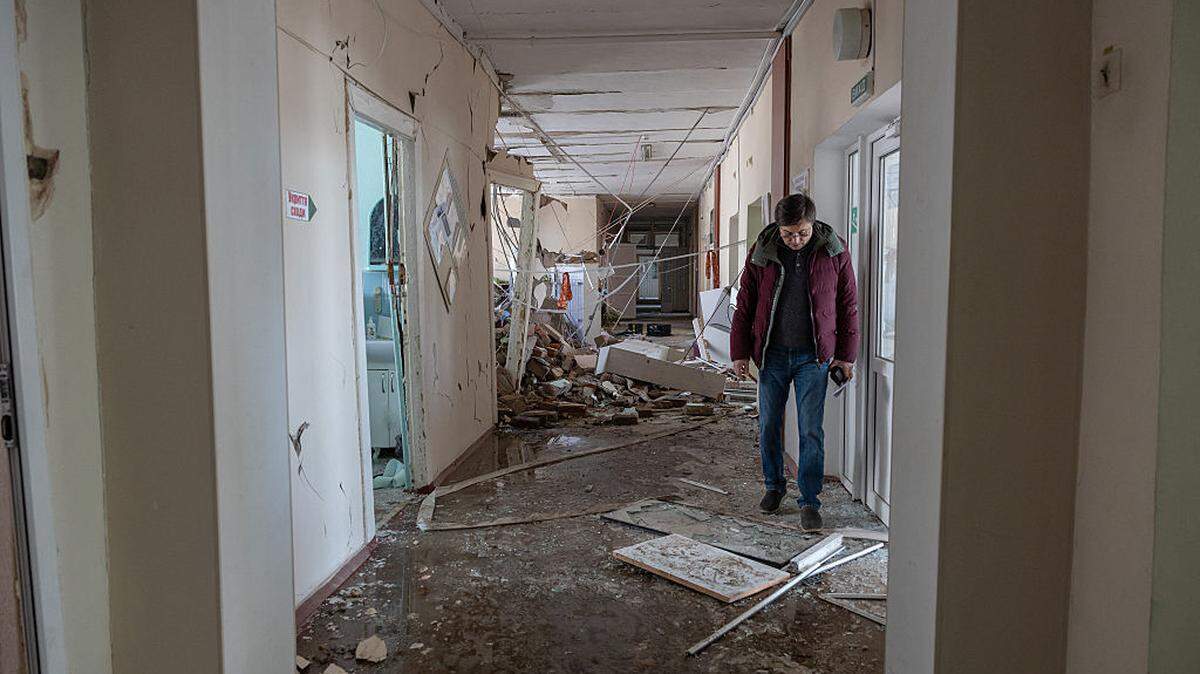
Since the beginning of the full-scale invasion of Ukraine, Russia has bombed hospitals roughly 2,600 times, killed more than 350 health care workers and kept an average rate of attacks on health care facilities at 56 times every month, according to a February update from ReliefWeb, a United Nations-sponsored website.
The vast number of patients and the difficult working circumstances of war create a complicated environment for medical personnel like Rud. The 26-year-old works for the Institute of Orthopedics of the National Academy of Medical Sciences of Ukraine (IONAMS) in Kyiv.
His department performs between 2,000 and 2,300 surgeries per year for Ukrainian soldiers and civilians with serious joint injuries. But, he says, there is a constant deficit of equipment required for effective diagnosis and treatment. It includes a lack of two things that are particularly important:
- Arthroscopes, which act as the eyes of the doctor inside of the joint that is being operated on
- Negative Pressure Wound Therapy Device VAC systems, which help when working with open wounds by using a vacuum to eliminate contamination
He often figures out a way to make do, but it’s not easy.
“When we don’t have the standard tools, we have to adapt,” says Rud. “We change tactics sometimes, combining techniques to use what we have as rationally as possible.”
Rud, who received six years of medical training, says he is often exhausted by staffing and equipment shortages and is sometimes briefly depressed. But he almost always feels better by comparing his position to that of the soldiers and medics who must work on the front lines, sometimes in below-zero temperatures.
While Rud indulges in momentary satisfaction after a strong repair and seeing a patient’s first steps after surgery, some loss is inevitable.
One soldier was particularly memorable, he says. He had a shattered knee that was reconstructed. The man went back to fight, but Rud suggested that he return in two months for rehabilitation and a checkup. That didn’t happen.
“He died during battle,” says Rud.
Another health care provider in Ukraine is a 27-year-old who asked to be identified by his call sign, Munin. He works in a mobile unit and has far less training than Rud.
“In 2023, I lost a lot of my boys in the front lines, and I decided to start learning tactical medicine,” he says. “Because when my boys died, I couldn’t do anything.”
He used to be a combat medic and now is an instructor.
Munin’s training took three weeks, he says. He had no previous background in medicine but had spent four years in the military.
He took on a job high in responsibility: planning operations; evaluating the medications, first aid and equipment; conducting training; communicating constantly with the chain of command; and checking on the mental health of his platoon.
Besides taking care of the physical state of the soldiers, Munin learned to spot nervousness or agitation among soldiers and to treat them while in battle.
To find solace, he watches anime. To calm platoons, he leads troubled soldiers away and tells family stories.
“When the enemies are shooting at me, lots of time I try to watch around and I try to find something good,” he says. “War is hell and combat is hell, but sometimes I find some flowers, some nature, and it makes me quite calm.”
There is no time for emotions on the front lines, he says. There is no room for focus to be lost.
“When I go back to Kyiv, or, you know, a big city from the battle lines for vacation, it’s [because of] a peak of emotion; it tries to destroy me, and it’s a very hard time,” he says.
The hardship of looking after the physical and mental health of 30 to 40 soldiers for 24 hours — applying a tourniquet while shooting a machine gun — is intensified by corruption and lack of resources, he said.
“I bought a proper tourniquet, but someone took it and sold it,” he said.
Mobile units, Munin says, get minimal training on how to use randomly provided equipment that often malfunctions during battle. There is also a shortage of medication.
These days, Munin is conflicted about the future. He has received more lucrative offers to work outside of Ukraine. But he remains in the Ukrainian military.
“ I stay here because of my boys who fight together,” he says.
He recalls one of his army brothers who fought beside him, then died during battle when Munin wasn’t present.
“I really feel guilty about that,” he says, “Maybe if I had been there, I would have died with him.”
This story is the result of a partnership between Florida International University’s Lee Caplin School of Journalism and Media and the Miami Herald.