Incredibly rare species — with ‘peacock’ body — found in India for first time
Nearly a decade ago, researchers in the central valley of Manipur, India, photographed two turtles.
The turtles were part of the trionychid family, or a group of soft-shelled turtles in which the shell lacks large scales and instead is relatively flat.
One of the turtles was identified as Nilssonia hurum in the 2016 study, but now, researchers are claiming that this was incorrect, and the photographs actually prove a critically endangered species has been living in India this entire time.
The photo “of an alleged N. hurum clearly depicts a (Nilssonia formosa) and thus constitutes the first photographic voucher of this critically endangered species from India,” researchers wrote in an Oct. 13 study published in the peer-reviewed journal Zootaxa.
Balázs Farkas and Peter Praschag, founder of research and conservation group Turtle Island, wrote that while young turtles of the two species have similar head and body patterns, “N. formosa lacks a light-coloured blotch across the snout typical for N. hurum, and has bar-like yellow patches on the temples that extend from ear level up to the crown.”
As the turtle grows, according to the study, these light spots are eventually replaced by black coloration and “vermiculations on a cinnamon ground.”
.jpg "MixCollage-15-Oct-2025-12-03-PM-8463 (1).jpg")
Nilssonia formosa, or the Burmese peacock soft-shelled turtle, has been known to live across the border from where it was photographed in Myanmar, as well as some reports of the species in Yunnan, China. The Chinese records, however, are believed to be from human introduction and not a natural expansion of the species’ range.
“The closest documented point of occurrence to those in Manipur lies at approximately (118 miles) air distance on the Yat Nar Sandbank of the upper Chindwin River in the Chin State of Myanmar,” according to the study.
The sighting in India not only shows a range expansion westward, but also a shift in the species occurring at higher elevations, researchers said.
Expanding ranges of any species are worth noting, but particularly those that are protected, vulnerable or in the case of the Burmese peacock soft-shelled turtle, critically endangered.
The turtles are considered one of the world’s most endangered freshwater turtles, brought to the brink of extinction because of overharvesting for the East Asian food market as well as habitat degradation and fishing net entanglement, according to Fauna & Flora.
The turtles are known for their striking and peacock-like pattern on their backs, as well as their ability to pull their heads entirely into their neck, the organization said.
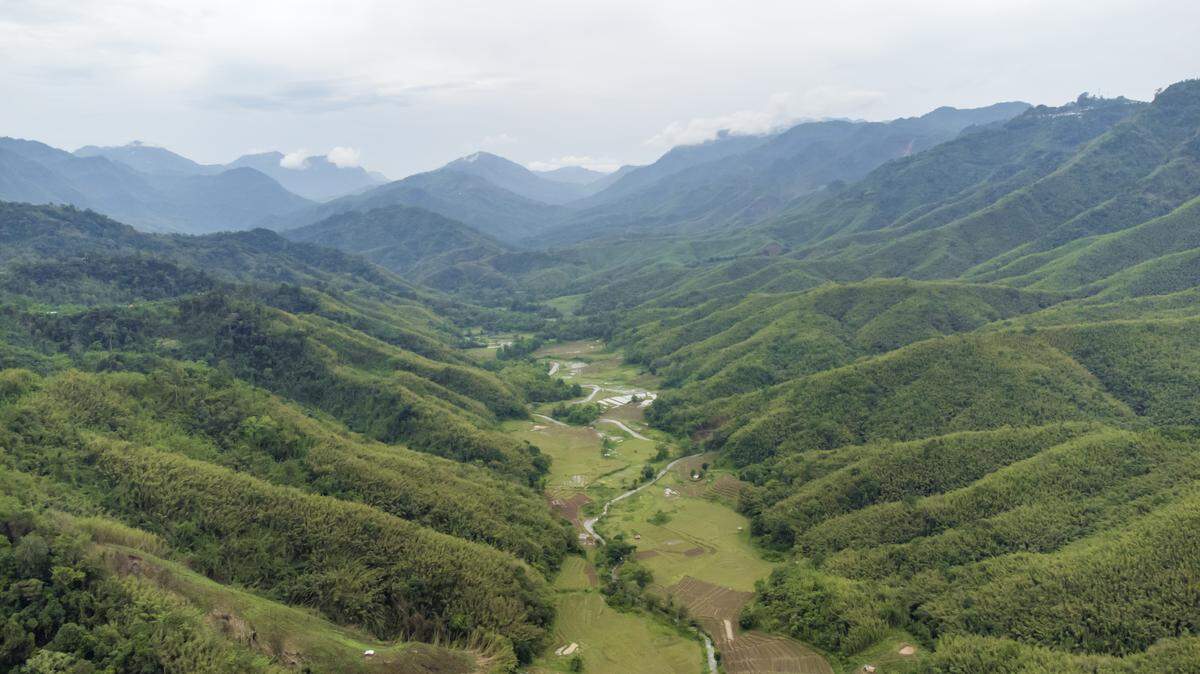
The state of Manipur is on the eastern border of India, west of Myanmar.
This story was originally published October 15, 2025 at 1:45 PM.