Yellow-tailed creature makes ‘surprise’ stop at fruit feeder in Panama. Watch it
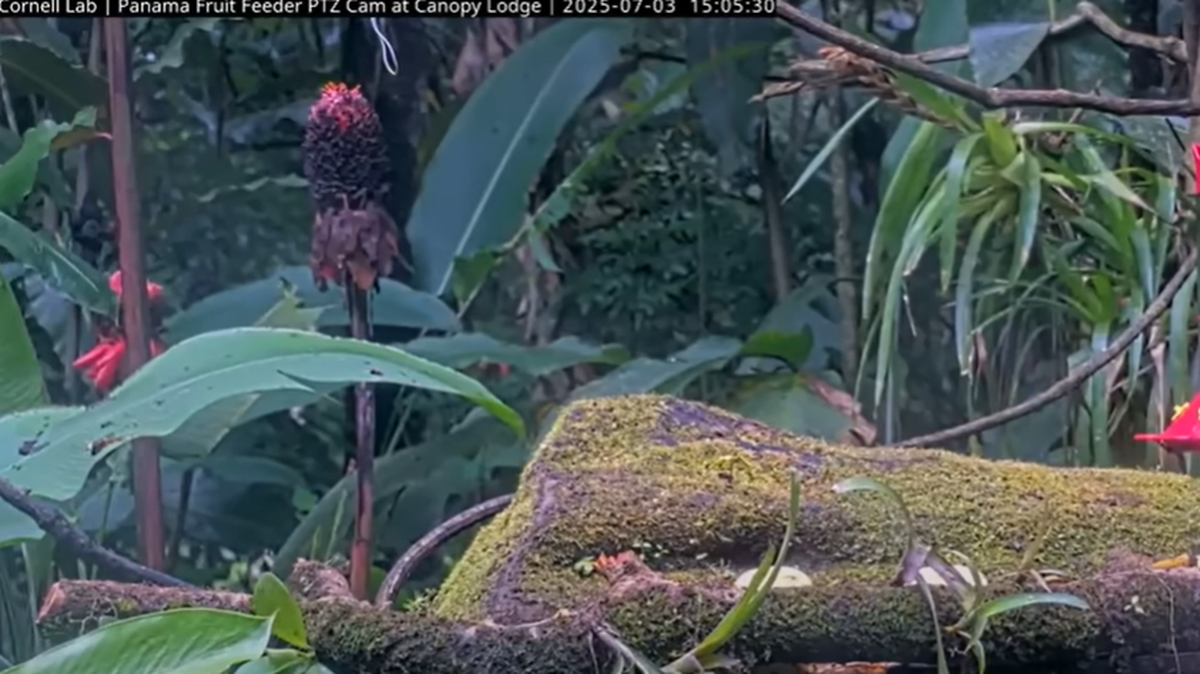
In the tropical rainforest of Panama, a camera trap is trained on a block of wood.
The log is covered with moss and small plants, and dotted with the remnants of fresh fruit. A hummingbird feeder hangs just to the right of the platform, filled with sugary water.
It’s a fruit feeder aimed at attracting local birds to step in front of the lens as a livestream records the interactions, run by Cornell Lab Bird Cams.
At the beginning of July, however, a bird from the neighboring country of Costa Rica made a “surprise” guest appearance on film.
“A surprise crested oropendola visited the Panama fruit feeders recently!” Cornell Lab said in a July 22 news release. “These relatives of blackbirds and orioles nest in colonies and are known for their complex, liquid-like vocalizations as well as their pendulous woven nests that can be over (3.2 feet) long.”
The video shows the “inquisitive” bird touching down once to check out the fruit, then flying off before returning again.
“Although an uncommon visitor to the Panama feeders, the crested oropendola is one of the more common and most widespread oropendola species, occurring from Costa Rica, where the species arrived as recently as 1999, south over much of South America east of the Andes, and as far as northeast Argentina,” Cornell Lab said.
The species is identified by its black and “chestnut” back end and stomach feathers, while the tail is a bright yellow color, Cornell Lab said in the caption of the video. The vibrant tail is easy to spot when the bird is in flight or perched on a high branch, the group said, and is matched in vibrancy by its electric blue eyes.
“The crested oropendola is principally found below (3,280 feet), but has been recorded to at least (8,530 feet) in Colombia, and in some areas it appears to perform some regular seasonal movements.”
.jpg "GettyImages-1391338707 (1).jpg")
Crested oropendolas earn their name from a breeding display exhibited by males, according to the San Francisco Zoo. The males swing their large nests back and forth like a pendulum to attract mates. The males then hang upside down and shake their tail while calling loudly, according to the zoo.
Each flock is made of between 15 and 30 females and a few dominant males, and they group their massive, woven nests together, the zoo says.
The cameras are positioned at the Canopy Lodge in El Valle de Antón, Panama, an area in the low mountains of Cerro Gaital that experiences a climate comparable to a mild spring year-round, according to Cornell Lab.
El Valle de Antón is in central Panama, about an 80-mile drive southwest from Panama City.