Tiny endangered creature is ‘smallest baby’ ever seen, Vietnam wildlife officials say

In the remote rainforests of Vietnam, the “king of the swingers” was thought to have gone extinct.
Cao vit gibbons, or eastern black crested gibbons, have maintained incredibly small populations following their rediscovery in 2002 by researchers with Fauna & Flora, and only 74 individuals are thought to live in the wild.
Now, that number has grown by one.
“Conservationists are celebrating an upswing in the fortunes of the critically endangered cao vit gibbon after a tiny infant was spotted during routine patrolling in the remote forests of Cao Bằng, Vietnam,” research organization Fauna & Flora announced in a March 6 news release.
The last survey taken just over a year ago suggested gibbon numbers were lower than previously believed, the organization said, as the difficult terrain in the region and extreme mobility of the species led to double-counting by officials.
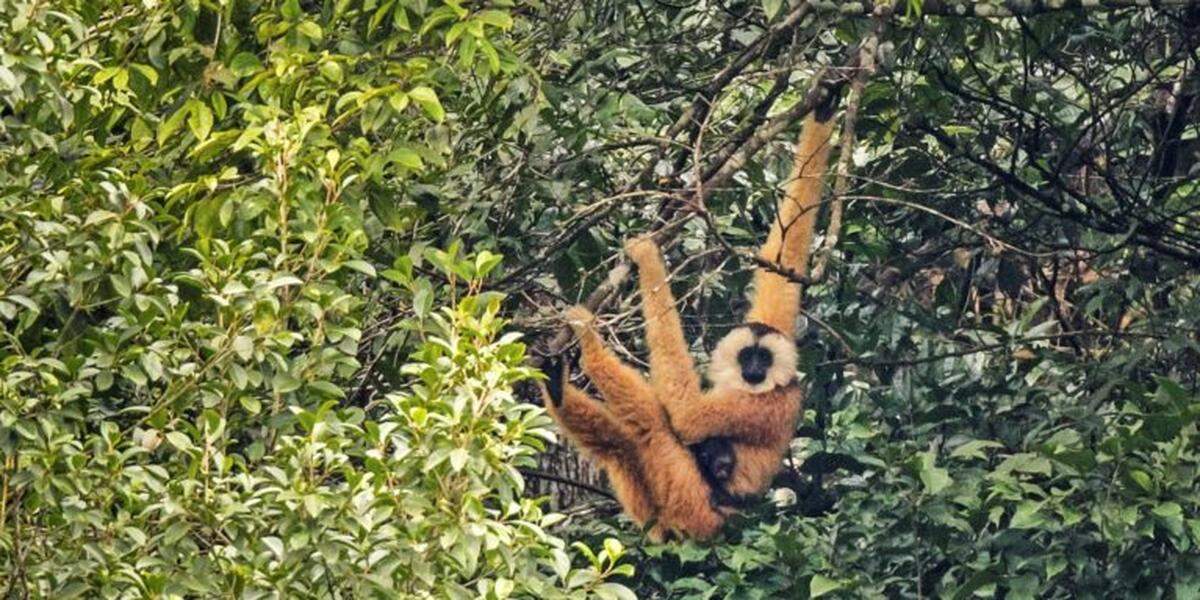
“Since that harsh reality check, the signs have been positive and this latest infant sighting is a further morale boost for the dedicated people working to save the cao vit gibbon, which is officially the world’s second rarest primate,” the organization said.
Officials have now recorded two newborns during forest patrol since the species numbers were “recalibrated,” Fauna & Flora said, with the most recent sighting “of a very young baby” taking place in November.
“We were very excited to spot another infant cao vit gibbon during our regular patrolling. This was the smallest baby gibbon I had ever seen and seeing it reminded me of my own children as babies being cared for by my wife,” project manager Tho Duc Nguyen said in the release.
Gibbons are known for their “acrobatic(s)” and “haunting calls” that permeate through dense forests, the organization said.
“Gibbons usually pair for life and live in very small family groups. They defend their territories mainly by singing,” Fauna & Flora said. “The dawn duets between male and female gibbons are one of the most evocative sounds of the forest. Many gibbon species — including the cao vit gibbon — are sexually dimorphic, meaning that males and females are different colors.”
Cao vit gibbons are listed as “critically endangered” on the International Union for Conservation of Nature Red List, with world adult population numbers in the 40s as recently as 2015.
“Every cao vit gibbon birth is another step on the ladder leading the species further away from the jaws of extinction,” Fauna & Flora said.
Cao Bằng is in northeastern Vietnam, just south of the border with southern China.