Researchers inside deep-sea vehicle collect strange creatures — and find new species
Off the western coast of Australia, the Wallaby-Zenith Fracture Zone splits open the seafloor.
The fracture in the Earth’s crust reaches depths of 21,000 feet below the surface, and much of it remains unexplored.
Some of the creatures that call the depths of the WZFZ home were undiscovered until 2017, and now, a manned deep-sea mission has brought more new species into the light.
“From October 2022 to March 2023, a joint China-New Zealand scientific expedition carried out a large-scale and systematic manned, deep-diving investigation,” according to a study published Feb. 21 in the peer-reviewed journal PeerJ.
Researchers aboard the “Fendouzhe,” a Chinese vessel, collected holothuroids, also known as sea cucumbers, from the eastern Indian Ocean, according to the study.
Two of the sea cucumbers were never-before-seen species.
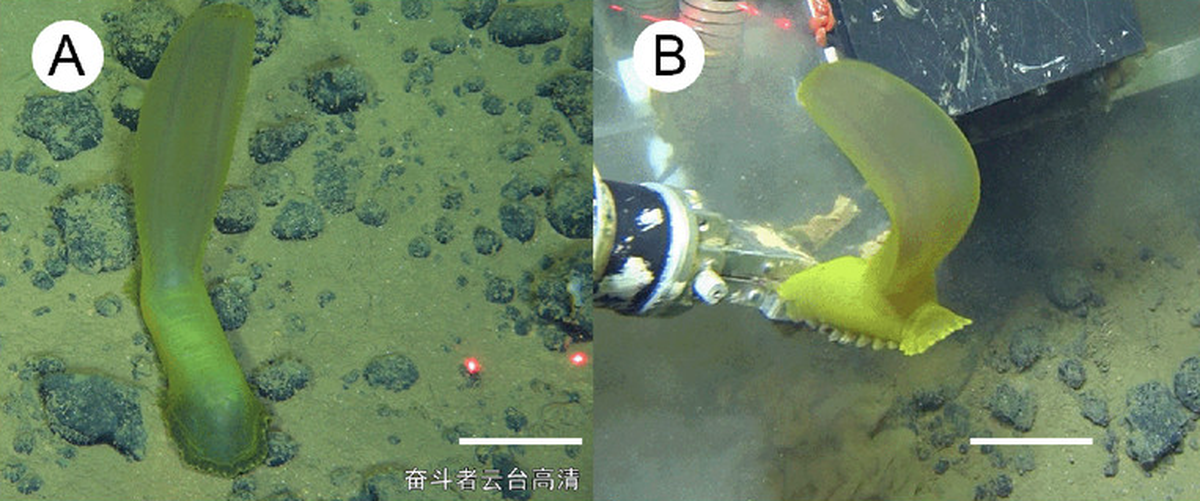
The first new species was found at a depth of 20,987 feet, researchers said.
Psychropotes diutiuscauda, or the longer-tailed sea cucumber, is “yellowish green” in color with 15 “shield-shaped” tentacles, according to the study.
The sea cucumber’s color is “unique,” researchers said, and its smaller number of tentacles (15 compared to 18 found in other related species) sets the animal apart.
The species earns its name from a tail-like appendage from the back of its body that is longer than the body itself, researchers said.
The sea cucumber has rough skin and small, tube-like feet in two rows on its belly side, according to the study.
The species is about 7 inches long in the water, researchers said.
The second new species was found in the same fracture in the Indian Ocean at a depth of 22,669 feet, researchers said.
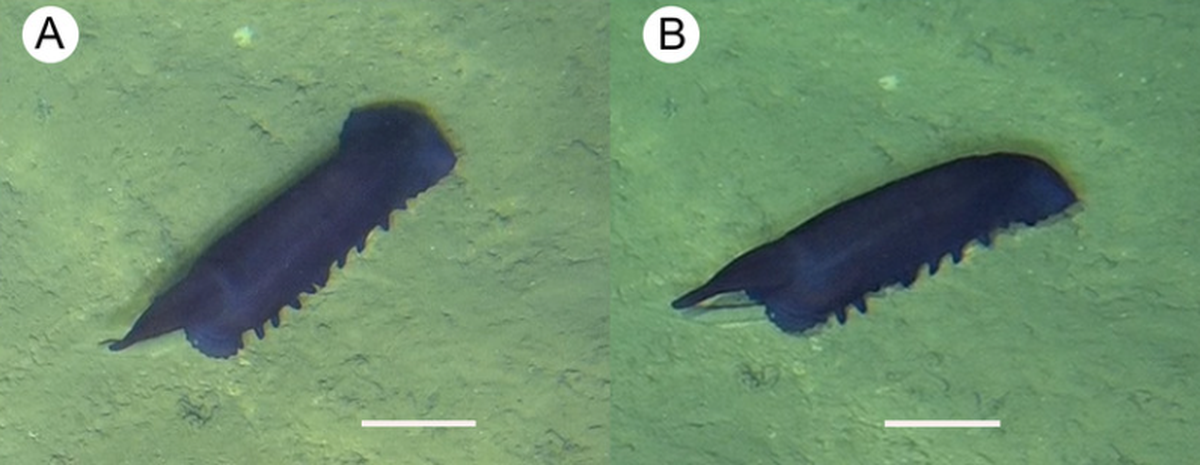
Unlike the highlighter-like color of the longer-tailed sea cucumber, this species is “dark violet,” with darker tube feet reaching “almost black,” according to the study.
The animal was named Psychropotes nigrimargaria, or the black pearl sea cucumber, “which alludes to the shape and color of the tentacles of this species,” researchers said.
The sea cucumber has “thick” skin and an appendage that is conical and tapers toward one end, appearing almost like a horn off its back, according to the study.
The appendage is only one-third of the animal’s body size, compared to the large appendage of P. diutiuscauda, researchers said.
The sea cucumber is 11.8 inches long when in the water but gets much smaller when taken out of the ocean.
Sea cucumbers are scavenger feeders that use the tube feet along their belly to move along the seafloor, according to the National Wildlife Federation. They can be found in the deep sea as well as shallow ocean environments.
The Wallaby-Zenith Fracture Zone is off the western coast of Australia, south of Indonesia.
The research team includes Yunlu Xiao and Haibin Zhang.