River creature — with ‘fringe’ lips and teeth — discovered in Taiwan. See new species
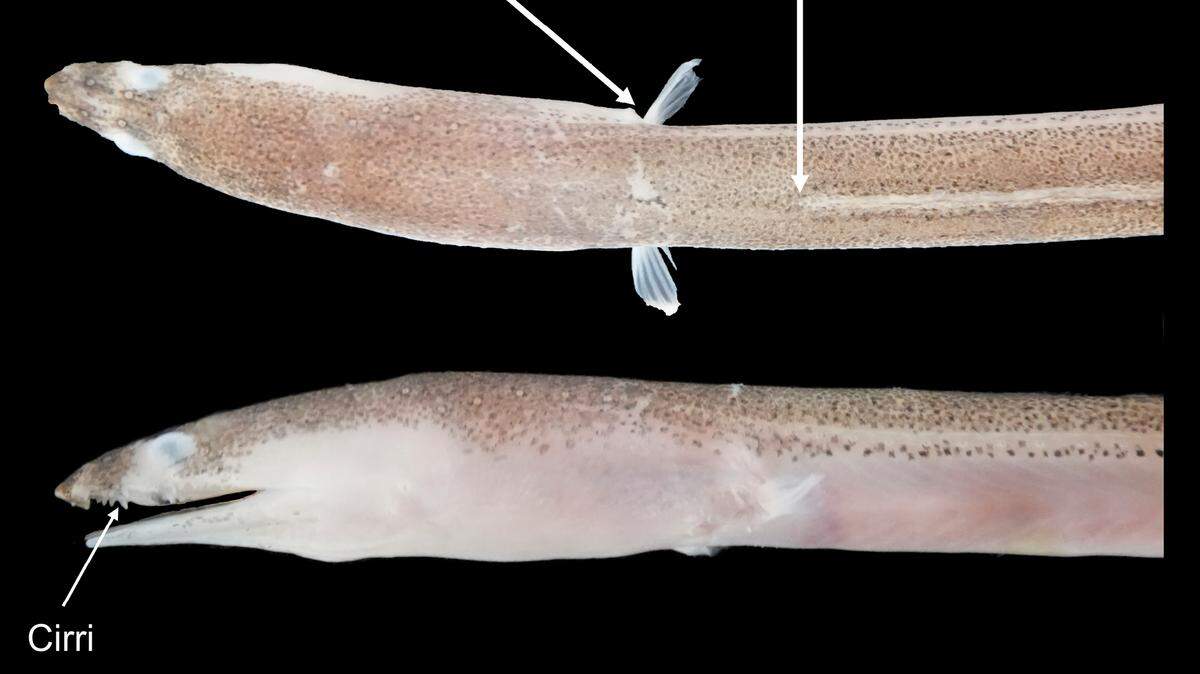
A snake eel with a fleshy mustache and sharp teeth caught in northeastern Taiwan is a new species, according to researchers.
Snake eels, or Ophichthidae, are a family of eels made up of 361 species, 60 of which have been identified in Taiwan, according to the study published Jan. 24 in ZooKeys.
The new species, Cirrhimuraena taiwanensis, is a member of a genus of snake eels with “small, fleshy projections located on the upper jaw,” known as cirri, according to the study.
The new “fringe-lip eel” is set apart from the other 12 in that genus by the row of sharp teeth along its bottom jaw, relatively large head and eyes, pointed snout, fin placement and 150 vertebrae. Its teeth are “numerous, closely arranged in a band, and primarily small and pointed, with slightly larger teeth at ends,” according to the study.
“Although only a single specimen was obtained, its distinct morphology and genetic characteristics underscore its importance in advancing our understanding of Cirrhimuraena species in Taiwan,” the study states.
Three researchers from National Taiwan University, Yen-Ting Lin, Yu-Hsiang Lin and Yu-San Han, teamed up with local fisherman Zhen-Hui Chen in northeastern Taiwan to catch the specimen in a fyke net, a fish trap commonly used for sampling. The eel was found dead and preserved in ethanol.
“We conducted a survey of freshwater glass eels (juveniles of Anguilla spp.) in the Langyang River estuary in northeastern Taiwan … twice a month since 2010,” researchers stated in the study.
The ongoing study yielded another new species of snake eel in 2018. A single specimen of this new species was collected Dec. 22, 2023.
“Furthermore, the discovery of new species and fish records highlights the need for conservation efforts to protect fish biodiversity in the Langyang River, one of the most critical habitats for Anguilliformes (eels) in Taiwan,” the study states.
The authors wrote that the find highlights how important the Langyang River estuary is in general.
“In addition, these new and recently described species suggests that many more unidentified species may be present in brackish waters, which highlight the importance of these environments for biodiversity,” researchers said.
This story was originally published January 28, 2025 at 3:00 AM.