Deep-sea creature — with yellowy tentacles and over 80 feet — is new species. See it
Thousands of feet below the surface of the South China Sea, scientists piloted a submarine through shadowy depths. Something along the seafloor caught their eye: a yellowy creature covered in appendages.
It turned out to be a new species.
Researchers explored the South China Sea through a series of five dives on a “manned submersible vehicle” between 2018 to 2023, according to a study published March 20 in the peer-reviewed journal ZooKeys.
Over the course of these dives, researchers found three yellowy and unfamiliar-looking sea cucumbers, the study said. They carefully collected the deep-sea animals.
Back on the surface, researchers looked closer at the sea cucumbers and realized they’d discovered a new species: Oneirophanta idsseica, or the IDSSE sea cucumber.
IDSSE sea cucumbers can reach about a foot in length and 3 inches in width, researchers said. They have “cylindrical,” “yellowish-white” bodies with 15 tentacles and over 80 tube feet.
Sea cucumbers use these feet-like projections to suction onto surfaces and move around, according to the University of Hawai‘i.
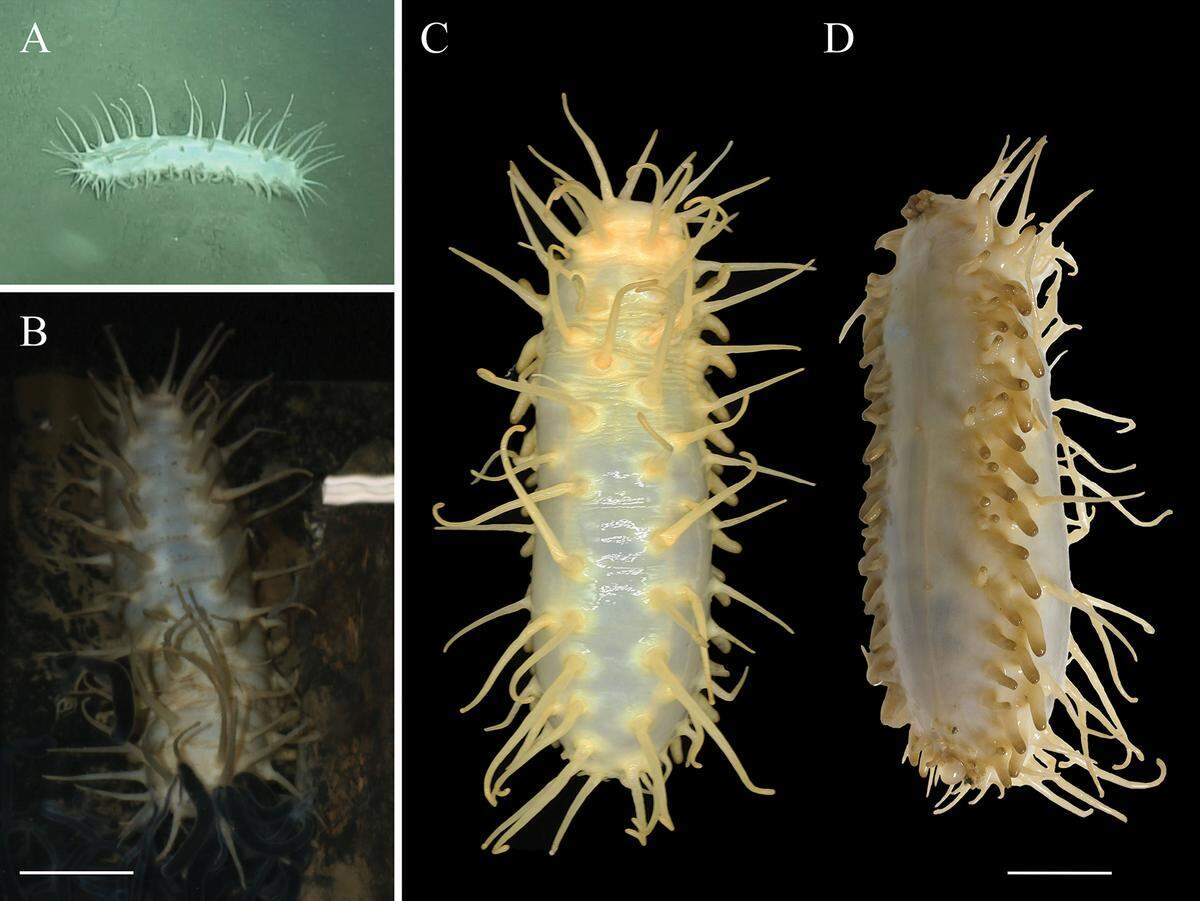
Several photos show the new species. The center of its body is white and slug-like with skinny yellow tentacles branching off. Seen from the side, it has several rows of shorter and stubbier feet with brown tips.
Researchers said they named the new species after the Institute of Deep-Sea Science and Engineering, or IDSSE, a Chinese research center, because of its contributions “to the field of deep-sea exploration.” Both of the study co-authors are affiliated with IDSSE.
So far, the new species of sea cucumber has only been found in the South China Sea between depths of about 9,800 feet and 12,500 feet, the study said.
The South China Sea is a contested body of water in southeastern Asia that borders Brunei, China, Indonesia, Malaysia, the Philippines, Taiwan and Vietnam.
The new species was identified by its tube feet, tentacles and other subtle physical features, the study said. DNA analysis found the new species had at least 8% genetic divergence from other Oneirophanta sea cucumbers.
The research team included Yunlu Xiao and Haibin Zhang. The team also discovered two more new species of sea cucumber: a reddish one and an orange one.
This story was originally published March 27, 2024 at 10:30 AM.