Venomous green creature with ‘forked’ genitalia discovered as new species in Myanmar

On a hot, humid night in 2008, scientists in central Myanmar found a vibrantly colored creature. The green, scaly animal was perched in a tree about 20 feet up.
Captured and then preserved in a museum collection, it turned out to be a new species.
A trio of scientists were studying pitvipers of southeast Asia when some museum specimens caught their attention, according to a study published Oct. 20 in the journal Zootaxa. The pitviper specimens were collected in Myanmar between 1998 and 2009.
Several earlier studies concluded that these Myanmar pitvipers had “significant genetic divergence” from other known species, researchers said, but no one had studied them in depth.
Intrigued, researchers took a closer look at these 25 preserved snakes and realized they’d discovered an overlooked new species: Trimeresurus uetzi, or Uetz’s pitviper.
Uetz’s pitvipers are “grass-green or deep green” snakes with a “long and thin” body, researchers said. They can reach about 2.7 feet in length. Female Uetz’s pitvipers have “green gold” eyes. Males have copper-colored eyes and “relatively short,” “deeply forked” genitalia, known as a hemipenis.
Photos show the vivid green snake perched on tree branches or coiled on the ground. Its body is largely a uniform lime green with hazy brown bands on its sides.
The photos were taken in 2022 and 2023, study co-author Tan Van Nguyen told McClatchy News.
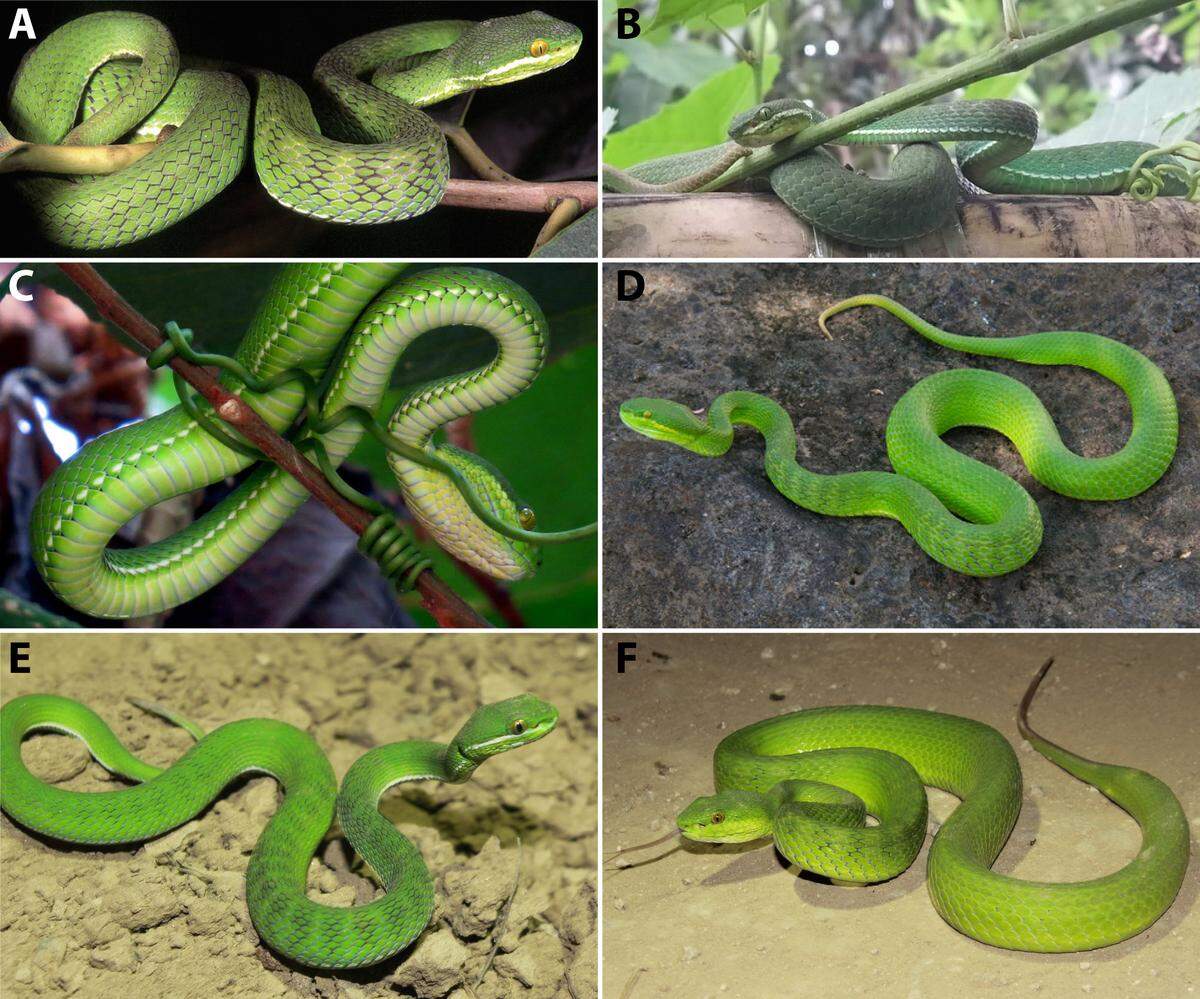
Although discovered from museum collections, Nguyen said Uetz’s pitvipers are “still very common” and live near residential areas. The new species is venomous, but no further research has been done on its venom, he said.
Uetz’s pitvipers have been collected during daytime and nighttime and found perched on trees, shrubs, branches and bushes as well as on the ground, the study said. They are often found in hot and humid environments.
Researchers named the new species after Peter Uetz, “the editor of the ‘Reptile Database’ website” and an “invaluable help to herpetologists.”
The new species has been found in six regions covering most of central, inland Myanmar, the study said.
Myanmar, formerly known as Burma, is a southeastern Asian country bordering Bangladesh and India to the west, China to the north, Laos and Thailand to the east and the Andaman Sea and Bay of Bengal to the south.
The new species was identified by its geographical region, eye color, coloring, scale pattern, genitalia and DNA, the study said.
The research team included Gernot Vogel, Tan Van Nguyen and Patrick David.