
World’s fastest creature snaps its jaws shut with the speed of a bullet train, study says
If you’ve ever stepped in a fire ant hill, you might have felt the stinging torment of those fearsome bites.
But at least fire ants don’t suck the blood of their own young, or chomp down with the force of a bullet train.
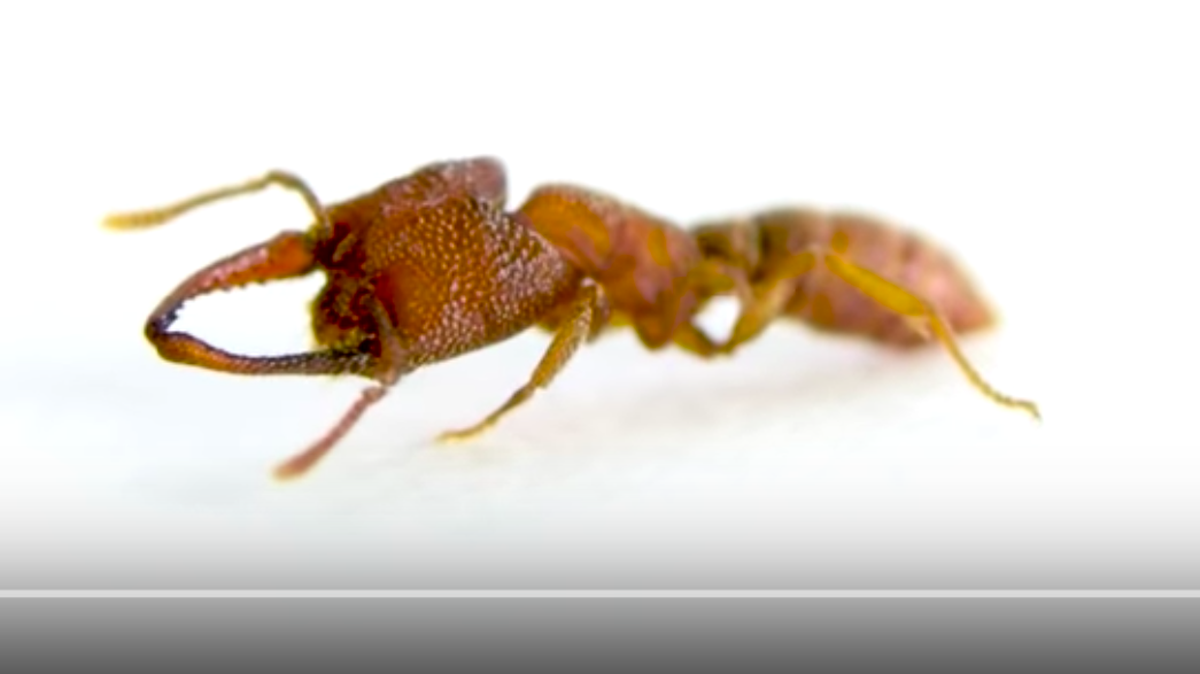
No, those traits belong to the “Dracula ant” — an ant species that makes its home in the tropics and in Africa and Australia, and which just snagged the title as fastest on the planet for its extremely-speedy jaws.
They do this by locking their jaws together like a spring and building up the tension until it suddenly releases with tremendous speed, according to a recent study published in Royal Society Open Science.
“Even among ants that power-amplify their jaws, the Dracula ants are unique,” said Adrian Smith, of the North Carolina Museum of Natural Sciences, who was a co-author of the study, according to the Guardian. “Instead of using three different parts for the spring, latch and lever arm, all three are combined in the mandible.”
That triple-threat allows the ant to chomp down at 200 miles per hour — about the speed of a bullet train, or more than triple the speed of a sprinting cheetah.
The scientists used a high-speed camera to zoom in on an ant’s lightning-fast jaws. The scientists slowed the footage down by thousands of frames to make a recording clear enough to show the jaws snapping closed in about 23 microseconds, according to the study.
“The ants use this motion to smack other arthropods, likely stunning them, smashing them against a tunnel wall or pushing them away. The prey is then transported back to the nest, where it is fed to the ants’ larvae,” said research leader Andrew Suarez in a news release.
“Our main findings are that snap-jaws are the fastest of the spring-loaded ant mouthparts, and the fastest currently known animal movement,” Fredrick J. Larabee, a postdoctoral researcher and co-leader of the study, also said in the release.
The ants “live in large colonies underground,” according to the Guardian. They get their name because the adult workers, who cannot process solid food, instead drink the blood of their young to survive, the paper reported.
“Hungry Dracula ants scratch and chew holes into their larvae and suck out the hemolymph, the ant equivalent of blood. This practice has been described as a form of ‘non-destructive cannibalism’, since the larvae are not killed by it. Nevertheless, when hungry workers enter the chamber, the larvae have been observed attempting to flee and escape their fate,” wildlife charity Arkive reported.
The team still isn’t sure how the ants use their super-jaws in real life, and it’s something they hope to explore in further studies, according to the news release.