Venezuela quake death toll nears 2,000 as anger over response grows
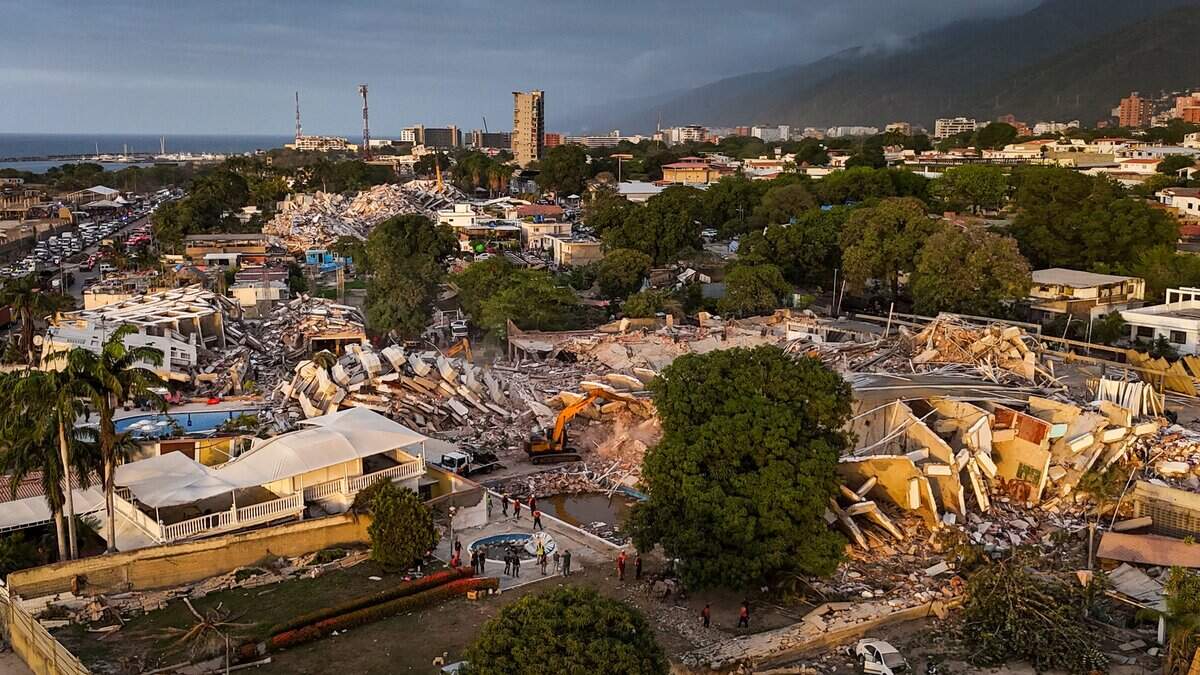
Venezuela’s earthquake disaster entered a critical sixth day Tuesday as the official death toll climbed to 1,943, rescue crews raced to find survivors beneath collapsing rubble, and frustration deepened across the country over what many residents describe as a slow and inadequate government response.
The twin 7.2 and 7.5 magnitude earthquakes that struck north-central Venezuela on June 24, just 39 seconds apart, have now left 10,571 people injured and 15,866 displaced, according to updated figures released by National Assembly President Jorge Rodríguez, who is overseeing the government’s public response to the catastrophe.
Rodríguez said 689 aftershocks have been recorded since the main quakes, though both their frequency and average magnitude appear to be declining — a cautiously positive sign, though not enough to rule out further dangerous seismic activity.
“We must remain relentless in the search for people who are alive,” Rodríguez said during a Tuesday press briefing. “We must keep hope alive that more survivors can still be found beneath the rubble.”
In a rare piece of encouraging news, officials said a two-year-old child was rescued early Tuesday from the ruins of a collapsed building in Los Corales, in the hard-hit coastal state of La Guaira, nearly 140 hours after the earthquakes.
The rescue followed another dramatic save on Monday involving a small child pulled alive from debris in La Guaira, fueling hope that more so-called miracle rescues remain possible despite rapidly shrinking survival odds.
Still, such rescues have become increasingly rare.
Search-and-rescue experts say the first 72 to 96 hours after a major earthquake are typically the most critical window for locating survivors under collapsed structures. After that, survival chances decline sharply due to dehydration, crush injuries, internal trauma and lack of oxygen.
The disaster has hit La Guaira hardest, particularly the coastal communities of Caraballeda and Catia La Mar, where residential towers, apartment blocks and commercial buildings crumbled into massive fields of debris.
Rodríguez said that of the 855 buildings officially reported as damaged nationwide, 189 suffered total collapse, and 158 of those were in La Guaira alone.
Using drone surveys, aerial analysis, census data and eyewitness testimony, authorities estimate that roughly 30,000 people were present in the worst-hit sectors of Caraballeda and Catia La Mar when the quakes struck.
Government estimates suggest 13,400 to 13,500 people escaped on their own or with help from relatives in the immediate aftermath, while 6,461 others were rescued by organized teams, bringing the number of known survivors from the main disaster zone to nearly 19,861.
But the number of people still unaccounted for remains highly uncertain.
Official family reports suggest as many as 68,900 people have been reported missing by relatives. International aid groups, including the International Rescue Committee and the United Nations, estimate roughly 50,000 people remain unaccounted for or trapped beneath collapsed infrastructure, while online missing-person registries have documented at least 43,251 individual cases.
The majority of those missing are concentrated in La Guaira, Caracas and Miranda, where rescuers continue racing against a narrowing window to find survivors.
The scale of destruction may also be far greater than official structural counts indicate.
A preliminary damage assessment released by NASA based on satellite radar imagery found that as many as 58,870 buildings may have been damaged or destroyed across the affected region — a figure dramatically higher than the government’s official count.
Researchers Corey Scher and Jamon Van Den Hoek of Oregon State University, working with satellite data from the European Space Agency’s Sentinel-1 system, stressed that the estimate remains preliminary and has not yet been verified on the ground.
Still, the assessment suggests devastation on a massive scale stretching from Caracas to Puerto Cabello, covering some of Venezuela’s most densely populated urban corridors.
The humanitarian response continues to expand.
According to Rodríguez, 51 international delegations have deployed 3,660 foreign rescuers, 148 canine units and 49 support vehicles to Venezuela. More than 26,000 Venezuelan security and emergency personnel are also deployed in disaster zones, supported by 15,467 registered volunteers.
Authorities said 69 shelters are now operating across La Guaira, Caracas, Miranda and other affected states, housing thousands displaced by the disaster.
The government also reported that 3.19 million liters of water have been distributed, while power service in La Guaira has been almost fully restored. Telecommunications remain partially disrupted, though officials said service is gradually returning.
Despite the expanding relief operation, public frustration continues to grow.
In communities such as El Junquito, a mountainous region west of Caracas that also suffered major damage, residents told the Reuters news agency that they had seen little direct government assistance and were relying heavily on neighbors, farmers and local volunteers for food and basic supplies.
“We are waiting for answers, for debris to be cleaned up, for inspections,” Keily Ibarra, a 33-year-old manicurist helping organize citizen complaints, told Reuters. She urged authorities to do “what needs to be done.”
The frustration reflects a broader pattern seen across several affected areas, where survivors increasingly describe citizen-led relief efforts as faster and more effective than the official response.
Analysts say that perception poses growing political risks for the interim government of Delcy Rodríguez, who took power in January after a U.S. operation captured former leader Nicolás Maduro.
The earthquake response is becoming the biggest test yet of her government’s legitimacy.
The political tension around the recovery effort escalated further after opposition leader María Corina Machado said Venezuelan authorities had blocked her attempt to re-enter the country from Panama, though she vowed to continue seeking a way back to assist victims.
Her claim adds a new political dimension to a disaster already straining public confidence in state institutions.
Experts say the catastrophe is exposing longstanding structural weaknesses in Venezuela, including poor building-code enforcement, decades of infrastructure neglect, and widespread institutional decay dating back to the administrations of Hugo Chávez and Maduro.
For now, most Venezuelans remain focused on survival — searching for relatives, medicine, food and shelter.
But as hope of finding survivors fades and the number of dead continues to climb, many fear the political aftershocks of the disaster may prove nearly as destabilizing as the earthquake itself.
This article was complemented with el Nuevo Herald’s wire services.