Machado returns to center stage as Venezuela opposition maps post-Maduro future
Venezuela’s main opposition coalition emerged from a high-profile summit in Panama with a renewed call for negotiations with the interim government of President Delcy Rodríguez, a demand for new presidential elections with international guarantees and a fresh show of unity around opposition leader María Corina Machado, who announced she intends to seek the presidency and return from exile before year’s end.
The gathering, which brought together leaders of the Democratic Unitary Platform, Machado’s Vente Venezuela movement, independent figures and prominent exiles, sought to reposition the opposition amid the uncertain political landscape that followed Nicolás Maduro’s capture by U.S. forces in January and the subsequent establishment of an interim government led by Rodríguez.
The summit concluded with what organizers called the “Panama Manifesto,” a political declaration proposing a negotiated transition backed by Washington and aimed at restoring democratic rule through new elections.
According to the document, Machado and opposition leader Edmundo González Urrutia are proposing a “serious, firm and responsible political negotiation” with Rodríguez’s government and with U.S. support to “restore democracy” in Venezuela.
The key goal, opposition leaders said, is the organization of a new presidential contest with broad guarantees.
“The central purpose of this negotiation is to achieve the holding of a free, transparent, and sovereign presidential election,” states the declaration, whch was circulated after the Panama meetings.
The proposal calls for a new National Electoral Council staffed by “independent and respectable personalities,” alongside a “viable and verifiable schedule” for the vote and full international observation.
Opposition leaders also demanded measures intended to build confidence before negotiations move forward, including the release of all political prisoners, guarantees for exiles wishing to return home and what they described as the dismantling of the country’s coercive structures.
Consolidating the opposition
The manifesto called for the “normalization of the civic and political space, including the dismantling of the repressive apparatus and of armed, illegal, or terrorist groups.”
The Panama meetings represented one of the most significant attempts in months to consolidate opposition forces after years of internal division and strategic disagreements.
Participants declared themselves in permanent consultation to align strategies and coordinate what they described as a peaceful and negotiated route toward a democratic restoration. The effort sought not only to unify parties but also to expand participation to civil society groups, labor organizations, churches, universities and Venezuelans living abroad.
The summit coincided with a wave of civilian and military prisoner releases in Caracas, developments that opposition figures privately described as an important source of leverage in shaping negotiations with the interim government.
Machado used the Panama stage to make her most politically consequential announcement since leaving Venezuela last year.
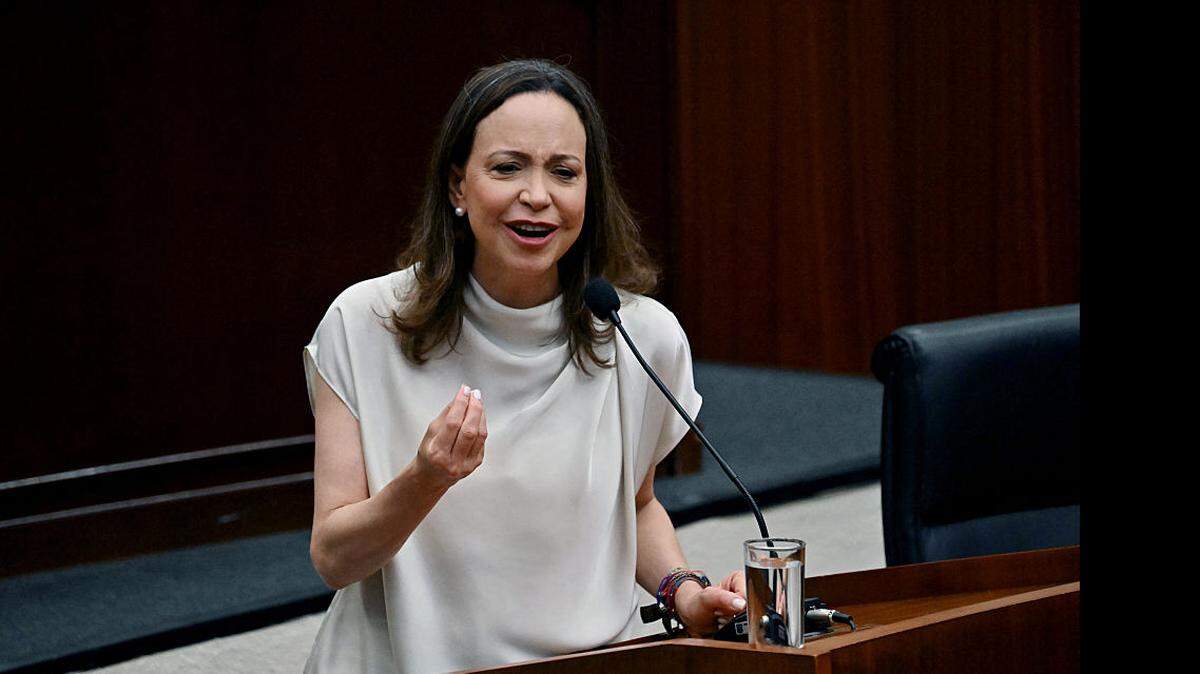
Speaking before thousands of Venezuelans gathered in Panama on May 23, the 2025 Nobel Peace Prize laureate confirmed she intends to run for president again and vowed to return to Venezuela before the end of the year to participate directly in the transition process.
“I will be a candidate,” Machado declared during the rally, while insisting that any future vote must be conducted under democratic conditions.
During a subsequent news conference, she said: “Rodríguez’s departure from power is not in doubt,” signaling confidence that the interim arrangement established after Maduro’s fall would eventually give way to a fully elected government.
Machado’s enduring influence
Machado’s emergence at the center of the Panama summit underscored both her enduring influence and the political transformation that has reshaped Venezuela since Maduro’s removal.
The opposition continues to maintain that González Urrutia won the disputed 2024 presidential election that Maduro later claimed he had won amid allegations of fraud and repression. Now, five months after Maduro’s capture, Machado argues that the country faces a narrow but historic opportunity to force democratic normalization through coordinated domestic and international pressure.
From exile, Machado framed the negotiations as necessary but conditional.
Manifesting what she called her “determination,” the opposition leader requested U.S. participation to “promote a serious, firm, and responsible political negotiation with the interim regime to restore democracy in Venezuela.”
The statement reflects a strategic shift by parts of the opposition toward combining negotiation with continued international pressure rather than relying exclusively on outside leverage or domestic protest.
At the same time, Panama served as an important diplomatic stage.
Machado and Democratic Unitary Platform delegates held meetings with Panamanian President José Raúl Mulino and Foreign Minister Javier Martínez-Acha at the presidential palace, where Panamanian officials reiterated support for democratic mediation efforts and presented the country as a neutral venue for dialogue.
Behind closed doors, discussions also focused on coordination with international allies, including the U.S. and European governments, particularly as Venezuela’s evolving political environment intersects with shifting energy and investment dynamics across the region.
The opposition’s declaration explicitly acknowledged Washington’s role in the post-Maduro transition.
The manifesto expressed support for the U.S.-backed three-phase framework of “stabilization, recovery, and transition,” arguing that the current moment offers the hemisphere an opportunity to build “a bloc of free, prosperous, and sovereign nations.
“The democratic transition demands unity and a vision for the nation,” the opposition coalition said. “This national unity is not a slogan: It is a commitment, a way of acting, a responsibility, and the most powerful tool in the service of freedom.”
Challenges remain
Yet even as the Panama summit projected cohesion, analysts and political observers noted that significant challenges remain.
Some opposition leaders privately expressed frustration over what they see as reluctance within the interim government to accelerate institutional change, while others voiced concern that Washington may be increasingly comfortable with the current transitional arrangement so long as it preserves stability and cooperation.
The question of electoral timing also remains unresolved.
While some participants argued that presidential elections could technically be organized within seven months, many favored a timetable extending into the second half of 2027 to avoid either a rushed process or prolonged uncertainty. The emphasis in Panama, however, centered less on exact dates than on forcing a credible electoral calendar into the public debate.
Public opinion data suggests Machado enters that debate from a position of unusual strength.
According to recent polling by the firm Meganálisis, Rodríguez continues to face deeply negative approval ratings, with many Venezuelans still associating the interim government with corruption, repression and economic collapse linked to the final years of Chavismo. The survey found Machado dominating national preference polls and maintaining her position as the country’s most popular political figure.
Had elections been held earlier this month, the poll found, Machado would have captured 76% of the vote compared with just 4% for Rodríguez.