Petro meets Delcy Rodríguez in Caracas to tackle border security issues
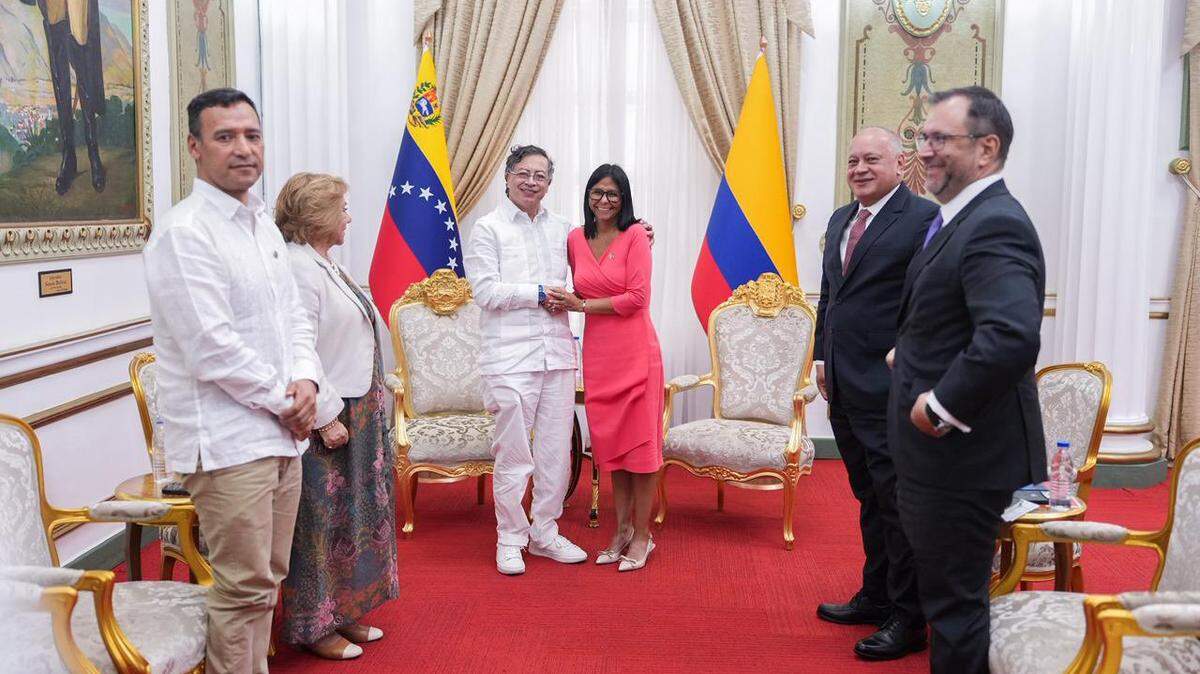
Colombian President Gustavo Petro met with Venezuela’s interim President Delcy Rodríguez in Caracas on Friday, marking his first visit since the U.S.-backed capture of former strongman Nicolás Maduro in January, as both governments seek to curb escalating border violence and deepen economic ties.
Petro was received at the Miraflores presidential palace after arriving earlier at Simón Bolívar International Airport. The visit comes amid Venezuela’s ongoing political transition and underscores Bogotá’s push to stabilize its volatile frontier with its eastern neighbor.
The two leaders held talks focused on security cooperation along their shared 1,379-mile border, a region long plagued by guerrilla activity, drug trafficking and smuggling networks.
In a statement, the Colombian government said the meeting was aimed to address “the main challenges along the shared border,” building on existing technical talks and binational mechanisms.
The discussions unfolded against a backdrop of renewed diplomatic engagement and rising concern over violence in the Catatumbo region, home to one of Colombia’s largest coca-growing areas and a stronghold of armed groups such as the National Liberation Army, which operate with relative impunity.
Speaking after the meeting, Rodríguez said both governments had agreed to a coordinated, far-reaching strategy to confront cross-border crime.
“If there is one thing I must say has been crucial about this meeting… it is that we have undertaken a very serious, very comprehensive approach to how we must combat criminal gangs and transnational criminal groups,” she said. “Both countries have committed to formulating military plans… as well as to the immediate establishment of mechanisms for information sharing and intelligence development.”
She added that the effort would also include parallel socioeconomic initiatives aimed at addressing the root causes of violence in border communities. “We have also agreed upon socioeconomic plans… through which both governments will address the needs of the most vulnerable populations,” Rodríguez said.
The meeting coincided with the latest session of the Colombia-Venezuela Commission on Neighborhood and Integration, a bilateral forum focused on security, trade and energy cooperation.
As part of that process, officials have established 11 working groups covering areas from defense and commerce to health, education and environmental protection, according to Venezuela’s Foreign Ministry.
Authorities have also outlined plans for bi-national special economic zones across key regions, including an industrial corridor linking Táchira, Norte de Santander and Zulia, an agro-industrial axis in Apure and Arauca, and a sustainability-focused zone in the Amazon basin.
Officials say the initiative aims to formalize cross-border trade, curb the influence of illegal armed groups and spur growth in historically neglected regions. Bilateral trade could exceed $2.5 billion by 2026, a sharp increase from recent years.
Energy cooperation is also high on the agenda, including potential reactivation of the Antonio Ricaute gas pipeline and closer coordination between Venezuela’s state oil company, PDVSA, and Colombia’s Ecopetrol.
Friday’s meeting highlights Petro’s evolving role as a regional player in Venezuela’s transition following the Jan. 3 operation in which U.S. forces captured Maduro, reshaping the country’s political landscape.
In the days that followed, Petro spoke with Rodríguez and proposed a three-party dialogue with the United States aimed at stabilizing Venezuela and preventing further violence, according to Colombian officials.
Rodríguez, who has cast herself as the face of a transitional government, has sought to balance cooperation with international partners while maintaining domestic stability in a country emerging from years of political and economic crisis.