
Before Maduro: The other time U.S. forces captured a Latin American country’s leader
President Donald Trump said early Saturday that U.S. forces had captured Venezuela’s de facto leader, Nicolás Maduro, and flown him and his wife, Cilia Flores, out of the country in a military operation that included attacks in several parts of the South American country.
The swift action tops a campaign that has included strikes on boats allegedly carrying drugs off the coast of Venezuela and what experts deem the largest military deployment in the Western Hemisphere in several decades.
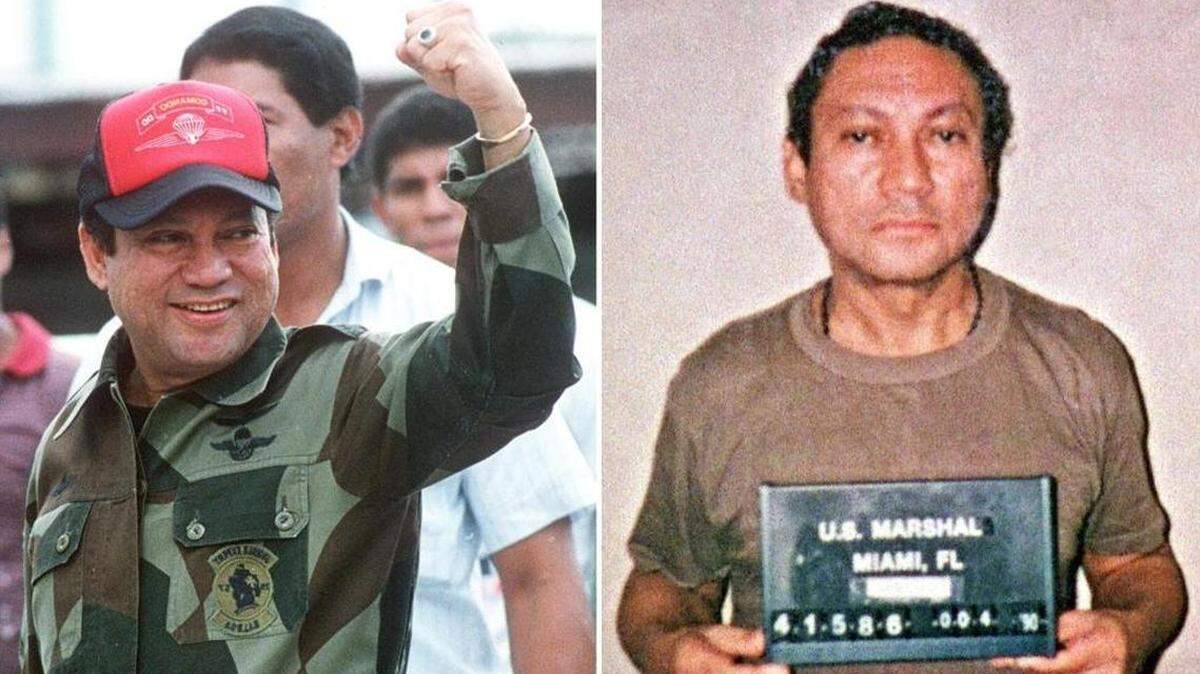
Maduro’s capture by U.S. forces shatters what has been a foreign policy of no military action in Latin America and the Caribbean for almost three decades. It also brings back memories of the capture of the military ruler of Panama, Gen. Manuel Antonio Noriega, the last time the U.S. used military force to depose the leader of a Latin American country in 1989, in what was called Operation Just Cause.
“This is a historic day in the Western Hemisphere, 36 years after the capture of Manuel Noriega, when the U.S showed we will not allow cartels to take over countries in our shared neighborhood,” said U.S. Rep. Rick Crawford, chair of the House Permanent Select Committee on Intelligence. “The arrest of Cartel De Los Soles leader Nicolas Maduro shows this clearly.”
Analysts of U.S. foreign policy towards Latin America said the move has sweeping implications for the region.
“Donald Trump’s capture of Nicolás Maduro is one of the most momentous decisions in the history of US-Latin America relations,” Brian Winter, the editor-in-chief of Americas Quarterly, wrote on X. “The operation confirms the return of Washington as policeman in its ‘sphere of influence,’ an idea that defined much of 19th and 20th centuries but had faded since end of Cold War. In some ways, it recalls not just Panama in 1989 but also Nicaragua or the Dominican Republic in the 1910s – invasions to topple leaders Washington saw as threat to national security.”
Just like Noriega’s arrest, whom the U.S. accused of partnering with Colombia’s Medellín cartel to flood U.S. streets with cocaine, Maduro’s capture was also presented as a law enforcement operation to arrest a drug lord.
Maduro had been indicted in the United States in 2020, under the first Trump administration, on charges of narco-terrorism and drug trafficking as the head of the Cartel de los Soles.
“The Cartel de Los Soles sought to not only enrich its members and enhance their power, but also to ‘flood’ the United States with cocaine and inflict the drug’s harmful and addictive effects on users in the United States,” the Justice Department said at the time.
As far back as July, Secretary of State Marco Rubio had insisted Maduro was not the legitimate president of Venezuela but the head of the Cartel de Los Soles, “a narco-terror organization which has taken possession of a country. And he is under indictment for pushing drugs into the United States.”
Both strongmen stood accused of grave human rights violations and electoral fraud. Noriega annulled the Panamanian general election in May 1989 and cracked down on opposition members. Maduro was sworn in for his third term in January following an election widely believed to have been won by the opposition candidate Edmundo García.
Maduro will face U.S. justice soon, Attorney General Pam Bondi said. Noriega faced the justice system 35 years ago. Shortly after he surrendered on Jan. 3, 1990, after hiding at the Vatican embassy, he was whisked to a federal courthouse in downtown Miami, where he was arraigned a day later. He was later convicted and sentenced to 40 years in prison.
But that’s where the similarities end.
Hours after the U.S. invasion of Panama began, Guillermo Endara, who was the rightful winner of the annulled election, was sworn in as president at a U.S. military base in Panama, marking one of the best known examples of the successful restoration of democracy after U.S. military action.
The outcome in Venezuela is less certain.
Unlike the invasion of Panama, Maduro’s capture did not involve putting U.S. troops on the ground. U.S. Sen. Mike Lee said SAturday that Rubio tod him he anticipated “no further action in Venezuela now that Maduro is in U.S. custody,” raising crurcial questions about the country’s future.
Hours after the U.S. hit Caracas and other cities with aerial strikes, it was clear that other leaders of the former Maduro regime, including Interior Minister Diosdado Cabello and Defense Minister Vladimir Padrino, remain in the country and spoke publicly to demonstrate they were in control of the situation.
Both Cabello and Padrino were indicted in the U.S. along with Maduro for drug trafficking.
This story was originally published January 3, 2026 at 10:11 AM.