
The U.S. says that Venezuelan opposition defeated Maduro in presidential election
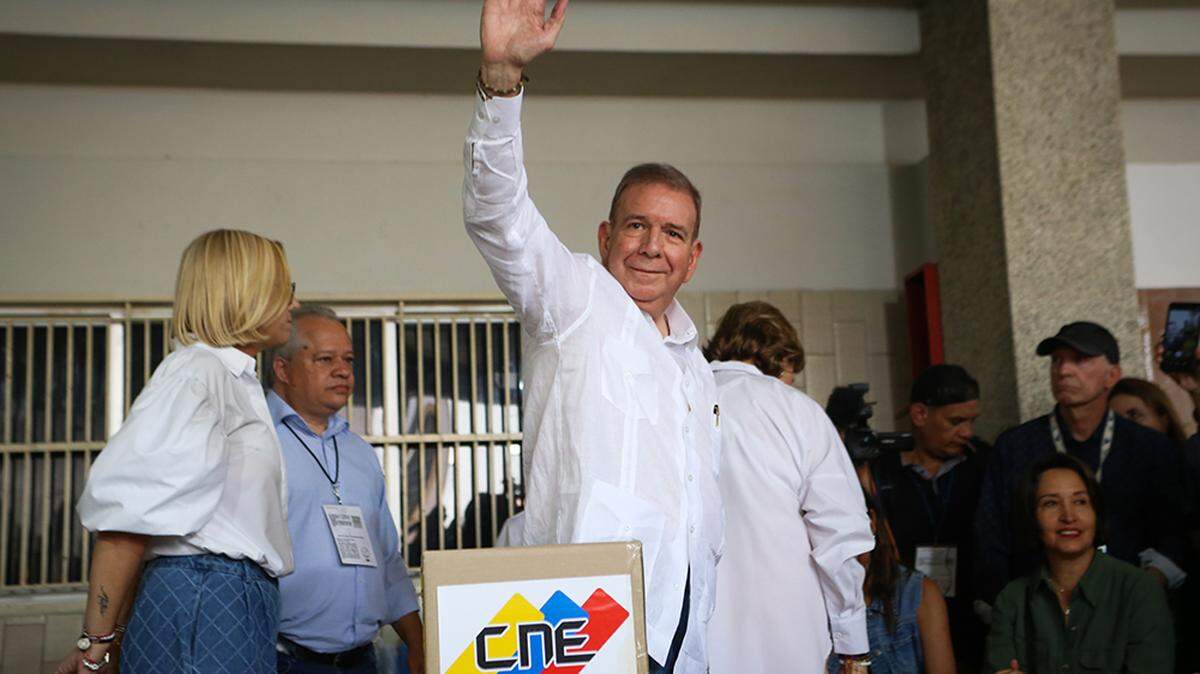
The top U.S diplomat for Latin America said opposition candidate Edmundo González won Venezuela’s presidential elections and beat strongman Nicolas Maduro by millions of votes, signaling that the Biden administration could be getting ready to officially recognize González as the country’s president-elect.
“Given the overwhelming evidence obtained by documented proof of millions of votes cast, Maduro and his representatives should recognize Edmundo González as the winner of the July 28 presidential election,” Brian Nichols, the assistant secretary of state for the Western Hemisphere, said during an emergency meeting of the Organization of the Americas States on Wednesday to discuss the results of the Venezuelan election.
“Given the clear evidence, the world’s governments should also acknowledge Edmundo González’s overwhelming electoral victory,” he said. “Those that fail to do so are only enabling Maduro and his representatives to attempt a massive fraud and disregard for the rule of law and democratic principles.”
The State Department and the White House did not answer questions about what the Biden administration would do next regarding the situation in Venezuela.
In a controversial decision, the Venezuelan electoral council, under Maduro’s control, declared him the winner in the Sunday presidential elections with 51.2% of the votes despite credible polling indicating that the opposition candidate Gonzalez had won by an ample margin. The opposition quickly came out to claim fraud.
The country has been in turmoil ever since, with Maduro’s forces cracking down on protesters and arresting members of the opposition. The clashes have resulted in at least 12 people dead and hundreds arrested.
So far, the Biden administration had been withholding judgment of the results, urging the Venezuelan electoral council to publish a detailed vote tabulation.
On Wednesday, Maduro said the electoral council was unable to present the information because the system had been hacked. He then asked the country’s rubber-stamp Supreme Court to audit the results in a maneuver that experts say is against Venezuelan laws and aims to bypass the request to show the voting records.
But in a swift effort, the opposition published a database online with scanned images of printouts — or actas, in Spanish — verifying 80% of the vote. The opposition was able to do so because in Venezuela, each voting machine prints a paper tally of the votes in addition to the digital results sent to the electoral authorities, and the opposition mobilized supporters around the country to volunteer as election monitors to obtain the paper copies.
According to this data, Gonzalez won 67% of the votes and Maduro 30%.
In the OAS meeting, Nichols called that paper trail presented by the opposition as indisputable evidence that Maduro had, in fact, lost the election.
“With the irrefutable evidence based on the actas everyone can see, it is clear that Edmundo González Urrutia defeated Nicolas Maduro by millions of votes,” said Nichols. Even if Maduro had won in all the remaining precincts that have not published their data, he could not surpass González’s vote total, he noted.
Nichols also referred to a damning report by the Carter Center, one of the few credible international organizations invited by the Maduro government to monitor the election, that concluded the process “did not meet international standards of electoral integrity and cannot be considered democratic.”
No regional agreement
However, the OAS meeting failed to pass a resolution calling on the Venezuelan government to release the detailed tabulation of the votes because several countries, including Brazil, Colombia, Mexico and a group of Caribbean nations, either abstained or were absent.
The failure showcases deep divisions and the waning of U.S. influence in a region where democracy has been backsliding in recent years.
For years, several Caribbean countries benefiting from oil sent by Maduro through the Petrocaribe initiative have been a reliable voting block that has opposed efforts to exert pressure on Venezuela in the OAS.
Experts with the Atlantic Council, a think tank based in Washington, told reporters Thursday they believe Brazil and Colombia’s abstention might indicate their governments are signaling to Maduro that they are credible mediators in back-channel efforts to offer him “off ramps” that would lead to a peaceful transition of power in Venezuela.
But others doubt that Brazil and Colombia, led by leftist leaders with historical ties to chavismo, the political movement led by the late Venezuelan leader Hugo Chavez, would help the United States convince Maduro to accept the results and leave.
Brazil’s abstention vote came after President Joe Biden called Brazilian President Luis Inácio Lula da Silva on Tuesday. According to a statement released by the White House, they “shared the perspective that the Venezuelan election outcome represents a critical moment for democracy in the hemisphere, and they pledged to remain in close coordination on the issue.”
This story was originally published August 1, 2024 at 2:29 PM.