Venezuelan opposition to hold primary vote on Sunday amid growing hopes for change
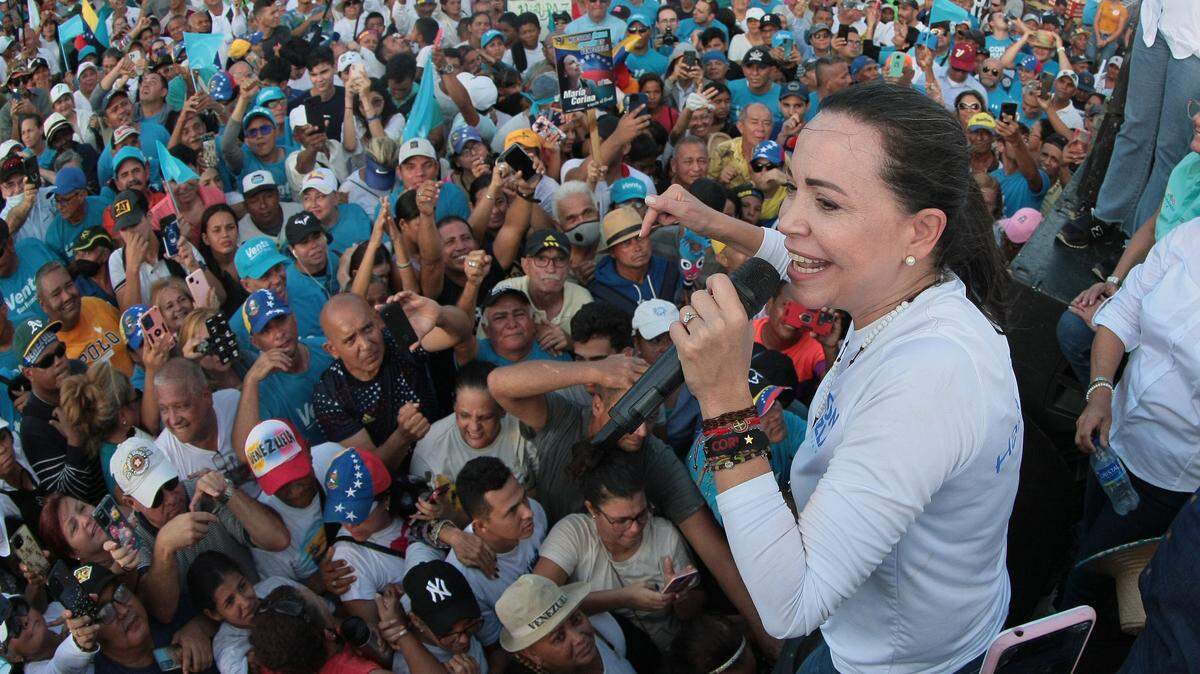
The Venezuelan opposition is holding its primary election on Sunday to choose a candidate who would face strongman Nicolas Maduro in an election expected to be held next year under more fair and transparent conditions, following a groundbreaking U.S.-brokered deal signed this week.
The primary vote is likely to be easily won by Vente Venezuela party chief María Corina Machado, even though the Caracas socialist regime has yet to lift an administrative ruling banning her from competing for public office.
This point was a major source of contention during negotiations held in Barbados on Tuesday between opposition and regime representatives and almost disrupted the signing of the documents, opposition sources told the Miami Herald. In the end, the parties reached a verbal understanding in which the regime would allow Machado to run in the presidential election without committing to it in writing in the final documents.
The next day, while announcing that Washington was partially lifting its sanctions on the regime as a reward for signing the accords, U.S. officials said they understood that Maduro’s commitments include allowing Machado to run and that failure to do so would lead to the reinstatement of the sanctions.
The accords also include the release of the country’s political prisoners and of at least three Americans prisoners the United States deem are being held unjustly in the South American nation.
By Thursday morning, Maduro had released six of the estimated 300 Venezuelan political prisoners but failed to release more, despite expectations to the contrary, by Friday afternoon.
More than 20.7 million Venezuelans registered to vote can participate in the open primaries, assembled by the opposition without the participation of the distrusted National Electoral National Council, which is fully controlled by the regime.
Organizers made efforts to organize voting sites outside Venezuela to include as many of the estimated 3.5 million voters who have left the country. Because of lack resources they were able to establish centers in just 77 cities in 28 countries, which were only able to register 396,818 voters.
In Miami, Venezuelans can vote at the Miami Dade West Campus in Doral, where 35,119 Venezuelans are registered.
According to the latest polls, Machado should easily come ahead in the vote, given that the 45% margin in her favor dwarfs the single-digit numbers of her rivals. A poll released this week by the firm Meganalisis has her also beating Maduro in a presidential election, by a margin of 54% to 11%.
“María Corina Machado has connected with the majority of Venezuelans who are fed up with socialism, and the omnipresence of the Venezuelan government in their daily life, which they hold responsible for a systemic social crisis and the collapse of the economy, of public service and fundamental rights, in the country,” Meganalisis president Rubén Chirinos said in the report.
Machado has been the opposition candidate most energetically arguing that Venezuelans can’t hope to conduct free and fair elections in the country as long as Maduro is in power, pointing out that the regime has a long history of committing fraud.
During her campaign to obtain the opposition’s nomination, Machado has said she doesn’t believe the Maduro-controlled electoral council woul admit the regime’s defeat in an election. But she said that if she wins the primary vote, she would work with the international allies of the democratic forces in Venezuela to force Maduro into accepting the will of the people.
“I have not changed one iota of my beliefs,” she told el Nuevo Herald in a recent interview, while stressing that there won’t be an electoral solution to the Venezuelan crisis unless Maduro is forced to accept one.
The accords signed in Barbados, if adequately enforced, provide some hope that conditions might be created in Venezuela to lessen Maduro’s control over the electoral system.
It contains a series of commitments from the regime to implement a number of electoral reforms, including the audit of the voters’ registry, long suspected to include hundreds of thousands of deceased and non-existent voters.
It also invites a number of international observers to observe the elections, including the European Union, the United Nations and the Carter Center.
The revision would also seek to include voters now residing outside the country, the great majority of whom oppose the regime.
This story was originally published October 21, 2023 at 5:30 AM.