
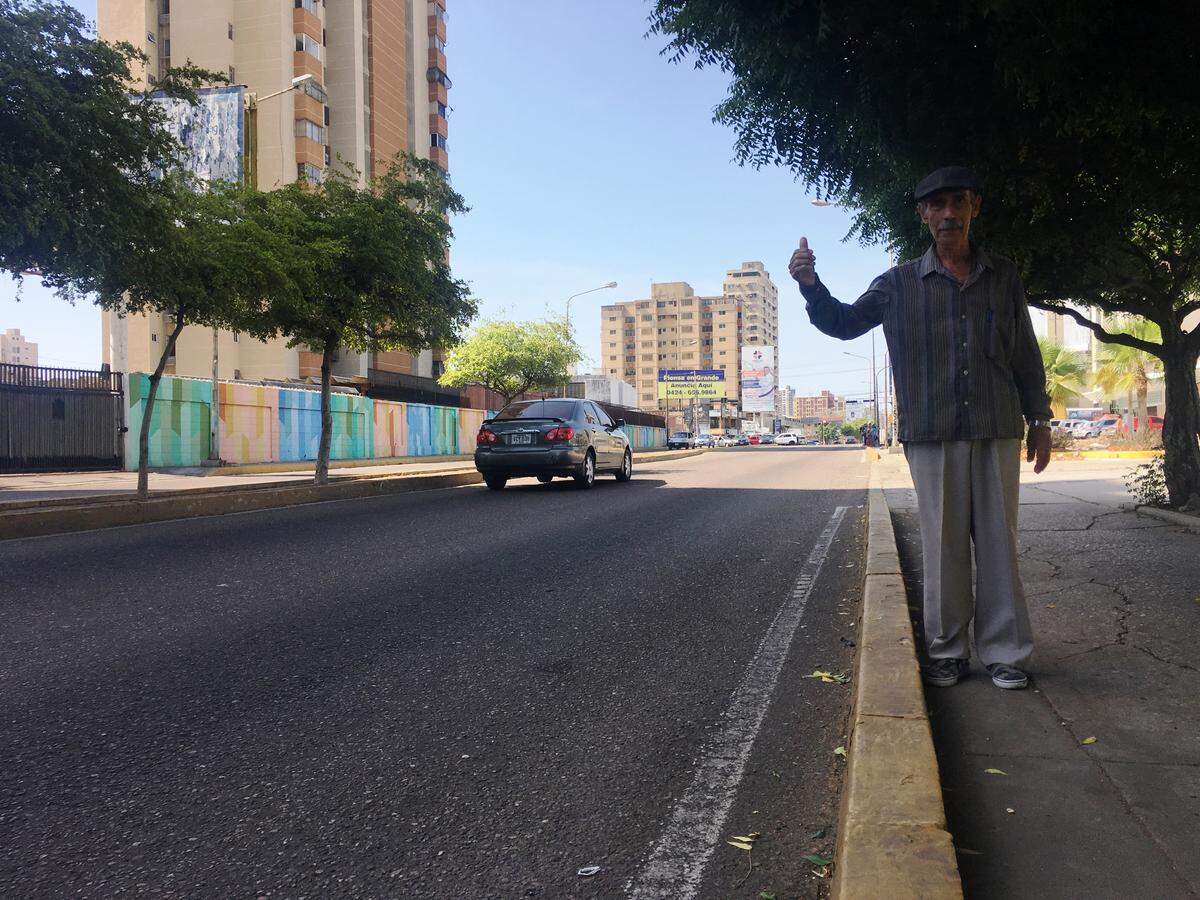
In one of the most dangerous countries in the world, hitchhiking is a matter of faith
Ana Chacín, a 69-year Venezuelan doctor, is sweating profusely after walking about 100 yards to the bus stop at Delicias Avenue in Maracaibo, the second-largest city in the country.
Her knees hurt badly. The temperature is 95 degrees around midday. So she was thankful when a driver she’s never met gave her a lift to get her just a little closer to home.
Chacín asks for a ride from total strangers almost every day, to and from wherever she needs to go, to avoid long walks.
Seated on a metallic bench waiting for the next bus to stop, she admits that her distress over hitchhiking in Venezuela, one of the most dangerous countries in the world, is long gone.
“Oh my! I lost the fear to ask for a ride a few years ago,” she says, breathing heavily after her recent walk. “I could be here waiting for a public bus or car for hours and hours and they won’t show up.”
Like Chacín, more and more Venezuelans of all ages are willing to risk whatever is in their pockets — and even their lives — just to get to their destinations on time or, at the very least, as close to their homes, jobs, schools or shops as they can.
The doctor, holding her white medical robe tightly in her right arm, says that hitchhiking is ultimately a matter of trust for both driver and passenger.
“I don’t look like a thief, so I can still get a lift,” she says in jest, before boarding her bus with the help of a young man.
Risky but necessary
Hitchhiking in Venezuela is a dangerous practice. The country has the highest homicide rate in South America, according to a recent report by the United Nations Office on Drugs and Crime.
Venezuela has experienced a dramatic increase in murders, rising to 56.8 deaths per 100,000 people in 2017 from 13 per 100,000 people in 1991, according to the U.N. By comparison, the rate in the United States is 5.3 per 100,000 people.
Non-governmental organizations say the danger in Venezuela is actually greater. Venezuela’s National Observatory for Violence, OVV, that tracks crime, says the rate of violent deaths is actually 81.4 per every 100,000 people.
El Orden Mundial, a Spanish think tank that analyzes global issues, reported that five Venezuelan cities were among the 10 most dangerous in the world, with Caracas at the top of the list.
So hitchhiking in Venezuela is both bold and risky.
Jesús Acosta, a 60-year-old mechanic, got robbed three years ago when he was on public transit. Since then, he prefers to walk for hours to get to wherever he needs to be.
“I don’t hitchhike,” he said. “You don’t know who is going to take you.”
Ana Montiel, a 58-year-old former bank worker, recently witnessed two criminals violently stealing a cellphone from a passenger on a bus when she went out to do some grocery shopping.
Even so, she still asks for an occasional free ride from strangers.
“It’s very scary, yeah, but what can you do? Tiredness hits you. I’d hitchhike anytime now,” she says while waiting at another bus stop in Maracaibo.
A matter of money and trust
The lack of public transportation in Venezuela pushes people to take a leap of faith hitchhiking.
At least 80 percent of the vehicles in the Venezuelan public transportation system — mostly buses and cars run by drivers paid by the government — are currently out of service because municipalities can’t afford repair parts, according to the United Platform for Venezuelan Transportation, one of the main unions for drivers of public transportation.
The lack of gasoline in stations, especially in states outside Caracas, like Zulia or Táchira, makes the situation worse.
José Sarayo, general coordinator of the driver’s union, estimated that no more than 2,000 public transport buses and cars are in service in a country of about 30 million people.
That’s why people like Leonardo Pérez, a Venezuelan lawyer in his early 40s, give an occasional free trip to whoever is in need and in despair on the streets.
“The situation of public transport is bad and the weather is absurd these days,” he says.
Many Venezuelans can’t afford a public transport ticket — about 1,500 bolivars, or 15 cents. Others simply don’t have enough cash to pay for it. Cash withdrawals in Venezuela are restricted to 6,000 bolivars per day, or about 60 cents, good for two or three trips.
Heberto Caña, 80, a retired member of the Venezuelan National Guard, says his wife scolds him for his constant hitchhiking on the streets of Maracaibo. He says that his monthly pension of about 40,000 bolívars – less than $4 — is not enough to move around the city, eat and pay utilities.
“I do it because the need is so great. Everything is so pricey now,” he complains, while he tries to get the attention of a driver near Cecilio Acosta Street in hopes of getting a free ride to his home 25 blocks away.
.JPG "Arcelia Vilchez, Venezuelan hitchhiker (2).JPG")
Arcelia Vílchez, 60, who lives on a government pension, leaves her house with little cash every day, but a lot of faith. She always prays for a free ride.
“I would say to God, ‘Lord, bring me an angel,’ so I can get a lift to where I’m going,” she says, sitting near a bus stop where she frequently hitchhikes.
She is not afraid for her safety but, just in case, she has developed an amateur way of profiling drivers to determine if it is safe or not to hitch a ride: The vehicles must not have tinted windows so she can check out the driver, no men driving alone, and older drivers, especially with kids, get preference.
“To hitchhike in Venezuela,” she said, “is a matter of faith.”
This story was originally published July 24, 2019 at 6:00 AM.