
Continuing blackouts in Venezuela are having adverse effects on the nation’s children
Five-year-old Alessandra has only been to school one week over the past month because of the continuous blackouts that are occurring in her state of Zulia, the most populous of Venezuela.
Her mother Luzmer Pichardo wouldn’t let her go to school when it opened its doors for daily three-hour lessons.
“It’s a risk, I believe,” she said. “It has been terrible for my baby girl.”
Just two weeks ago as Alessandra was sitting in darkness outside her house trying to get fresh air on the third straight night without electricity, she felt a tickling sensation crawling up her leg. Then came a sting and, soon after, an instantaneous and extreme burning.
Pichardo, a professional nurse in her late thirties, ran toward her screaming daughter to discover that a poisonous small centipede was coming out of her pajama pants. She rushed to clean the wound in panic. She also gave the child an analgesic and took her to a nearby private clinic whose emergency room was pitch-black due to the power outage.
Alessandra was lucky that she did not succumb to fever after the insect bite. But fear of insect bites, crime and other worries continues a month after the blackouts began. Her family, neighbors and most residents of the city are still spending the night on mattresses outside their homes because the heat indoors is unbearable.
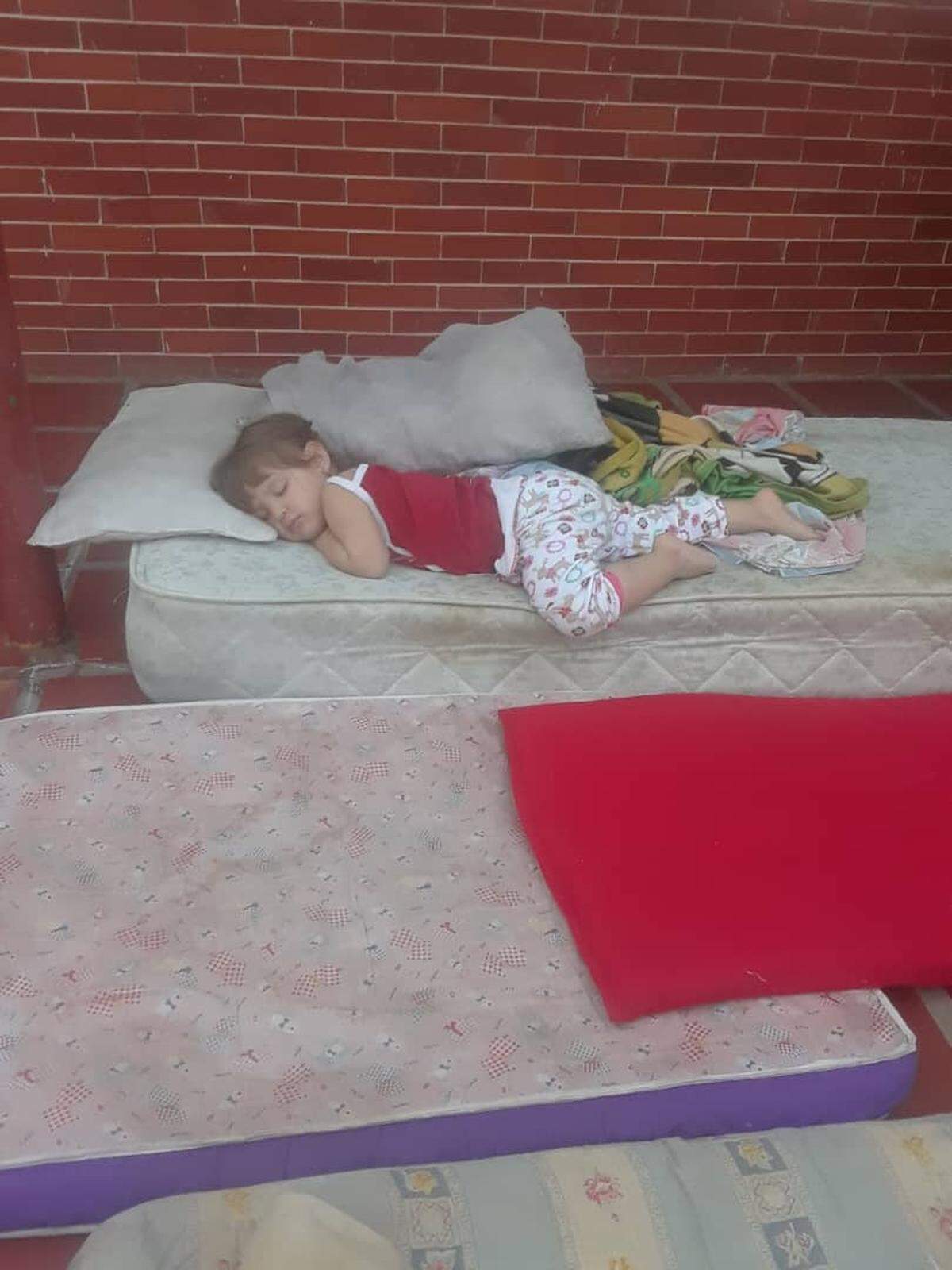
“These blackouts have been total chaos for my daughter,” Luzmer said. “She doesn’t like to drink warm water. The fridge didn’t work for days and lots of our food got rotten. Our neighbors and we are taking turns to watch the block from criminals on bikes who are constantly passing by to try to rob us.”
Such nightly dangers and discomforts are becoming routine for Venezuelans during the rolling blackouts that leave most of the states without electricity. Tens of thousands of Venezuelan youth have been living in poor life conditions with little — or no — education, inadequate hygiene, lack of water, insufficient food and deficient personal security, all exacerbated by daily blackouts.
Most of them are feeling overwhelmed from the experience, said Abel Saraiba, a psychologist and psychoanalyst.
“They’re feeling angry, afraid, frustrated, anxious and short-tempered,” said Saraiba, who coordinates programs against violence at Community Learning Center (Cecodap in Spanish), a nongovernmental agency that promotes children’s rights in Venezuela.
Regions like Zulia, on the western side of the country, have been under energy rationing for 18 to 20 hours per day since power outages began in early March. Venezuela is going through its deepest electrical crisis. On March 7, a large power outage — the first of five just in the past five weeks — left 23 of 24 states in the dark for days.
In Caracas, the capital and center of political power, electricity is functioning on a more consistent basis since the Nicolás Maduro regime instituted the rolling blackouts.
Saraiba said that children are extremely vulnerable under the added strain of conflict and darkness in a country already experiencing shortages of food, medicine, water and other basic necessities.
“They can’t adequately channel their own emotions since they’re being confined to their houses with no power and with lootings and clashes on the streets,” he said.
Extreme environments
Fears and anxiety are triggering physical responses during such long periods of stress, Saraiba said. The little ones, especially, are so vulnerable that many are suffering what psychologists call “regressions.”
“They start to suck their thumbs again or begin to wet their beds again,” he said. “They used to sleep alone but now, since the power outages began, they want to sleep with their parents.” Little kids burst into tears with irregular frequency, too.
Blackouts are also provoking exhaustion and fatigue.
Luis Ignacio, a 12-year-old who has lost several school days and soccer practices, is tired of carrying bucket after bucket of water from a well in the backyard of his house in Maracaibo just to take a bath, brush his teeth or clean his restroom. The hydro-pneumatic pump is not working most of the day. And he is suffering from back aches.
“We have to throw a bucket too many times inside the well to get sufficient water,” Luis Ignacio said one night at his home during a 15-hour power cut. “It’s very exhausting. My back hurts.”
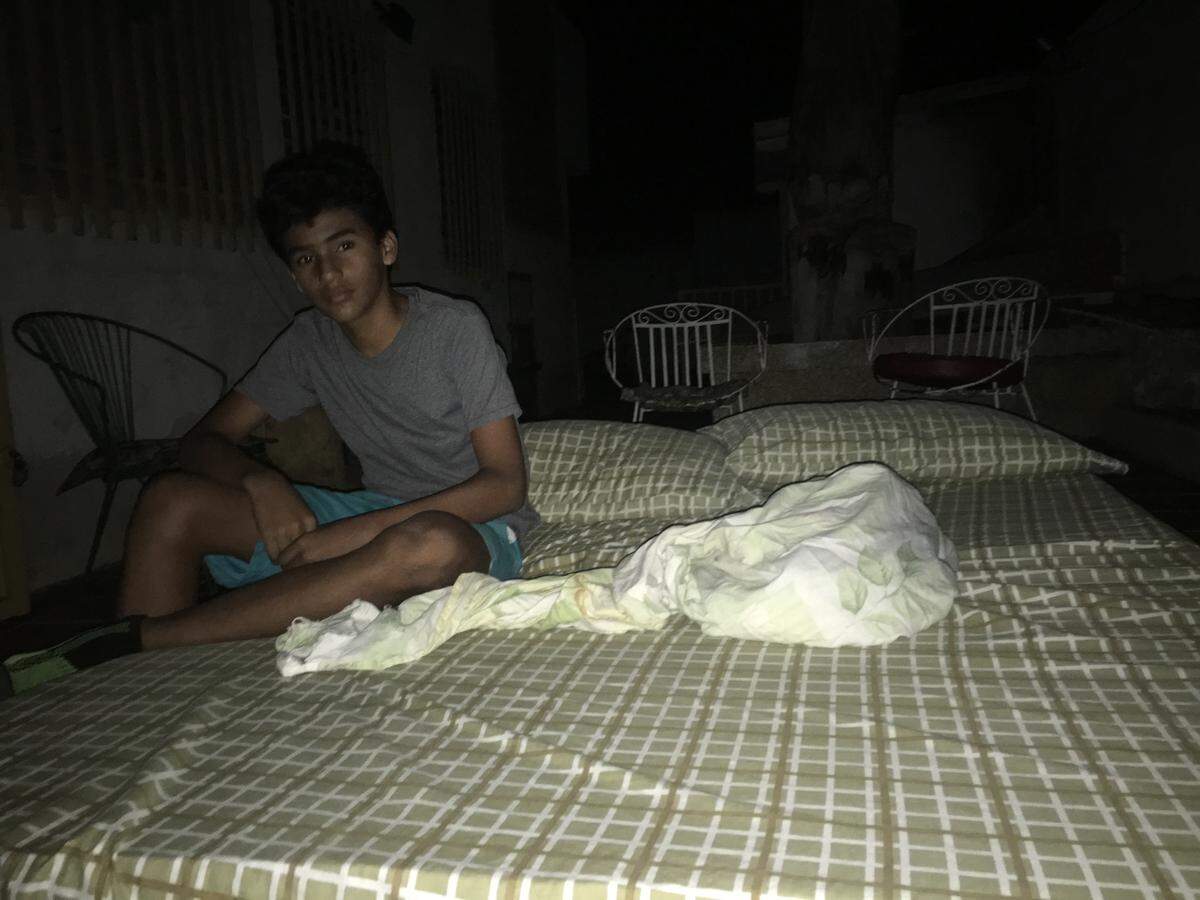
The teenager was sitting in the dark in his backyard, just a few feet away from a queen-size mattress he shares at night with his father Alejandro Fernández and and sister Camila. The bed-sharing is uncomfortable. And the heat and incessant mosquito bites make the nights even more difficult.
Children like Luis Ignacio are challenged by what psychologists refer to as “extreme environments” in cities like Maracaibo, where the temperature can hit records of 95 to 100 degrees Fahrenheit accompanied by 70 to 80 percent humidity.
Loud sounds from metal pans — cacerolas in Spanish — being banged could be heard in the distance while the boy talked. It is a constant act of protest used by Venezuelans to illustrate their discontent with the extended power cuts.
“Everybody is getting hit hard by this situation,” Luis Ignacio said. “Nobody can sleep or rest.”
Paula, a 4-year-old girl from northern Maracaibo, thought she was on on a short break from school during the first days of the national power outage. She watched movies in the playground of the private village where she lives — thanks to a power generator of a neighbor — and sometimes swam in a pool installed by one parent for the whole community.
But the fun stopped soon after those cheery days. She and her 2-year-old sister, Emma, began to suffer from throat inflammation because of the effect of the severe breeze on their frequent sweating in moist and hot nights.
Mosquitos also led Paula, who is allergic, to damage her skin after scratching so much in late and dark hours. “It’s so hard for me to see them like this,” said her mother, Denyse Carrero with a faltering voice, showing pictures of her older daughter’s lacerated skin.
Meurys Rivero, a psychologist from Central University of Venezuela (UCV in Spanish) with 12 years of experience, warns adults about how misleading their kids’ capacity to adapt to special circumstances can be.
“Yes, they’re flexible to adapt to any situation, but that doesn’t mean that they find blackouts fun or that they like them,” she said. “We can play with them, review past homework or read with them in the darkness, for example, and we’re not evading the reality. It’s a way to let the kids drain their anxiety.”
Isabella, an 8-year-old who lives with her younger brother Gabriel, both of her parents and her grandmother in a house close to an electric substation, has spent most of the days since March without electricity. They had no energy at all for 112 straight hours in the last power outage.
On a recent day, the girl smiled as she talked about how she paints colorful clothing designs during power cuts. That day, her family was using an extension cord borrowed from a neighbor’s generator to charge cellphone batteries and turn on a fan and one television set.
Multiple tiny red dots could be seen in her eyebrows, nose, cheeks, forehead and arms when the sunlight reflected on her. Those were marks of mosquito bites from recent nights, said Vanessa de Chávez, her mother.
“Every time the electricity goes off at home, Isa asks me repetitively and nervously if it is a general power outage,” she said. Her family would get power in a matter of hours if it is just a rolling blackout. If it is a nationwide one, though, it can be days until the energy comes back.
After the fourth day of the first national blackout, Isabella heard her family talk about how they could see looters with supermarket carts filled with food and articles that they just robbed passing by on the streets near their house. She could also hear gunshots and screams.
She also learned that the principal of her school called for classes after one week and a half without them due to power cuts. “I love my principal. She is calling us for classes with or without power,” Isabella said with a huge smile.
Her distraction during blackout nights is to draw her sketches, play with a blond doll named Valentina — whose hair she cut short herself — or to hug a teddy bear she calls Nubecita, or Little Cloud in English.
On a recent night without electricity, she played a game with her mother called The Hanged Man — El Ahorcado in Spanish — which consists of guessing the letters and words that your opponent has written down before you commit too many mistakes and get yourself hanged or eliminated.
Vanessa was deeply concerned in one particular turn from Isabella. She had written down a three-word phrase with the last name of Venezuela’s president, the one that has been labeled illegitimate by the United States and some 50 other nations.
“I feared that she had written a curse or an obscenity,” she recalled. The three words Isabella wrote on that pitch-black night: “I hate Maduro.”
“I hate him!,” the girl said with a wrinkled face, firmly hugging the pink folder where she keeps her illustrations for the dark nights.
This story was originally published April 9, 2019 at 4:34 PM.