
Maduro losing support in former stronghold: neighborhoods for the nation’s poorest
During the recent blackout here, the longest in Venezuela’s history, when the entire country was plunged into darkness, Marilú Ramírez Sánchez, 61, thought American missiles were about to rain down on her.
A devoted supporter of leader Nicolás Maduro, she walked around her native Caracas shantytown, Las Brisas, trying to keep her neighbors informed about a possible U.S. attack against the embattled regime. Ramírez was also trying to help people feel calm in the face of eminent danger.
Her lifelong friend, Thibisay Rodríguez, 56, didn’t need Ramírez to calm her nerves. She was certain the power outage wasn’t part of a foreign plot but due to two simple reasons: government incompetence and corruption.
Ramírez and Rodríguez, who have known each other since childhood, say their friendship is built on countless moments they have shared throughout their lives. But these days, domestic politics sometimes drives a wedge between them.
On a recent afternoon, as the two chatted in Ramírez’s rundown apartment on a hill overlooking the city of Caracas about 200 feet below, there was harmony and the sense of warm nostalgia when they reminisced about past events. Both were born in Las Brisas, both gave birth to their children here, and both plan to retire in the neighborhood.
But when the chatter turned to the issue of paramilitary groups, or colectivos, it quickly became a source of contention.
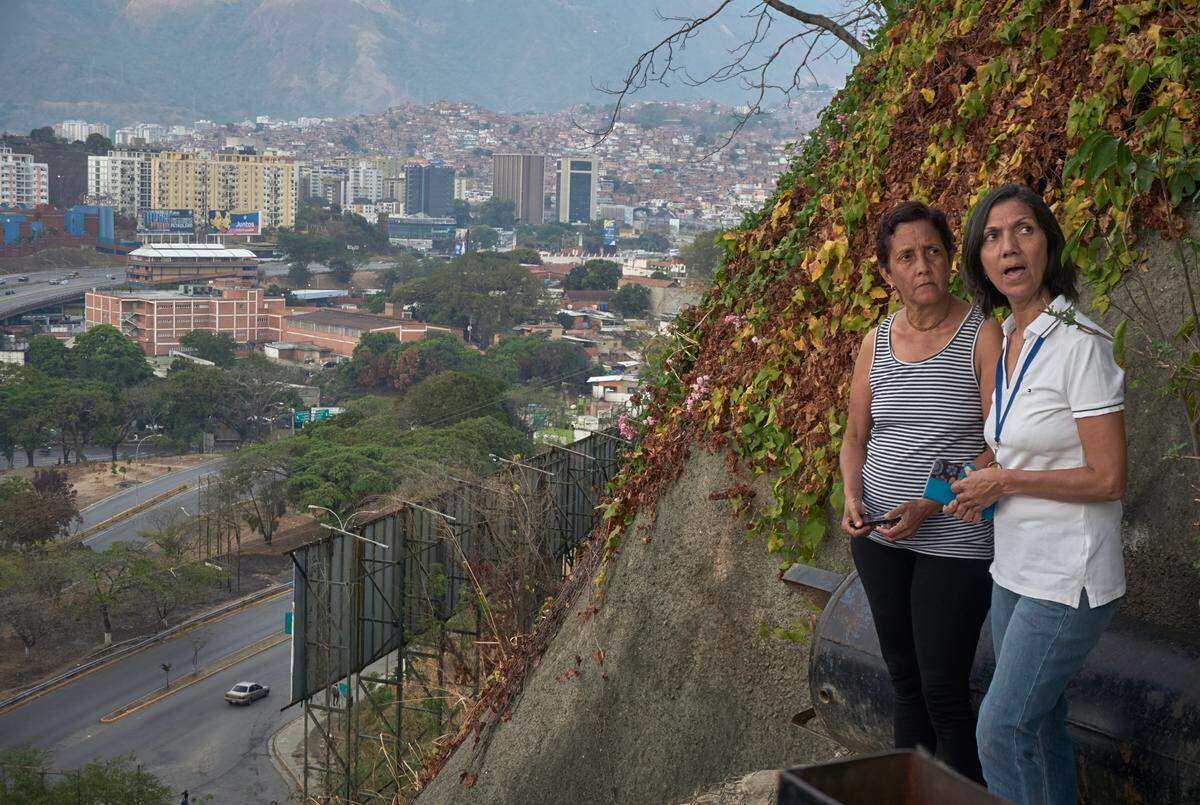
For Rodríguez, the colectivos are a bunch of rough criminals bent on extortion and murder. Ramírez, however, believes the colectivos, created by the late President Hugo Chávez, are essentially kind individuals ready to help out and are on the streets to keep Venezuelans safe.
Still, Ramírez, who as a young woman spent two years in Cuba and became enamored with Fidel Castro’s revolution, has increasingly found that her political views are in the minority while in the company of formerly like-minded Venezuelans. The residents of these barrios, neighborhoods that serve as home to Venezuela’s poorest, have historically been the most fervent supporters of the revolution launched by Chávez, who first came to power in 1999.
This appears to be dramatically changing.
According to the latest survey conducted by the domestic polling company, Datanalisis, interim President Juan Guaidó now enjoys approval ratings of more than 60 percent, while Maduro’s popularity has fallen to 14 percent. Maduro’s low rating is also registering in poor, working class areas, according to Datanalisis.
Experts say support has fallen as quality of life worsens.
The government “is losing support in the poor neighborhoods. Maduro might be able to distract his slum followers by fear-mongering and blaming Guaidó, but he can’t distract them when they don’t know how and when they will get their next meal,” said New York-based political analyst Guillermo Zubillaga at the Americas Society and Council of the Americas, AS/COA.
In Las Brisas, it’s hard to find Maduro supporters.
“The majority of people here voted for Chávez, including me, but now this is opposition territory,” Rodríguez said.
Roberto Briceño León, a crime expert and a sociologist who has been studying the barrios for the past 50 years, points out a surprising trend — a sharp decline in violence in the notoriously dangerous Venezuelan slums. Like elsewhere in the country, these neighborhoods also have experienced an exodus of residents due to the economic crisis.
“The youth, including the bad guys, are leaving the slums behind, making their way out of Venezuela,” he said.
In Catia La Mar, another slum in the northern state of Vargas, residents are often confronted by the police whenever they complain about their disastrous living conditions.
“They come when we protest about bad services,” said Baudy Hernández, 55, who shares a tiny room with his partner Yunesky Barrios, 24, and her 3-year-old son.
Hernández used to be a truck driver but lost his job two years ago. The reason: There are no trucks left for him to drive as many have broken down.
The couple can’t afford to buy new clothes, let alone go to the movies or out to eat. “Last time I bought myself a skirt was like four years ago,” Barrios said, as she breast-fed her son. The fact that she can breast-feed is potentially life-saving in a country where baby formula and milk are not currently available for purchase at supermarkets.
Their neighbor, 25-year-old Desiree Victoria Espinoza, has four children to feed. The first one was born when Espinoza was just 15 years old. She said contraceptives are not only difficult to find but also not a priority. Many couples use their money to buy extra food and basic medicine.
The barrios are full of children playing out in the streets and alleys.
Back in Las Brisas, residents recently celebrated Carnival — minus a tradition that has historically been part of festivities: throwing flour and water at their neighbors. It is what the children do simply for fun.
Not this year. Flour and water are in short supply and can’t be “wasted” on a celebration.
“Before the revolution, we were poor but happy,” said a middle-aged man who presented himself only as Marvin. “Now, we are poor and miserable.”
This story was originally published March 27, 2019 at 1:21 PM.