
How one man’s decision to stay in Venezuela feeds hundreds every day
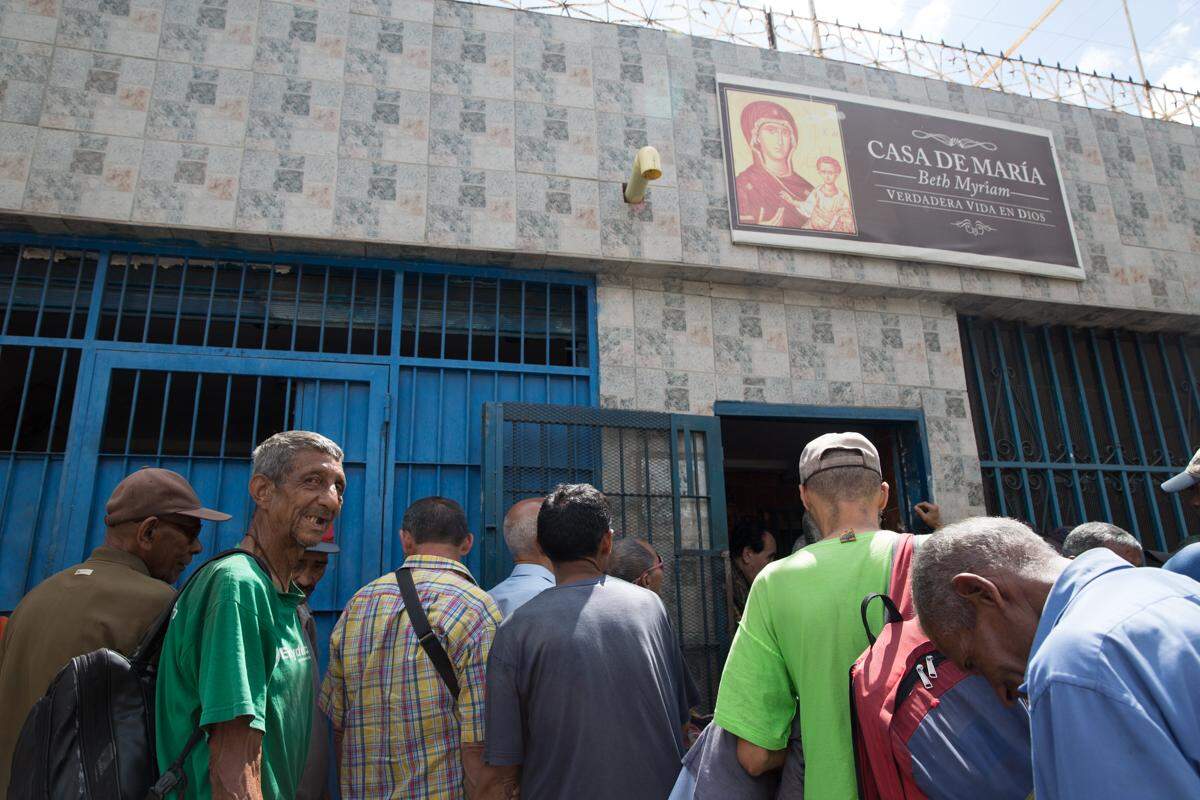
Benito Prieto stood at the door of Casa de Maria, greeting the hungry Venezuelans who line up every day at the soup kitchen he helped found in Propatria, one of the poorest and most dangerous areas of Caracas.
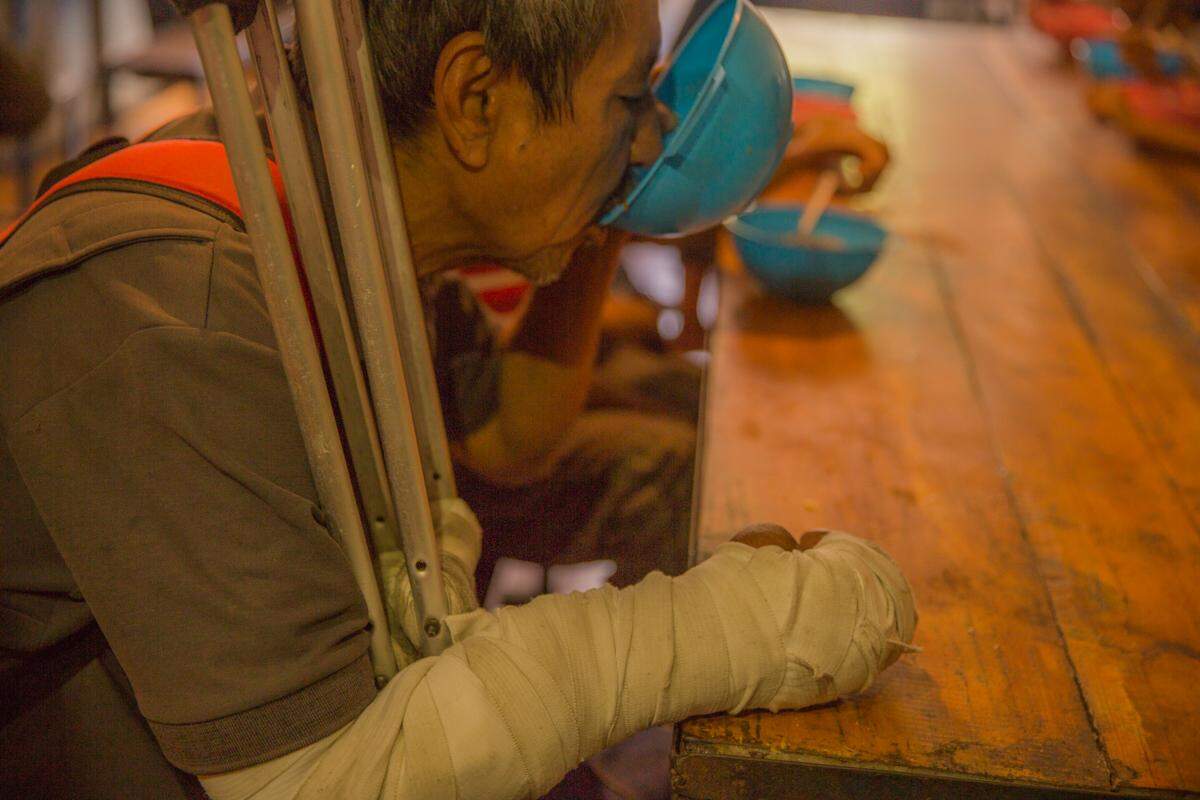
He welcomed a 55-year-old amputee, Israel Vasquez, helping him to the front of the line. “Amputation has become all too common for diabetics,” he said. “They cannot find medicine, so when wounds get infected, their only choice becomes amputation.”
In a country engulfed in an economic crisis, where anyone who can leave has already left, the 84-year-old psychiatrist and retired human resources director has decided to stay — and to help, with some of his own money and with donations from others.
“I will not abandon a ship when it is sinking,” Prieto said. “And right now, Venezuela is a sinking ship due to the hunger, the health and humanitarian crisis, and the hyperinflation that makes it impossible for the majority of people to eat. To abandon these poor people would be the most cowardly, disloyal act on my part.”
According to the latest statistics from the International Organization for Migration, the leading intergovernmental migration organization, more than 900,000 Venezuelans have left the country since 2015. And more asylum seekers in the United States come from Venezuela than from any other country, according to U.S. Citizenship and Immigration Services statistics.
Prieto, a deeply religious man who once considered becoming a Catholic priest, added, “I need to follow what Jesus said in a way that makes sense to me. So I stay and do my part.”
Twenty years ago, Prieto got together with a group of friends and created Casa de Maria. They started out making 20 meals, but soon more than 100 people were coming for food, and Prieto realized the organization needed a cook and more help.
“Now all of the friends who started this with me have either passed away, left the country, or can no longer participate because of their health,” Prieto said. “But I am not going anywhere.”
He originally decided to open the soup kitchen, he said, during a spiritual crisis. “For 65 years, I was able to live a life providing only for myself and my children. I made all the money I needed to provide for my family and educate my children. ... I thought, we all will die one day and we cannot take anything material with us, we have to take our actions. So I need to show up with something more.”
But now, with food shortages so prevalent that most Venezuelans have lost weight, he sees the kitchen playing a bigger role than he had imagined.
“We never thought, when we started, and for many years, that we would reach this point,” he said. “But now we are playing a vital humanitarian role. At the beginning, we opened to feed abandoned women, children and homeless people in the square, but the new reality has transformed us into the only help for the survival of many.”
One of his three children, Luis Arturo Prieto, is a U.S. citizen who lives in Boca Raton and manages a dry cleaning company. The former TV producer in Caracas decided to emigrate due to safety concerns. Before he moved to Florida, he spent several months going with his father to Propatria and worried about him and the risks he took.
“It was not a safe neighborhood, but my father managed,” he said. “I have asked my parents to come and live here, but they refuse. My father is very committed and he wants to help everyone but he is one of those people who never takes credit for himself.”
In Caracas, Prieto lives on money he earns from some rental properties he owns and from a handful of psychiatry patients he sees. His work at Casa de Maria takes much of his time and energy.
“When I saw that my hair was becoming white,” Prieto said, “I decided that I would not let my age get in my way. So I bought black hair coloring. Now I look at myself in the mirror and see dark hair and say to myself, ‘There is that young man with energy!’ and that keeps me going.”
Each day, Casa de Maria makes enough soup for 350 people. The charity uses private donations — from Prieto and many others — to pay for the ingredients and to cover expenses. Prieto handles every penny himself so that he can purchase the maximum amount of food for the money. Because of severe food shortages in Venezuela, Prieto has to buy from the “bachaqueros,” the black market.
He is quick to note that the real credit for the work they do should go to the cook, Livia Madueño. “Without her,” he says, “we would have no food.”
Madueño is a domestic violence survivor herself but has since remarried and lives at Casa de Maria with three of her four children. Her current husband works outside, but her children help out in the kitchen. Her fourth child lives in Argentina, and two of the others are planning to leave Venezuela — one to go to Colombia; the other, to Ecuador.
“My children have to leave because there’s no future here,” Madueño explained. “My family and many others are dividing.”
Madueño has been Prieto’s trusted partner for nine years, longer than any other cook. “I have to stay,” she says. “Like Benito, I feel that if we don’t feed these people, they will die. But it breaks my heart to see so many people going without. There are days when I cannot feed everyone, or I think about how bad the country is going and I sit in the hallway and cry. I never thought this would be my country. But we need to keep helping.”
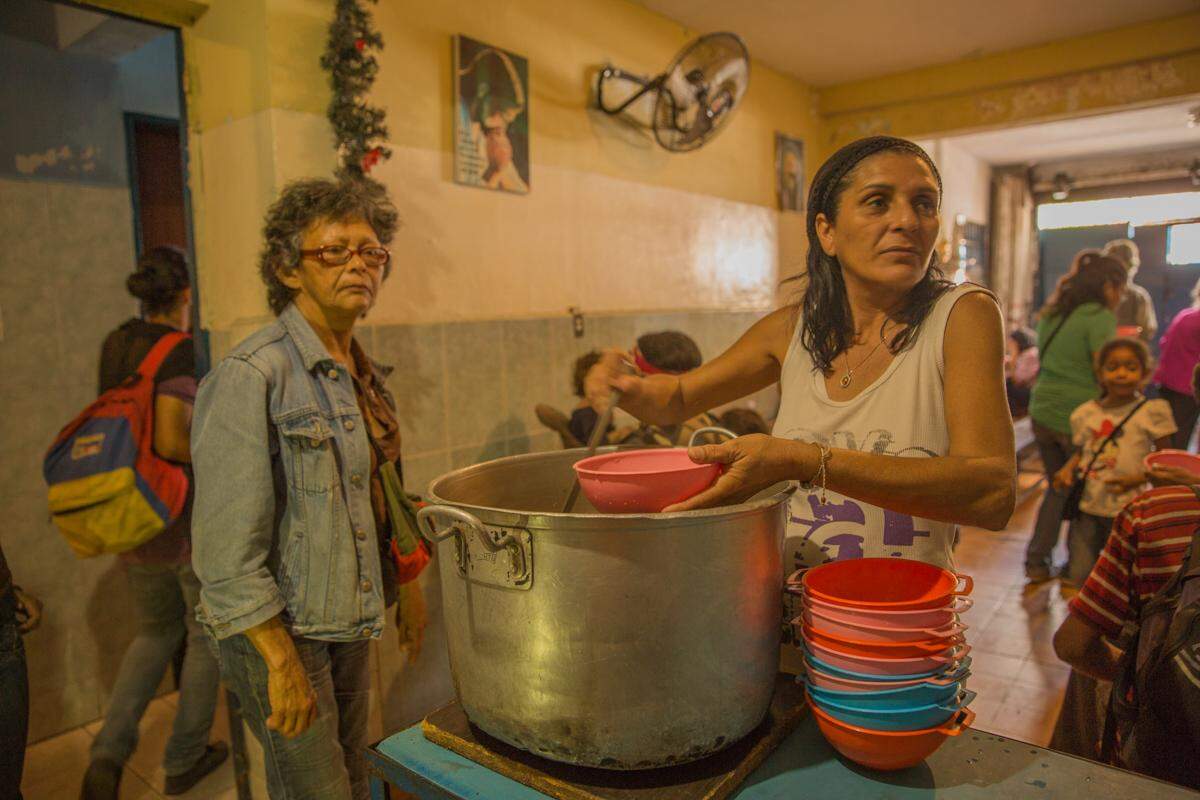
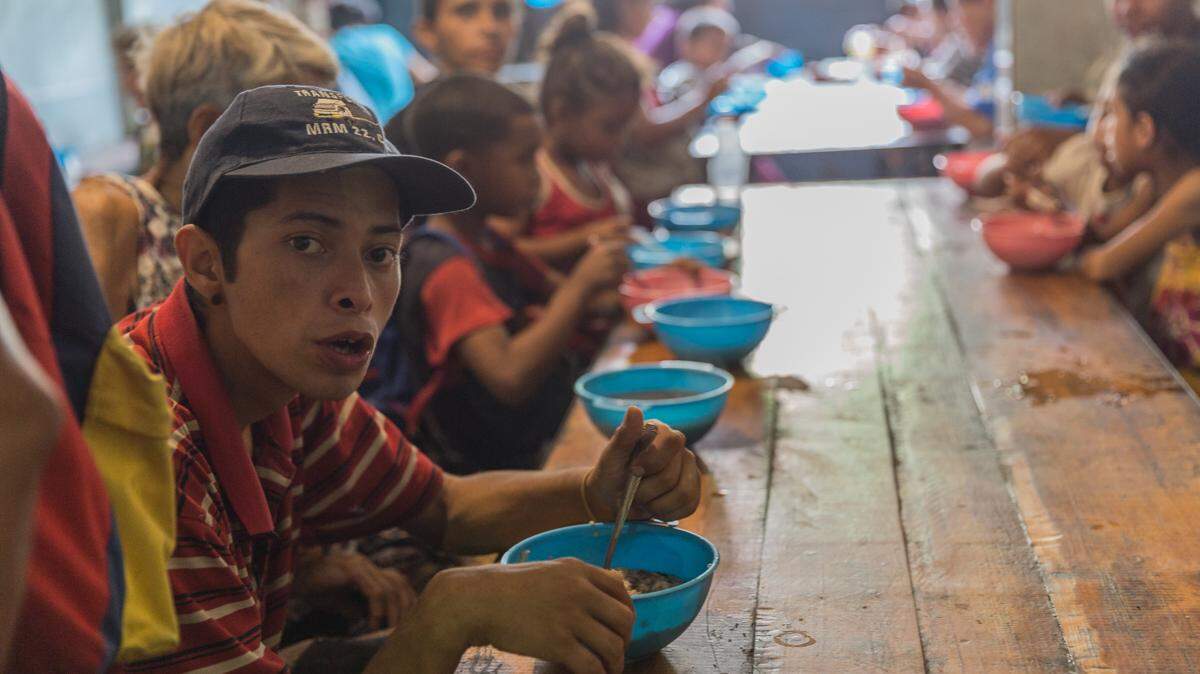
The soup is made of broth, rice or pasta, beans and oats to fortify it. Three hundred and fifty tickets are given out each morning, with those who are most ill or handicapped served first, followed by the elderly.
Those who cannot carry their small bowls of soup to the table are helped by others. People squeeze tightly around the few wooden tables. As soon as they finish eating, their bowls are quickly washed for the next group of people. The government rations water, limiting it to two days a week, so Madueño fills a tank, and her daughters who do the dishes have to make it last all week.
One of the people who comes regularly is Mercedes Marina Villalobos. She needs to take anti-seizure medication for her epilepsy but doesn’t have enough money to pay for both medication and food.
“If it wasn’t for this place, I would not be able to eat,” she said. “I eat thanks to Benito.”
Casa de Maria also has a small infirmary with basic first aid supplies and some medications. “I have exhausted my doctor colleagues for help with medicines,” Prieto said, “but I can only cure simple ailments here.”
Nearby, he keeps a small statue of Gregorio Hernandez, a revered doctor who died in 1919 and is considered by many to be the patron saint of doctors in Venezuela. “Every little bit helps,” he said.
Oscar Toto, 43, a street sweeper, comes every day at lunch time and helps Prieto organize the lines. He also eats there. “Benito is a saint,” he said.
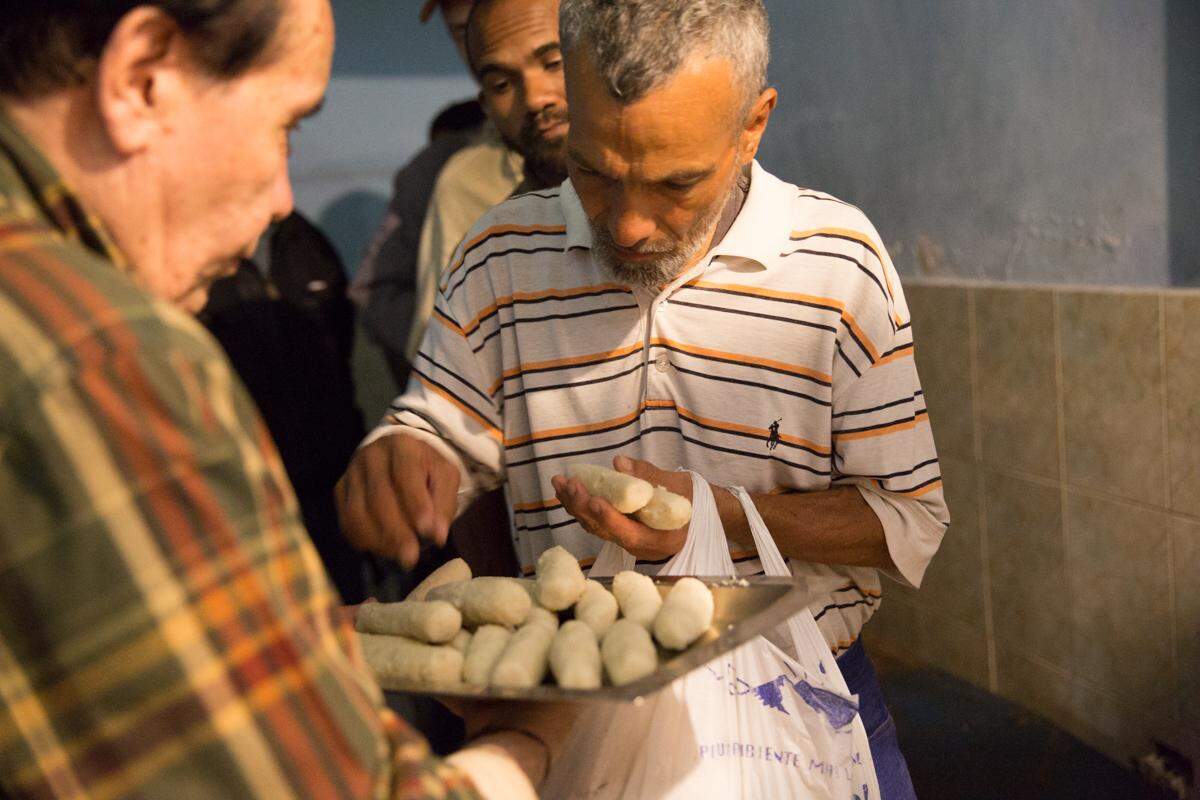
When the soup runs out, if there are people still waiting, Prieto and Madueño have a tray of already-prepared “bollitos,” cooked corn flour dough.
“The idea is that no one leaves without something in their belly,” Prieto said. “And hopefully tomorrow they will get soup.”
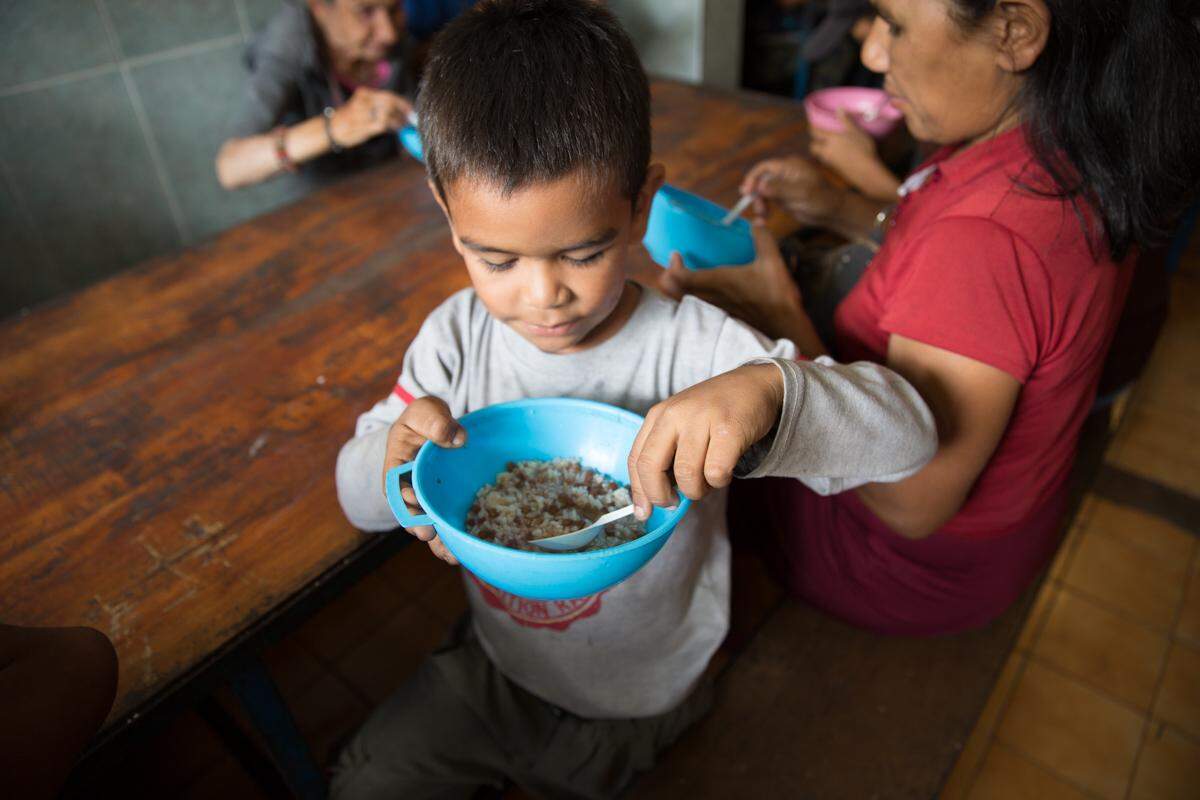
At the front of the soup kitchen is a statue of the Virgin Mary. People stop on the way out to bless themselves, ask for help and whisper gratitude for the food.
“As long as we get donations, we will not stop,” Prieto says. “It’s not just about the food. It’s also about the dignity. People who come here feel like they are the discards of society who cannot afford food and desperately need it. They know that here I will look them in the eye. I do believe that one person can make a difference or I would not stay.”
This story was originally published July 25, 2018 at 10:46 AM.