Caribbean leaders offer to mediate tensions between the U.S. and Cuba
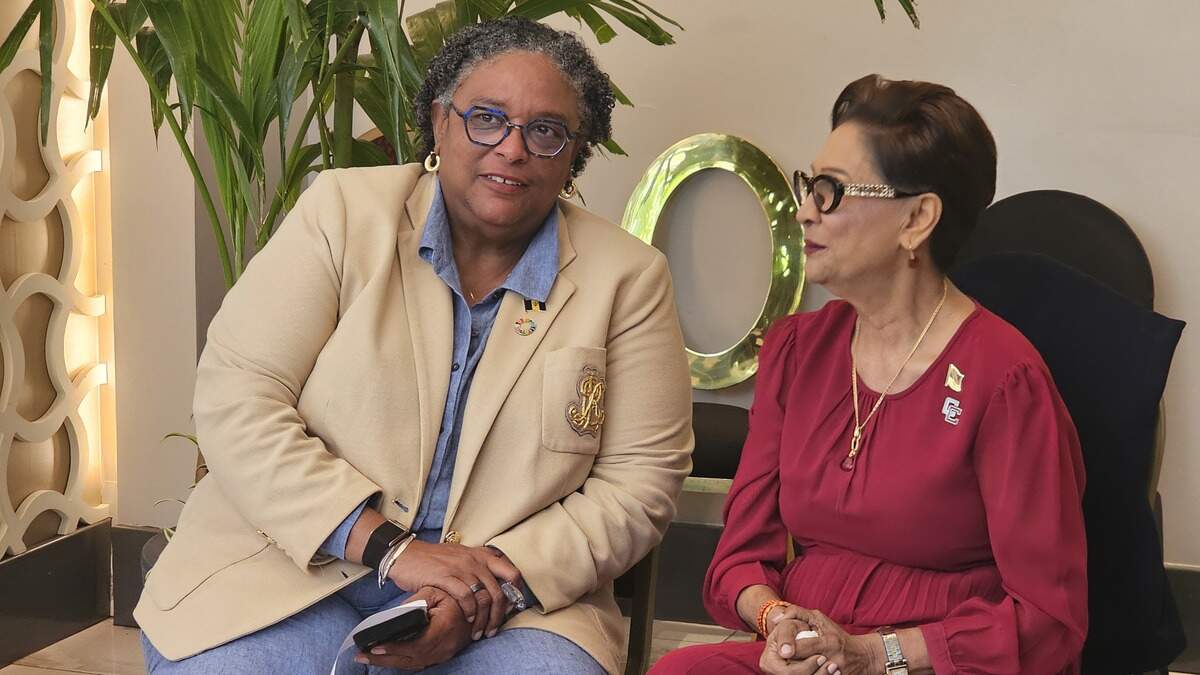
Caribbean leaders said Wednesday they are willing to mediate escalating tensions between Washington and Havana even as Barbados Prime Minister Mia Mottley acknowledge the conflict is complex.
“This is not an easy issue,” Mottley said, noting that leaders of the Caribbean Community bloc known as CARICOM discussed Cuba during their four-day summit here in Saint Lucia. “I think that we are agreed that discussions and the debate must take place, but without prejudice… for a peaceful resolution of what is transpiring with Cuba -- that there is a humanitarian crisis, and you cannot continue to ignore that reality.”
The Trump administration’s escalating pressure on Cuba has forced Caribbean governments to recalibrate their longstanding relationships with the island’s communist regime while trying to carefully balance ties with Washington.
Despite agreeing that they are concerned about the worsening humanitarian crisis on the island, leaders stopped short of adopting a broader common position on the country – a fact underscored in Tuesday’s United Nations vote when CARICOM’s long-standing tradition of consensus showed cracks.
“All of us here in CARICOM and in the region, we are very touched by what has happened,” said Saint Kitts and Nevis Prime Minister Terrance Drew, who lived in Cuba for seven years while attending medical school.
Leaders on Wednesday wrapped up their annual meeting by providing a resume of what was discussed and decided. But even as current chairman and Saint Lucia Prime Minister Philip J. Pierre, said they tackled issues of importance to the region, on some issues leaders lacked a unified position. Leading the list is the United States’ third-country refugee agreements and the Citizenship by Investment program, which both Washington and the European Union have now linked to visa restrictions.
Pierre said leaders discussed the refugee agreements but acknowledged they did not take a position.
“We took the position that we would share some more information among ourselves about what really is each island doing,” he said of the program that deports migrants in the U.S. to third countries when they cannot be returned to their home countries. “It’s a fact that the United States has asked most islands to accept third-country nationals.”
Saint Lucia is one of five countries in the region that sell citizenship to foreigners who invest. Known as Citizenship by Investment, the program grants visa-free access to up to 150 countries, including Europe’s Schengen area and, in some cases, the United Kingdom.
While the so-called golden passports have become a major source of revenue for countries, concerns about inadequate oversight and criminals getting access to the passports have prompted Washington to impose visa restrictions on countries that use the program. The European Union has also warned that it could suspend visa-free access for holders of Antigua and Barbuda passports beginning in July 2028.
Ahead of Wednesday’s closing news conference, Antigua and Barbuda Prime Minister Gaston Browne said he has been trying to get a subregional consensus within the Eastern Caribbean in response to the U.S.’s new policy dictates, which has led to the twin-island being placed on a partial U.S. travel ban.
So far there seems to be a reluctance on the part of countries to have a regional approach to accepting deported U.S. migrants. “I think that is what was required on the onset, for us to have a regional approach, because we’re stronger together than alone,” Browne said. “So, what has happened, unfortunately, is that countries have been negotiating bilaterally.”
Browne said he is also seeking consensus among countries in the Citizenship by Investment programs as they comes under attack by both the U.S.. and the European Union, which like Washington argues that they allow people who otherwise would not qualify for visas to get visa-free access to their nations.
“The problem that we’re facing is these programs are so important for these small vulnerable countries that ending our programs may not be the most viable option,” he said. “In the case of Antigua and Barbuda, we earn about $100 million a year. It’s not taxpayer money and there’s no way we can contemplate taxing our nationals to cove that $100 million and we don’t have any known avenue or recovery at this time.”
Pierre says CARICOM doesn’t have a common position on either refugee agreements or CBI. He stressed that it’s only in a handful of countries that offer the passport program, and therefore he doesn’t view it as CARICOM issue.
“All the due diligence procedures that we are asked to do, we take these steps,” he said of CBI. “But each country has a right to impose its own domestic policy, and we are in no position to tell anybody what to do as far as their domestic policies are concerned. So regardless of what we do, if Europe decides that it don’t want us to have a CBI program, that’s what is going to happen. There is literally nothing we can do under these circumstances,”
Pierre said he was pleased with the summit. Leaders discussed a range of issues from climate change to how they are responding to the high cost of living to their efforts to seek reparatory justice from the United Kingdom, which had colonized most of the countries in the 15-member grouping other than Haiti and Suriname. Leaders also agreed to strengthen regional cooperation.
While the conference started off with tensions involving Trinidad and Tobago Prime Minister Kamla Persad-Bissessar’s public objections over the reappointment of the bloc’s secretary-general, Carla Barnett, by Wednesday the Trinidad leader and her colleagues were embracing and doing photo ops.
“I’ve always said Trinidad remains committed to CARICOM,” Persad-Bissessar said, welcoming the decisions taken to address her concern. “We have unwavering support to CARICOM.”
Since they last met in February, countries have taken it upon themselves to deploy aid to Cuba and Venezuela. In the case of Cuba, Mottley said financial transactions have become increasingly difficult because of U.S. sanctions.
She recounted how an effort to purchase infant formula for Cuba was rejected by banks four times before the payment was finally processed on Tuesday.
“We recognize that this is always going to be a complicated issue, as was recognized on Tuesday in the United Nations vote,” Mottley said. “But we want to remain focused on the humanitarian efforts, and we want to remain focused on the dialogue that should take place for the resolution of this matter.”
CARICOM has informed both the United States and Cuba that it stands ready to facilitate such talks, she said.
“When you live in a neighborhood, what happens in the neighborhood affects everyone,” Mottley said. “The neighborhood stretches from Florida to Guyana and Suriname.”