Celebrated Haitian artist’s Everglades murals debut at new Miami-Dade courthouse
Haiti-born contemporary artist and curator Edouard Duval-Carrié is no stranger to having his work displayed in prominent places. They’ve been exhibited at some of the world’s most prominent museums and enliven Española Way in Miami Beach, where his hanging aluminum contortionists marked the 20th anniversary of Art Basel in 2022.
Now the artist, renown for his luminous mixed media and use of glass, glitter and other translucent materials to evoke spiritual themes, has one more public space to add, one that’s particularly personal.
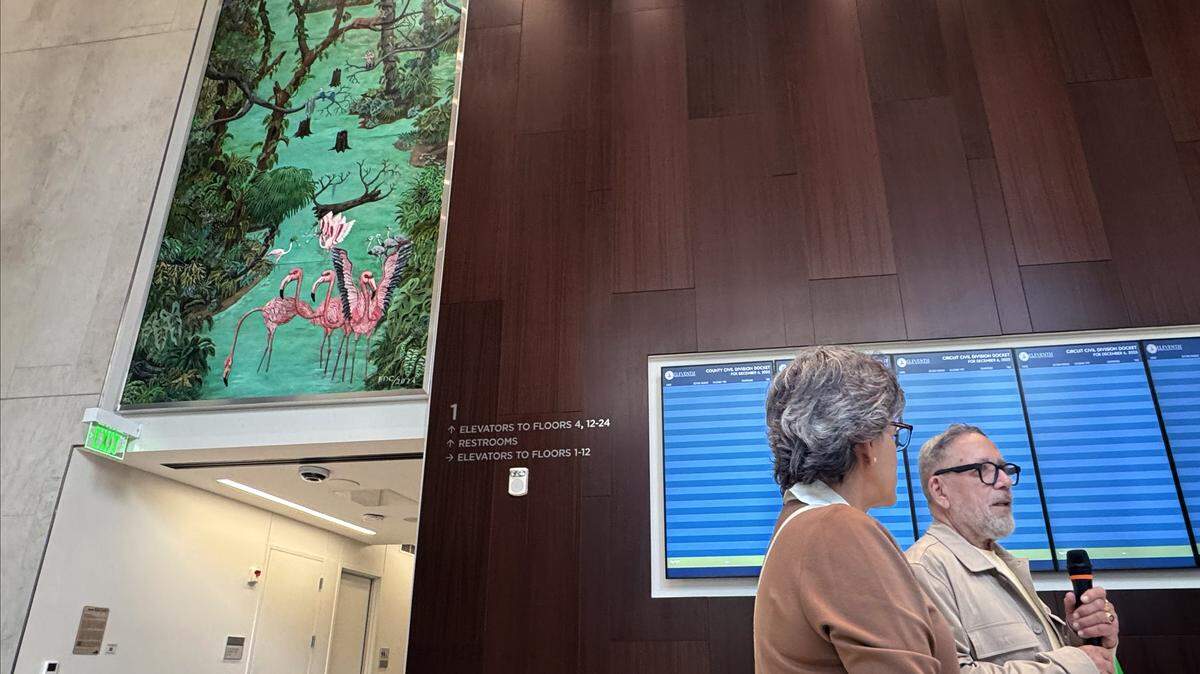
His latest work, “Ode to the Everglades,” is a pair of acrylic glitter glue and UV resistant satin varnish paintings on aluminum, each towering 34 by 10 feet. The installation is among the new commissions by 25 South Florida-based artists whose works are displayed on all 24 floors of Miami-Dade County’s new courthouse, the Osvaldo N. Soto Justice Center in downtown Miami, named for the Cuban American lawyer and civil rights pioneer.
Duval-Carrie’s gigantic rectangular panels greet visitors on the first floor.
“Overwhelming,” he said Saturday, describing the feeling of seeing his large-scale installation hanging in place.
Dedicated to the Everglades and its endangered ecosystem, the paintings reflect more than a year of planning and painting in which the artist reflected not just on the imagery but also the message he hoped to convey as people pass through the lobby on their way to the security screening.
“It is one of the most salient aspects of Florida,” Duval-Carrié said of the Everglades. “I wanted to stress that it had to be protected.”
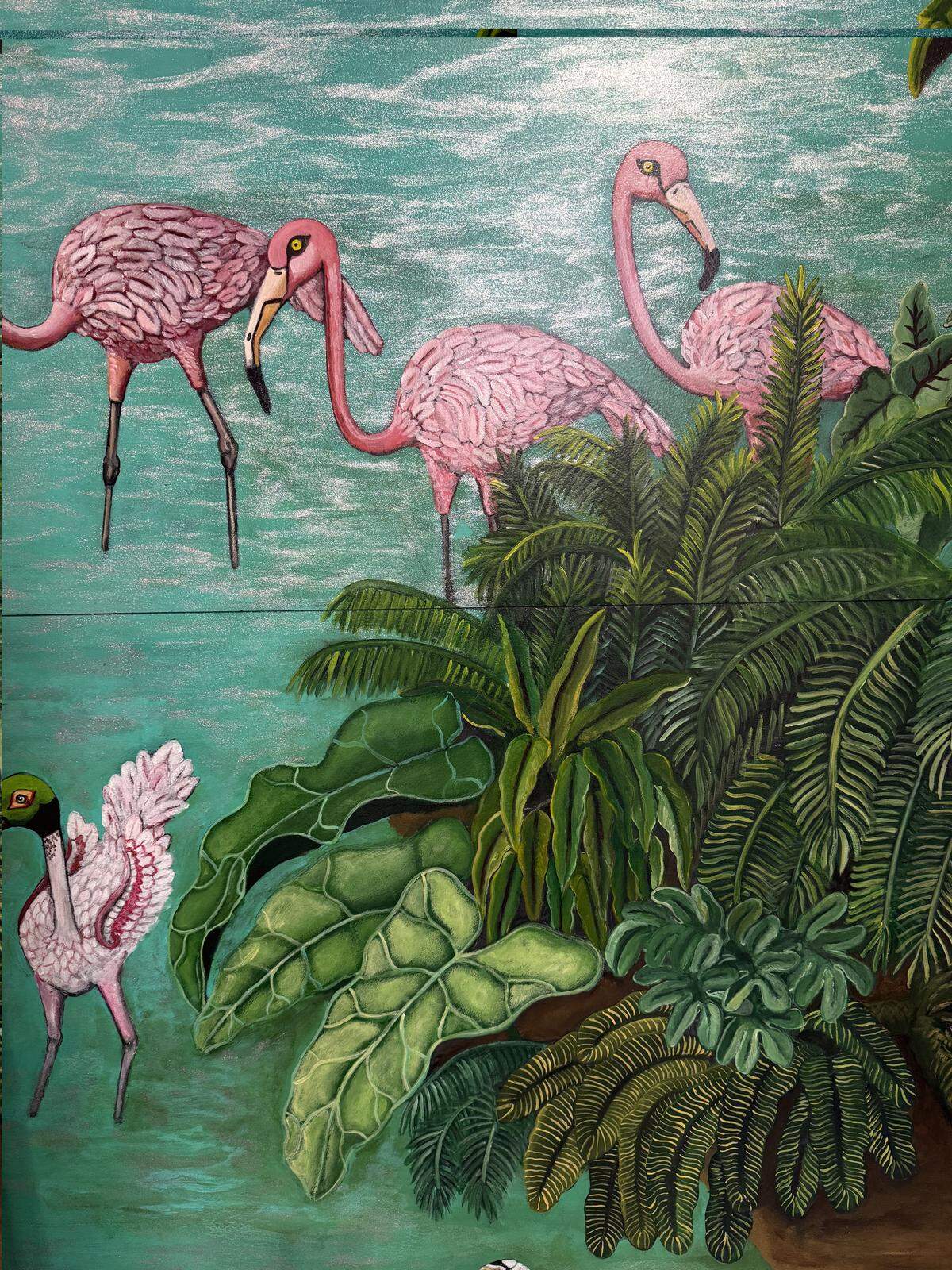
More than 2,000 birds and other wildlife call the Everglades home, he noted. ”It’s very important that we take care of it,” he said. “It’s a sanctuary.”
As a group gathered Saturday to tour the building and its “Art in Public Places” acquisitions, Duval-Carrié remarked that the area became protected land only after “countless birds were massacred to adorn ladies’ hats.”
“Thank God, that style has gone away,” he said, eliciting laughter.
More than 90 pieces of art have been selected for the building as part of Miami-Dade County’s Art in Public Places program, organizers said. The county has invested about $3.5 million, an official told the group, in both commissioned work and acquired artwork for the new courthouse. Duval-Carrié, last year, was named Miami-Dade County artist-in-residence by Mayor Daniella Levine Cava.
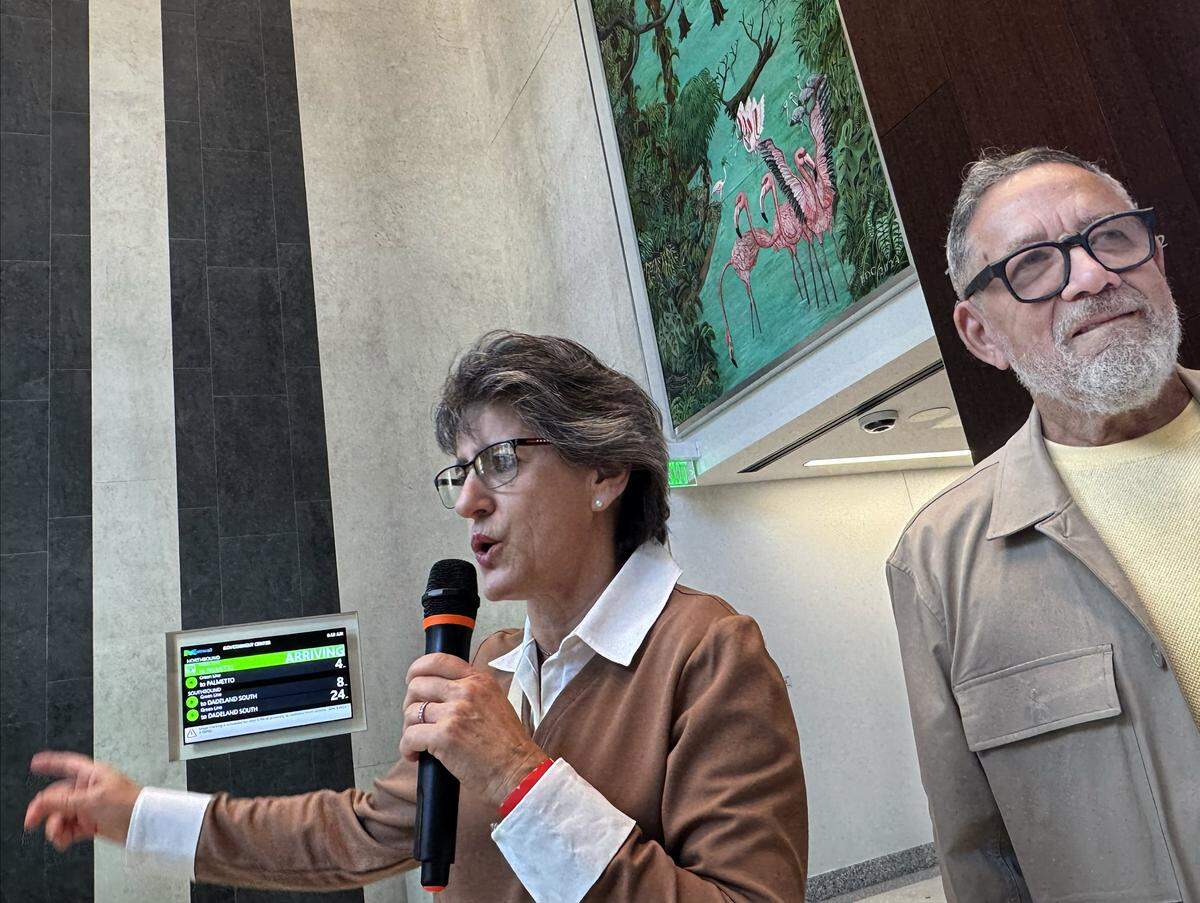
Other participating artists who were present Saturday were Loni Jhonson, Karen Rifas and Morel Doucet. The three also discussed their installations. Rifas’ 1 “Building Blocks of Color” featured painted wood blocks and reflects her long-standing interest in geometric abstraction. Johnson’s “His Arrow Never Misses The Mark” on the 16th floor incorporates black and white photographs set in gold frames adorned with gold beads and cowrie shells.
Doucet, also a Miami artist of Haitian descent, has his “Sunset Serenade: Notes on Vanishing Landscape” installed on the 21st floor. The mixed-media work, with its warm sunset pallet, draws inspiration from both South Florida and his Haitian roots, he said.
The Osvaldo N. Soto Miami-Dade Justice Center held its official ribbon cutting last month, and judges are in the process of moving in. Located at 20 NW First Ave., the building replaces the historic 1928 Miami-Dade County Courthouse. The new building features 46 fully equipped courtrooms and four additional shelled courtrooms for future expansion.
For Duval-Carrié, who fled the brutal regime of Haiti’s President-for-Life, Francois “Papa Doc” Duvalier, as a teenager and has since become one of the most widely recognizable Haitian artists globally, the significance of having his work displayed prominently in such a civic institution, and one named for a pioneering Hispanic, is not lost.
“Crossing barriers,” he said about the symbolism of the intersection.
This story was originally published December 7, 2025 at 4:11 PM.