
‘Intentionally harmful.’ South Floridians react to end of TPS for Haitians
Farah Larrieux never imagined herself leaving her native Haiti where she had a successful career as a TV and radio personality.
But life in Haiti became too much to handle, with its political instability, corruption and gang violence. She left for Miami in 2005 and built a new life in South Florida.
Larrieux is now one of the hundreds of thousands of Haitians who are in an immigration limbo after the Department of Homeland Security announced last week it would end Temporary Protected Status, TPS, for Haitians.
READ MORE: Trump says Haiti no longer meets requirements for TPS. Haitians have to leave
The decision, which becomes effective on Feb. 3, 2026, could affect up to more than a half million Haitians living in the U.S.
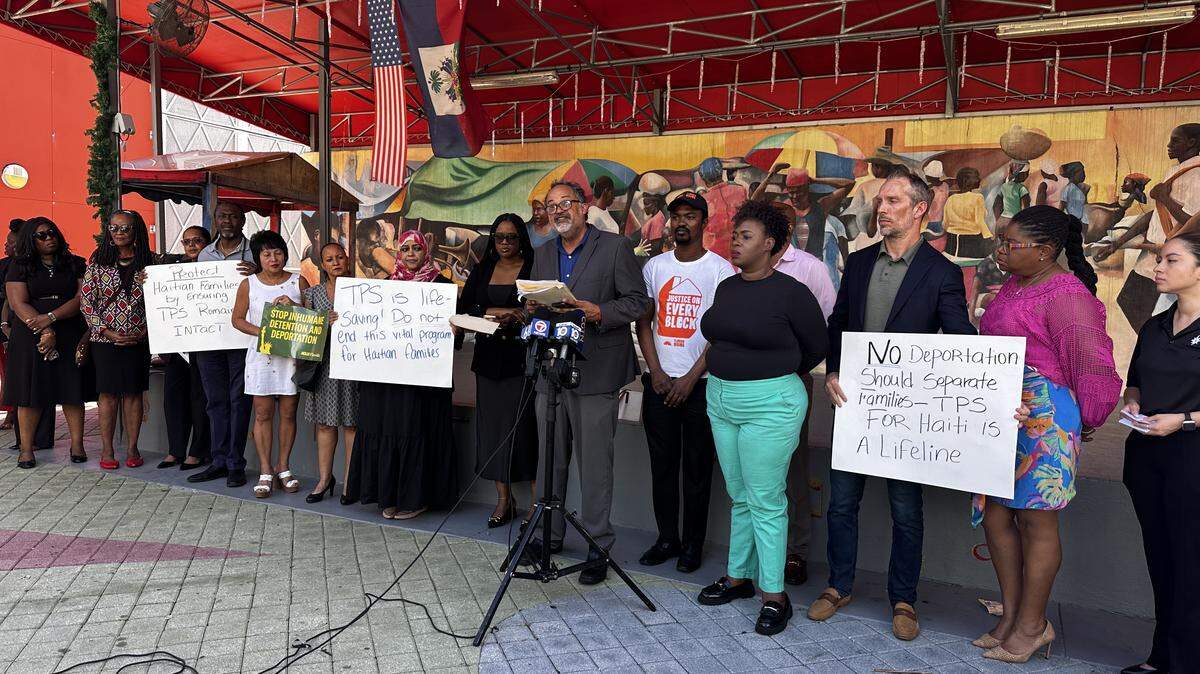
But the termination will not come without a fight from community activists, who gathered at the Little Haiti Cultural Complex on Tuesday to condemn the Trump administration decision.
Recent reports from Haiti shows that the country continues to be plagued by violence from armed criminal groups that have forced more than 1.4 million people from their homes, and caused the deaths of more than 4,000 this year.
While controlling up to 90% of the capital, Port-au-Prince, gangs are quickly expanding to rural regions north of the capital. A report published by the United Nations International Organization for Migration on Wednesday showed that recent deadly attacks in the country’s Artibonite region, also known as the breadbasket, have displaced about 6,342 people.
READ MORE: Fresh gang attacks in Haiti’s Artibonite region leave more deaths, destruction
“DHS acknowledged that certain conditions in Haiti remain concerning. Despite that admission and despite the worsening conflict and daily terror gripping Port-au-Prince Secretary, [Homeland Security Secretary] Kristi Noem concluded that there are no extraordinary or temporary conditions in Haiti preventing Haitian nationals from safely returning,” said Paul Christian Namphy, political director of Family Action Network Movement, a Miami nonprofit that advocates for Haitians.
He denounced Noem’s claims and said that the forceful return of tens of thousands of Haitians could leave them at risk of death, kidnapping, rape and armed robbery.
Namphy, who used to work at the National Directorate for Water Supply and Sanitation, said two of his former colleagues were killed in Port-au-Prince the same month the humanitarian parole instituted by the Biden administration for Cubans, Haitians, Nicaraguans and Venezuelans was launched in January 2023. President Donald Trump has ended the program since retuning to office in January.
Don’t panic, act now
Vanessa Joseph, the elected chair of the National Haitian American Elected Officials Network and an attorney with Catholic Legal Services in Miami, said the decision to end TPS for Haitians on the eve of Thanksgiving is a “clear sign that we’ve lost compassion for folks who built this community.”
Joseph, the daughter of Haitian immigrants, urged TPS holders to “not panic, but do act.”
Haitian TPS holders have work authorization through Feb. 3 and should consult reputable attorneys or legal organizations to explore other immigration options, she said. They should also “beware of unscrupulous individuals who might promise a quick fix but cannot guarantee those results.”
But hours after the press conference, Trump closed many of those options or at least put them on hold. Haiti is one of 19 countries the administration targeted in a new sweeping immigration directive that is leading to the halting of all immigration benefits, including maturation ceremonies and status adjustments for those already here.
Joseph stressed that people should know they are not alone.
“To our Haitian community, especially those on TPS, I want you to know that you’re not a problem to be managed, you’re not a threat that needs to be contained, you are human beings who deserve dignity,” Joseph said.
READ MORE: New Trump policy puts immigration ‘on hold’ for Cuba, Haiti, Venezuela and others
‘Unfair, cruel and intentionally harmful’
Larrieux, 46, has lived in the United States for over 20 years.
She is the founder and co-director of THÉLAR Management Group, a South Florida communications firm aimed at increasing visibility to minority markets, beginning with the Haitian market, according to the firm’s website.
“My whole adulthood is in the United States,” Larrieux said. “And so I don’t see myself going back to Haiti now.”
She has been a TPS holder since 2010 after then-President Barack Obama granted TPS for Haitians after the Jan. 12, 2010, earthquake left the country in economic ruin, and more than 300,000 dead.
Larrieux said she’s ready to fight for her stay in the United States.
Nurse Marie Etienne, speaking on behalf of the Haitian American Nurses Association, urged policymakers to protect and modernize TPS, calling it essential to address the nursing shortage in the U.S. She emphasized that thousands of TPS holders serve as nurses, aides, and support staff in U.S. hospitals, long-term care facilities and underserved communities.
Etienne warned that uncertainty around TPS destabilizes the healthcare workforce and harms patients who rely on continuity of care. She stressed that TPS nurses are “longstanding members of our community” and reminded leaders of the profession’s core mission: “We are in the business of human caring.”
“This is the most unfair, cruel and intentionally harmful decision that Secretary Noem has made,” said Tessa Petite, executive director of the Florida Immigrant Coalition.
Petite emphasized that Haitians contribute more than $4 billion annually to the U.S. economy and pose no national security threat, challenging the government’s claim that ending TPS serves the “national interest.” She questioned what interests could be undermined by a community that has supported the U.S. economy and sought safety from violence and famine in Haiti.
Petite suggested that the policy decision raises deeper concerns, questioning whether Haitians are being targeted because they come from a poor nation—or because they are Black.
“What is happening is absolutely racist. It is absolutely classist, and we must stand for something,” said Santra Denis, executive director of Miami Workers Center.
Call to action
Tuesday’s press conference served as a call to action from the various organizations present. Many advised for people to call their congressional representatives.
“Don't be silent, because silence is what allows these kinds of things to happen,” said Dale Holness, the former mayor of Broward County.
The administration’s latest effort to end TPS for Haitians— its second attempt, once blocked by a lawsuit led in part by Miami attorney Ira Kurzban, who called the administration’s rationale “outright lies”
“They’re people who have families, they’re your friends, they’re your neighbors, they’re your health care workers. They’re people who live in this community,” said Kurzban, who is among several immigration lawyers suing the Trump administration over its TPS decision.