U.S. revokes visa of top Haiti official for alleged gang support, fanning instability
U.S. officials have imposed visa restrictions on a top Haitian government official for allegedly supporting gangs and other criminal organizations and obstructing the Haitian government’s fight against gangs that have been designated as Foreign Terrorist Organizations.
The State Department’s decision comes amid intensifying political infighting and maneuvering by members of the ruling transitional presidential council to oust Prime Minister Alix Dider Fils-Aimé, less than there months before the transition is scheduled to end. While Washington did not provide the name of the official, the Miami Herald has learned it is Fritz Alphonse Jean, a member of the transitional council who represents a group known as the Montana Accord on the council.
Jean expressed surprise and said he had no confirmation his U.S. visa is being revoked.
Later, on Tuesday, a defiant Jean hit back at both the U.S. and Canada, as well as Fils-Aimé and his ministers, calling them “incompetent.” The ministers, he said, had failed to heed the Transitional Presidential Council’s requests to address a series of issues, around the gang violence, governance and elections.
“Once we started talking about the incompetence of the government to resolve the problems of insecurity, to resolve the governance, elections....threats started arriving” Jean said on the Whatsapp messaging platform about some members of the council.
During the press conference, where he was joined by fellow council member Leslie Voltaire, Jean shared copies of alleged exchanges with the U.S. chargé d’affaires and the Canadian ambassador where both urged against the push “to topple the head of government.”
“You will see the threats from the U.S. embassy and Canadian embassy where they said, ‘If we don’t desist...they will cut our visas and those of our families,” he said.
The alleged message from the U.S. embassy also ordered the publishing of an electoral decree, which has the first round of general elections scheduled for August and allows anyone, including gang leaders who have not been convicted in Haiti, to run for elected office.
Last week, as gangs launched fresh attacks across the capital and Fils-Aimé appeared to be on his way out, Deputy Secretary of State Christopher Landau took to X to issue a public warning to Haiti’s politicians not to test its resolve.
“The U.S. and other countries in the region and around the world have a clear message: enough with gang violence and destruction—and political infighting,” he posted. “Now is the time for Haiti’s leaders to unite against a common threat, and anyone who obstructs Haiti’s path to political stability must expect consequences from the U.S. and others, including visa revocations.”
READ MORE: Haiti’s elections council has submitted an election law, and people are worried
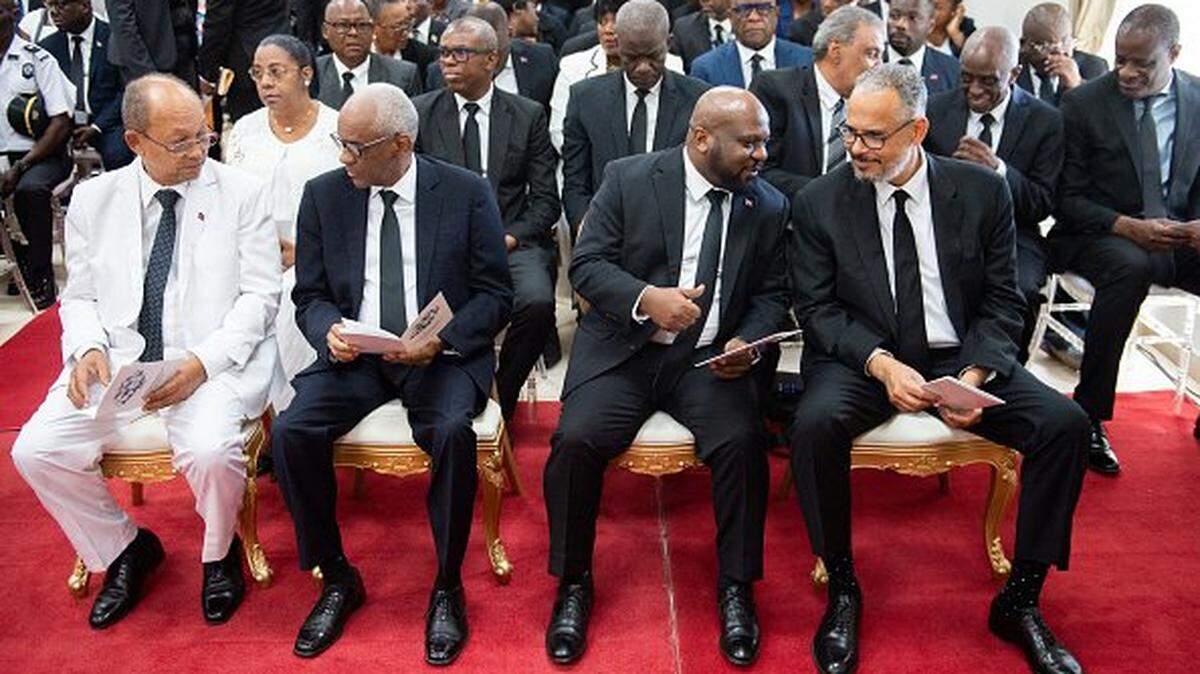
The U.S. Embassy in Haiti, along with other foreign missions, has grown increasingly impatient with members of the nine-member Transitional Presidential Council as they once again move to oust another prime minister. The council, which has faced allegations of corruption and lack of effectiveness, is set to leave power on Feb. 7. 2026 without having accomplished its main tasks: improving security and returning Haiti to democratic order through elections.
With five of the council’s seven voting members needed to dismiss Fils-Aimé, the U.S. and Canadian embassies have been engaged in trying to halt the move, arguing that a political vacuum would invite more instability at a time armed criminal groups are on the offensive.
On Sunday, gangs fired shots at a domestic aircraft operated by locally-owned Sunrise Airways as it approached a runway at Port-au-Prince’s airport. The flight had been arriving from the southern city of Les Cayes. A post-flight inspection reportedly revealed holes in the rudder and elevator, but there were no reports of injuries. The incident prompted Sunrise to temporarily suspend all domestic flights to and from the capital. Later that evening, reports circulated that gangs were preparing to lock down the capital the following day by blocking key roads.
On Monday, however, the city remained relatively calm, and a Brazil-bound charter flight even departed from the capital’s Toussaint Louverture International Airport. Meanwhile, Fils-Aimé and members of the nine-member Transitional Presidential Council were locked behind closed doors discussing his fate.
Washington, which recently pushed through the creation of a new “Gang Suppression Force” at the United Nations Security Council, has repeatedly insisted that the era of impunity in Haiti has ended. Landau in his post made it clear that the Trump administration will not tolerate “the calls for open war against the central government.”
Jean has dismissed the allegations of gang ties as an attempt to soil the image of the transitional council. He said their political fight is being waged on behalf the Haitian people who have been forced to endure misery and shame amid the ongoing crisis.
“We are battling for our dignity, the dignity of the country and the dignity of the heritage we are leaving for our children,” Jean said, accusing the government of being held hostage. “If the battle to put people who have competence and experience at the head of the government to solve the population’s problems is a crime then I am prepared to continue fighting non-stop for that.... If telling the truth to certain ambassadors about an ineffective government that should be changed is a crime, then I am prepared.”
Jean’s comments mark a new chapter in the ongoing battle between the presidential council and the prime minister. While some experts don’t see how the two can come together to govern Haiti in the coming weeks, others saluted Jean’s “courage” and said Haitian leaders should not take dictates from foreign governments.
“It is unacceptable for embassies to presume to threaten a presidential council member under the pretext that he has decided to participate in the dismissal of Prime Minister Alix Didier Fils-Aimé, whose inability to govern the country is undeniable,” former Prime Minister Claude Joseph said in a post on X after Jean’s comments.
“I myself met with the United States chargé d’affaires and clearly, but respectfully, expressed my disagreement with his attempt to impose Prime Minister Didier Fils-Aimé on us. I gave him a three-page document detailing Didier Fils-Aimé’s failures,” he added. “No Haitian political leader should submit to foreign dictates. I will not submit to it. My political party, EDE, will not submit to it either. Didier, like the CPT, has failed. They must all go. No foreign sanctions will change my mind.”
This story was originally published November 25, 2025 at 10:04 AM.