Organization of American States pitches a $2.6 billion Haiti rescue plan
Helping Haiti tackle its escalating crisis will require more than just confronting the armed gangs sowing chaos, but also mobilizing and coordinating countries’ help in putting the crisis-wrecked nation on a path to economic development and good governance, according to the head of the Organization of American States.
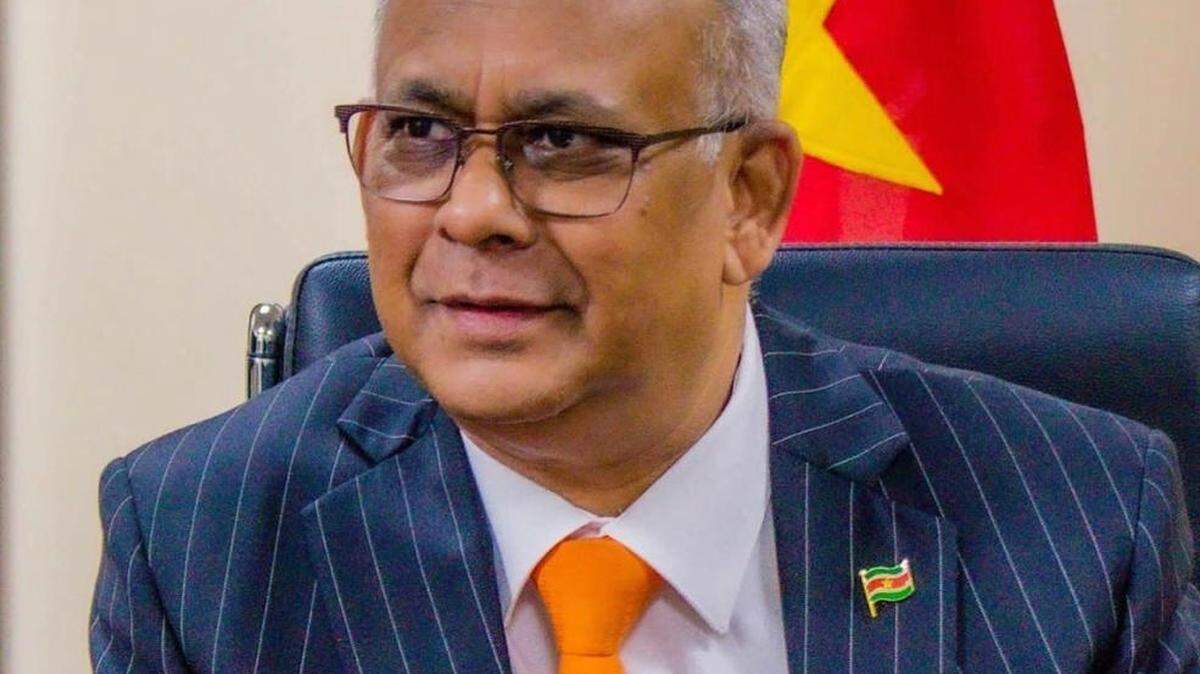
“There are opportunities,” said Albert Ramdin, the newly elected secretary-general of the OAS.
Days after unveiling an ambitious $2.6 billion roadmap for Haiti, Ramdin is defending his rescue plan’s lofty price tag and goals and laying out an argument on why security intervention alone isn’t enough to address the crisis in Haiti, where governance, human rights and democracy are all under assault.
“We often tend to forget how critical it is to have economic development,” he said in an interview with the Miami Herald. “If people do not have food on the table because they don’t have an income… they fall in the trap of gangs, crime, illegality, migration because they have been pushed out of country. It becomes a human rights issue.”
Ramdin’s proposal is built around five pillars: peace and security, a clearly defined political framework, electoral support, humanitarian assistance and economic development. It seeks to coordinate efforts by the OAS, the United Nations, and the Caribbean Community under a unified governance structure.
The largest share of the proposed money is $1.33 billion for maritime security, weapons seizures and judicial reform. Another $908 million is earmarked for humanitarian assistance, matching the U.N.’s current appeal, which has struggled to raise even 10% of its target. An additional $256 million is dedicated to economic initiatives, with $104 million proposed for helping Haiti’s electoral process.
“We are putting a plan together which is much more integrated and also focused on a long term sustainable development,” Ramdin said. ”In the end, Haiti has to be able to take care of its own security. Haiti has to be able to have a development trajectory, which they can manage on their own.”
The plan will evolve given developments taking place in the region and in Haiti, he said. Also, “no entity, no organization” will have the lead in the process that’s proposed to unfold over a three-year period.
“I will be the first person to say it’s not going to be an easy road,” he added. “The point we are making is, let us coordinate, let us make sure that we don’t duplicate and that there is an impact, which can be felt by the people in Haiti.”
Ramdin unveiled his sweeping plan last week before foreign ministers from Latin America and the Caribbean, whose nations make up the Washington-based agency’s 35 members. On Wednesday, he will hold a series of bilateral talks in hopes of getting the political support needed to launch the effort. The discussions will culminate with a 2p.m. “Group of Friends of Haiti” meeting in which Haitian Prime Minister Alix Didier Fils-Aimé will be present.
“We certainly look forward to Haitian leadership in this process, but the Haitian leadership that understands that past experiences cannot be repeated, and that we need to work together,” Ramdin said.
Getting Haiti’s leadership onboard is not the only challenge the plan faces. It has received both praise and skepticism, as supporters like Panama and Antigua and Barbuda acknowledged the urgency and “scale of Haiti’s crisis” but also raised concerns about funding, coordination and the absence of Haitian-led planning. Critics say the plan is overly ambitious and fear that, absent real commitment from donors, the initiative will join an already long list of unfunded international interventions in Haiti.
“The ask is large. The fiscal space is small,” Antigua’s alternative representative, Joy-Dee Davis-Lake, said.
Panamanian Ambassador Ana Irene Delgado, who made “a clarion call” to member states to mobilize financial and technical resources, said “no country, not even the closest ones, should be alone in dealing with this challenge.”
U.S. scrutiny
Ramdin’s ambitious pitch comes at a difficult time for the agency’s member nations — which are under scrutiny by the Trump organization — and for Haiti.
At the OAS General Assembly meeting in Antigua in June, U.S. Deputy Secretary of State Christopher Landau invoked Haiti’s crisis as he placed the group on notice. The Trump administration, Landau reminded the room, is reviewing its funding to multilateral organizations, the OAS among them.
“While Haiti descends into chaos, the unfolding humanitarian, security and governance crisis reverberates across the region,” he said. “And again, what has this organization done? Right now, a basic modicum of security is provided by a Kenyan-led multilateral force blessed by the U.N.... Again, if the OAS is unwilling or unable to play a constructive role in Haiti, then we must seriously ask ourselves why the OAS exists.”
Haiti’s deteriorating humanitarian crisis and relentless gang violence have struggled to get the world’s attention. Both a U.N. trust fund to support the armed Kenyan mission and the humanitarian appeal have been unable to raise the needed money.
“It’s not going to be easy to mobilize resources, but we’re going to be very actively engaged bilaterally with member states to say, ‘OK, where can you help?’ ” Ramdin said. “We’re not going to give up on this process.”
Not the first Haiti plan
This is not the first time the international community or the OAS has attempted to come up with a stability plan for Haiti. Ramdin’s predecessor, Luis Almagro, tried before he stepped down in May after 10 years at the helm.
Ramdin’s proposal has drawn comparisons to the high-profile effort launched by the U.S. after the 2010 earthquake to help Haiti recover and rebuild, the Interim Haiti Recovery Commission.
The commission sought to coordinate the international community’s response. But the effort, co-chaired by Haiti and former President Bill Clinton, faltered. The international community failed to live up to its commitments to deliver the billions of dollars promised and the commission was later scratched by a newly elected Haitian president, Michel Martelly.
Carlos Bernardo Cherniak, Argentina’s OAS ambassador, wondered during Ramdin’s presentation about countries’ willingness to commit to a united strategy and to give up control, given the historic precedent.
“We have a clear-cut idea with the roadmap that there is the intention of having a systemic coordination process,” he said last week. “But there are some doubts as to how the stakeholders that would eventually put in resources… would be willing to delegate coordination to the OAS this point.”
OAS’ credibility and past history in Haiti
The lessons of the post-quake commission should be heeded, said Ricardo Seitenfus, a former OAS special representative to Haiti.
“Without a functional state capable of fulfilling its obligations, there is no future. We must invest in Haiti in Haiti and not in intermediaries,” he said. “The resounding failure of the so-called reconstruction after the 2010 earthquake should serve as a warning.”
Seitenfus said the OAS was created for “diplomatic negotiation” and not to “tackle the root causes of problems” or to lead peacekeeping efforts, as U.S. Secretary of State Marco Rubio has challenged the group to do.
“How can we expect diplomats to succeed when all the specialized organizations, both private and public, have been failing in Haiti for decades?” he said.
Seitenfus, who was in Haiti during its controversial 2010-11 presidential elections, said neither the OAS nor Ramdin, who led Haiti’s elections intervention at the time as the agency’s No. 2, has the credibility to oversee a response to the current crisis.
Seitenfus, whose book “Haiti: International Dilemmas and Failures,” revisits the era, was present when President René Préval was famously threatened with exile in 2010 by the U.S. and the OAS if he didn’t remove his handpicked successor, Jude Célestin, from the race after opposition groups claimed fraud.
Ramdin said he doesn’t believe the OAS’ past controversial roles in the country will be an obstacle.
“Let’s focus on the future,” he said, “that will be more beneficial to Haiti than anything else.”
Collective effort
Whether the plan will pass muster with Washington, which funds at least half of the OAS’ budget, remains to be seen. The U.S. has continued to push the idea that the security response in Haiti should be led by countries in the region.
“I think the best way to convince countries is that the issues that are of strategic interests to those countries... will be addressed through such a plan and we need their support to be onboard,” Ramdin said. “If migration can be mitigated, if the issue of security can be addressed in a meaningful way, I think the U.S. will see the benefit of a plan going forward… and it will support.”.
This story was originally published August 26, 2025 at 3:50 PM.