Senators demand answers from Trump administration on ‘contradictory’ Haiti policies
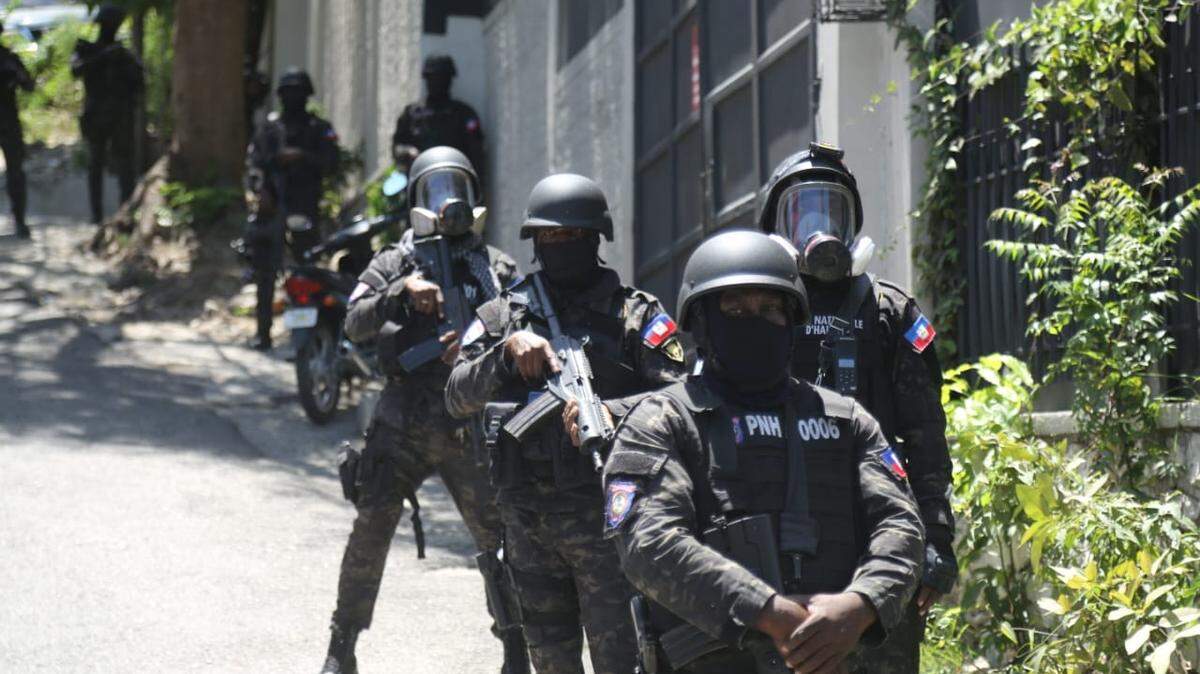
A group of Democratic senators are calling out the Trump administration on what they call its “increasingly inconsistent” policies toward Haiti, demanding answers on both its stance on immigration and the presence of U.S. private military contractors in the country helping the government go after armed gangs with weaponized drones.
A letter signed by nine senators, including Massachusetts’ Elizabeth Warren and Bernie Sanders of Vermont, is addressed to both Secretary of State Marco Rubio and Department of Homeland Security Secretary Kristi Noem. The two have until Aug. 15 to answer lawmakers’ questions on how the administration can include Haiti on a list of banned countries under a travel ban, yet deem the Caribbean nation safe enough to end Temporary Protected Status for its nationals living in the United States.
“How does the Administration reconcile the security justification for Haiti’s inclusion in the travel ban with its simultaneous assessment that Haiti’s TPS status should be terminated because it is safe for Haitians to return home?” the senators ask.
The letter comes on the heels of a visit by Haitian Prime Minister Alix Didier Fils-Aimé earlier this month to Washington and ahead of a scheduled leadership change on Haiti’s Transitional Presidential Council next week. It also comes amid a lack of clarity on the part of the Trump administration on what its policy regarding Haiti will be. Under the previous administration, the United States supported a Kenya-led Multinational Security Support mission to help the Haiti National Police take on the gangs.
The Trump administration, while thanking the Kenyans for stepping forward, has said it cannot continue to shell out the lion’s share of the cost for the mission, which officials now say has cost the United States nearly $1 billion. This has left the mission and Kenya uncertain about what will happen when the United Nations’ one-year mandate comes up for renewal in September.
Senators mention the Kenya-led mission in their letter, but their main concern is about a private military contractor the Haitian government has hired to help fight gangs.
Last month, Fritz Alphonse Jean, the head of Haiti’s Transitional Presidential panel acknowledged that the government had signed a contract with foreign contractors. But Jean declined to provide details about the deal with Erik Prince, the former head of Blackwater Worldwide, which senators are now demanding from Rubio.
“These reports raise urgent questions about compliance with U.S. arms export laws, the risk of U.S. complicity in gross violations of human rights, and fundamental contradictions in current U.S. foreign and immigration policy toward Haiti,” the letter, spearheaded by Sens. Edward J. Markey of Massachusetts and Raphael Warnock of Georgia says.
They describe Prince’s armed operations as the “unchecked deployment of a U.S. private military contractor with a troubling history.” Prince was brought on earlier this year to assist Haiti with a gang task force operating out of the prime minister’s office. The force has been using weaponized drones and is expected to soon beef up operations, raising concerns about non-gang casualties in heavily urban Port-au-Prince.
The lack of transparency around the operation doesn’t sit well with them, senators say. Public sources, they say, confirm that arms have already been shipped to Haiti for use by the private military contractors, and “such operations risk undermining the legitimacy and effectiveness of the U.N.-sanctioned and U.S.-supported Multinational Security Support mission, which is intended to stabilize Haiti through a transparent, accountable multilateral framework.”
Blackwater was implicated in a 2007 massacre of civilians in Nisour Square in Baghdad, Iraq, where 17 Iraqi civilians, including children, were killed while scores of others were wounded. The incident became a symbol of the dangers posed by mercenaries. Though Blackwater is no longer in existence, neither Prince nor Haitian authorities have publicly provided the name of the company his reported 150 security contractors are operating under in the country.
The subject has become thorny for many reasons. To begin, Haiti is under a U.S. arms embargo, which means that U.S. nationals are prohibited from exporting defense items or providing military services to foreign entities without prior authorization from the State Department of State, which until recently had been reluctant about greenlighting military contractors in Haiti.
“In this case, weaponized drone operations, arms shipments, and deployments of U.S. mercenaries unquestionably constitute activities requiring export licenses,” the letter states.
There have been questions not just about the private military private contractors’ presence in respect to U.S. laws, but also in respect to a global arms embargo the U.N. Security Council has also imposed on Haiti in hopes of controlling weapons flows into the country. U.N. experts have said that the existence of the contractors are a gray area and the global entity has been cautious about publicly criticizing them due to the building frustrations among Haitians with gangs that have already killed more than 4,000 people this year and now control up to 90% of the capital.
Inconsistent policy
“What accounts for the contradiction between State’s support for armed stabilization operations in Haiti and DHS’s determination that TPS protections should end?” the letter asks. Senators also want to know whether expert licenses have been given to any private military contractors in Haiti, and whether the police units involved in the drone operations been vetted.
“The Haitian national police, which reportedly receives U.S. assistance, has a well-documented record of human rights violations and abuses, including credible allegations of extrajudicial killings,” the letter said. If police units units are operating in coordination with private military contractor, “that may expose U.S. security assistance” to violations put in place by Congress, the lawmakers note.
The senators also raise concerns about what they are calling the contradictory and inconsistent U.S. policy in regards to immigration.
According to recent U.N. briefings, more than 1.3 million people have been displaced from their homes in Haiti; more than half are children. Nearly half the population faces crisis-level hunger, and 42% of health facilities in Port-au-Prince are not functional, the letter emphasizes. Given this reality, the lawmakers say they need clarification on the decision to terminate immigration protections for Haitians who are temporarily in the U.S. and Haiti’s inclusion in a sweeping travel ban targeting countries deemed security threats.
“These two actions are contradictory: The Administration claims Haiti is safe enough to deport Haitians back to, but, at the same time, is so dangerous to block Haitians from seeking refuge in the U.S. It cannot be both,” the lawmakers wrote.
This story was originally published July 28, 2025 at 9:29 PM.