Beheadings in a church highlight growing threat in Haiti: Self-defense brigades
The planter was harvesting his rice crop in Haiti’s violence-torn Artibonite region when he heard the bursts of automatic gunfire and the thud of marching feet.
Fearing the worst, he ran to the Maranatha Baptist Church of the Haitian Evangelical Baptist Union believing he would find sanctuary with its 86-year-old pastor, Jean-Jacques Brutus, and members of his congregation who were inside praying.
He couldn’t have been more wrong. Within moments of his arrival, the church became the site of an unspeakable horror — the beheading of several people in the congregation.
The brutal attack that unfolded two weeks ago inside the rice-growing community of Préval wasn’t the work of the region’s terrorizing armed criminal gangs, but of the people who are supposed to be protecting the population from them: local self-defense brigades.
“They came with force and started banging down the pastor’s door,” the planter, 36, who survived the attack and remains in hiding, told the Miami Herald. “They broke the locks, ransacked the church and they pulled out machetes; they started hacking people with machetes. When everyone saw that, we started saying ‘We’re going to die.’”
After the blades were put away, Brutus and 14 of his congregants lay dead, victims of beheadings.
“What they did here had nothing to do with protecting the people,” said the planter, highlighting the terrifying power vacuum in Haiti where so-called self-defense brigades that sprouted up out of Haiti’s ongoing gang violence are now themselves driving the violence in some communities and giving birth to a new crisis.
Self-defense group attacks agents
The tragedy in the Artibonite region, considered the country’s breadbasket, is yet another example of Haiti’s descent into chaos and the degree to which impunity and barbarity rein as armed gangs tighten their grip.
It also shows the weaknesses of the country’s security forces and an under-funded and ill-equipped international armed force, led by Kenya.
Three days after the armed and machete-wielding brigade members invaded Préval, members of another self-defense brigade headed by a man named “BenBenn” stormed a customs office east of Port-au-Prince on the border Haiti shares with the Dominican Republic. The gunmen assaulted customs agents inside the key border point for imported goods and ransacked the office, tearing up checks and documents before seizing vehicles carrying lithium batteries.
“These are the actions of a gang,” said a customs agent who barely survived the attack that left some of his colleagues with broken limbs. “It’s like you now have groups of gangs. How can you enter into a customs area and put all of the agents out?”
The supervisor in charge that day has since gone into hiding, vowing not to return until security has been beefed up.
The brigade, several people from the area said, has taken full control of the Malpasse border point, placing what it calls “soldiers” inside the customs area and along the road, where they’ve set up checkpoints to collect fees from truckers transporting cargo from the border to the capital. The checkpoint, the agent noted, is no different from those set up by members of the nearby 400 Mawozo gang.
“The Haitian constitution only recognizes the police and the Army. Once you are illegally armed and you’re neither, you’re a gang,” the customs agent said.
About 20 agents were working the day of the Malpasse customs office attack. Now they are scattered, worried for their safety. “What’s bad is that all kinds of merchandise are now moving through the border without any control,” said the agent. “The government needs to be very careful here because what defines a bandit? It’s his actions.”
Mob justice
Mob justice has long reigned in Haiti, especially in the country’s countryside. But as the country’s increasingly autonomous gangs fight for territorial control and expand their reach to include most of Port-au-Prince and parts of the Artibonite and Central Plateau, self-defense brigades have become the last line of defense.
Diverse in their makeup, they can have hundreds of members or just a few. Some cover several square miles and are equipped with firearms, while other are armed with just machetes and stones.
But while some brigades are pushing back against the anarchy, others are contributing to it.
Romain Le Cour Grandmaison, a Haiti analyst at the Global Initiative Against Transnational Organized Crime, said the evolution of these militia-type structures are given little, if any, consideration in the analyses of the violence gripping Haiti.
“Yet it is on these dynamics that efforts to understand Haitian criminal groups and their institutional and violent consolidation should be focused,” he said. “The territory of the capital, and more and more, of the country, is made up of hundreds of turfs, controlled by brigades on one side and gangs on the other, creating a mosaic of strongholds each led by a strongman.”
The brigades are in contact with and fight alongside police forces, and some, like the one in Port-au-Prince’s Canape-Vert neighborhood, are led by police officers. They have been indirectly deputized by government officials who repeatedly call for “a marriage” between the population and the police to push back encroaching armed groups.
“The brigades, which effectively respond to the desperation of the population, can be understood as informal auxiliary forces of the public forces, and an extension of the power of the state,” Le Cour Grandmaison said. “This reflects the blurred boundaries between the public forces and informal groups. The authorities’ acquiescence risks both giving rise to the creation of more brigades.”
The United Nations Integrated Office in Port-au-Prince, in its latest quarterly report, said of the 1,617 documented killings in the first three months of this year and the 580 who were injured, close to 10% were victims of violence carried out by self-defense groups
The groups, which emerged from the “popular justice” movement commonly known as Bwa Kalé, “is a major source of human rights abuses,” the U.N. said, even as aid workers and others acknowledge that the brigades are also the only force in some cases preventing full gang-rule.
“In the absence of security forces, they are also the last security entities present in many neighborhoods to face the threat of gangs,” the same U.N. report said.
No difference between gangs, brigade
Bertide Horace, who works with the activist group Commission for Dialogue, Reconciliation and Awareness to Save the Artibonite, said the attack in Préval wasn’t carried out by just one self-defense brigade but seven different groups from nearby communities that joined forces.
“They cut off the heads of everyone inside the church, inside God’s house,” she said. “We are living in total anarchy. While the gang is striking one place, they [the brigades] are striking somewhere else. We have truly descended into a civil war.”
What happened in Préval, Horace said, wasn’t much different than what occurred in December when brigade members in Petite-Rivière began targeting local residents after members of the Kenya-led Multinational Security Support Mission and the Haiti National Police moved in after a gang attack.
“They never attack the gang, it’s always the population that ends up paying the price,” she said. “People are afraid to denounce them because the police have legitimized them, the justice system has legalized them.”
Horace, who has been the target of death threats as recently as last week because of her public criticisms, said that on their way into Préval, brigade members burned “everything they found.”
Once inside the church, they decapitated the congregants and the pastor, then set fire to the bodies. “Afterward, they pulled them out into the streets and laid their bodies out at a crossroad,” she said. “They set fire to the church. Then they burned the school and set fire to two rice mills.”
At least 55 people died in the massacre, said Horace, who counts among the dead a man whose corpse was missing his head, which was taken by brigade members to set an example, and at least 23 other people who have not been accounted for.
When residents from the nearby village of St. Marc arrived in the afternoon of the carnage in hopes of retrieving the bodies of their loved ones, brigade members, armed with guns and machetes, barred their access.
The rice planter, a father of two young children, said Préval residents were targeted because they had refused to pay the local brigade to protect them from gangs or to pay to cross checkpoints. They also refused to form their own self-defense brigades.
“We didn’t want to enter into that logic,” he said.
‘We’re going to kill you’
The rice farmer was working in his rice paddies, he said, when he and other farmers heard “a lot of shooting,” and a friend warned that the self-defense groups were “entering and would kill any babies they find and any livestock” and that they had to get to safety.
The church emerged as a safe haven because Pastor Brutus, who had ministered for 50 years and given refuge to some of the more than 1 million Haitians who have been displaced by the violence, had attained hero status.
That didn’t appear to matter to the brigade members, who were described at Brutus’ funeral three days later as “monsters with human faces.”
“The men said, ‘We’re going to kill you, we’re going to finish you,’” the rice farmer said. “They started pulling people into the streets, cutting off their heads and shooting them.”
Local livestock, which is considered money in the bank for Haiti’s poor farmers, were also gunned down under a hail of bullets. Afterward, the brigade members pillaged the town, taking sacks of rice, motorcycles and whatever else they could haul.
“It was extremely difficult for us,” the planter said. “It’s only by the grace of God that I didn’t die.”
Only three bodies, including that of Brutus, his sister-in-law and a congregant, were retrieved, Horace said.
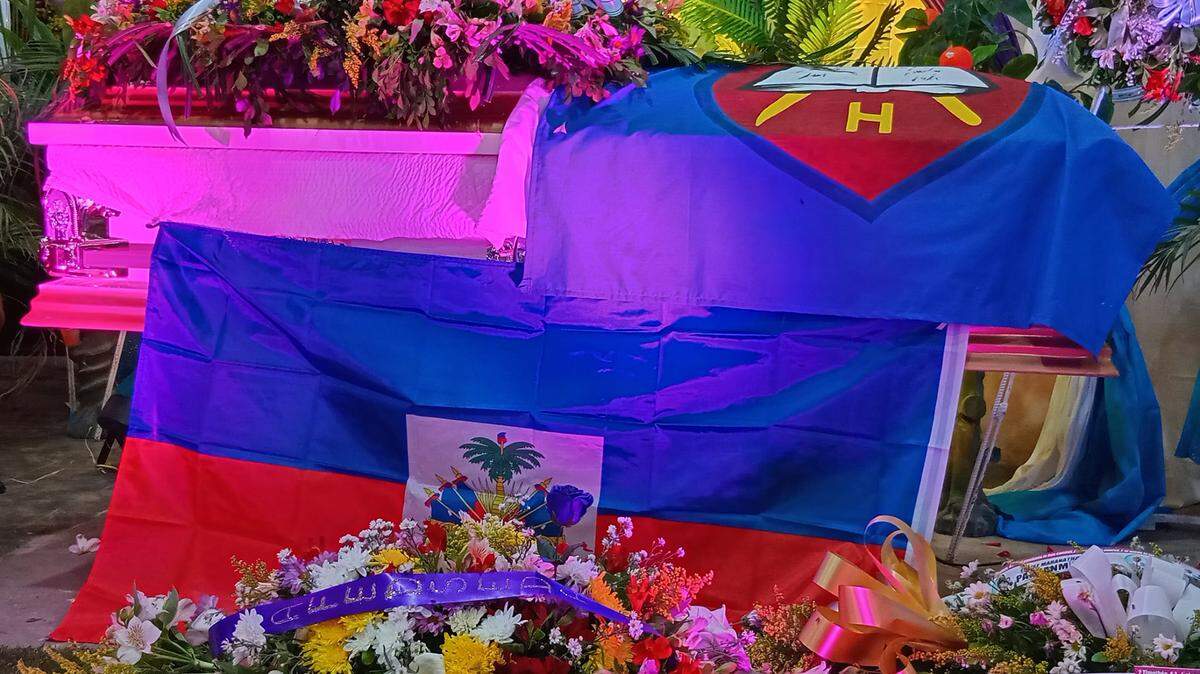
At Brutus’ funeral at the Eben-Ezer Baptist Church of Saint-Marc, the pastor was eulogized as honest and dedicated to his flock, refusing to abandon them even as the violence of Port-au-Prince reached into their once quiet villages.
In a note, the Roman Catholic Church’s Episcopal Conference in Haiti condemned the massacre and called out the interim government for its silence. The government must take responsibility to protect citizens and restore public order, the priests said, reiterating their demand for the perpetrators of massacres and their accomplices to be brought to justice.
“The scale of the evil that is affecting us requires us to make a deep examination of conscience,” the Episcopal Conference said. “Those who destroy lives and kill the dreams of so many families... are a reflection of a sick society, undermined by injustice, corruption and poverty.”
This story was originally published June 3, 2025 at 5:30 AM.