Aid cuts mean Haiti will need to do more to shoulder humanitarian response, UN says
As United Nations agencies and other humanitarian aid groups in Haiti continue to feel the effects of global aids cuts, Haiti will need to take a more significant role in its humanitarian response, a top U.N. official says.
“Part of the humanitarian response needs to be shouldered by the government,” Ted Chaiban, the deputy director of the U.N.’s leading child welfare agency, UNICEF, told the Miami Herald.
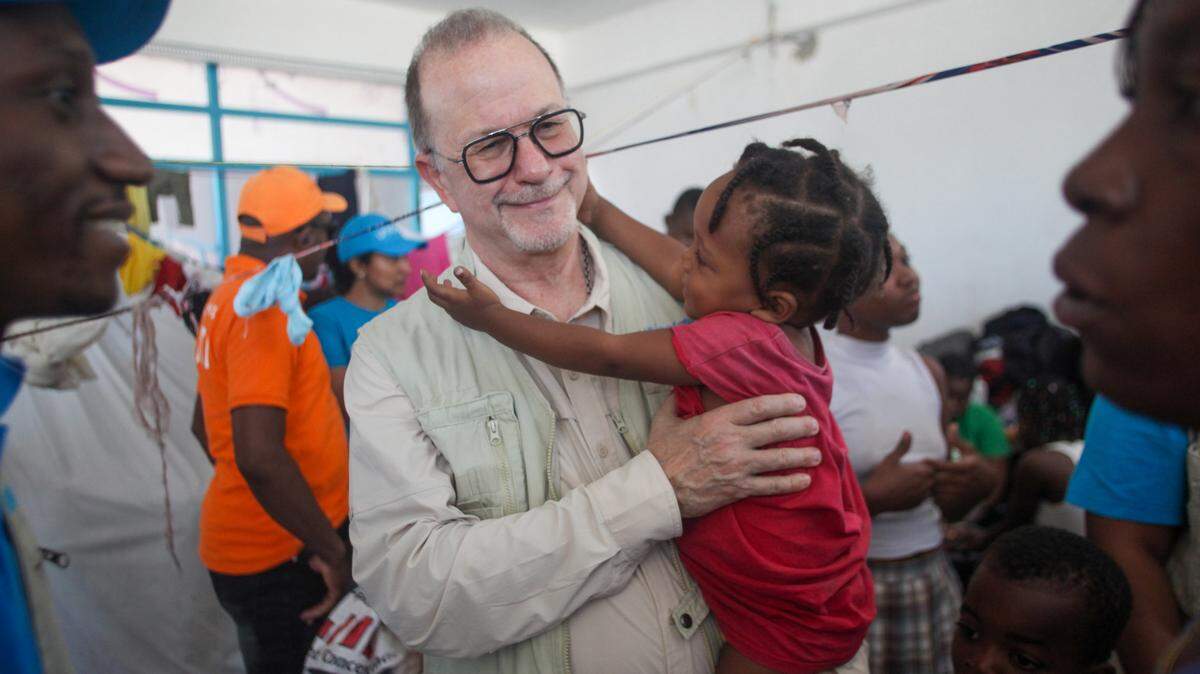
Chaiban, whose connection to Haiti dates back to the early 1990s, spent several days in the country recently. He wanted to see first-hand the effects of the ongoing gang violence that has already led to more than 1,500 deaths this year and the destruction of at least 47 schools. He also wanted to see what was being done to help children, who are increasingly caught in the crossfire.
“The situation in Port-au-Prince in particular is heartbreaking, what’s happening to people who have been displaced many times, who have lost everything,” he said.
Chaiban’s visit first took him to the city of Gonaives in the Artibonite region, where schools and hospitals are still functioning despite the incursion of armed gangs in its lower valley just north of Port-au-Prince. Among his stops was a busy primary-care health center that treats about 500 people a day, including new mothers and babies, pregnant women, malnourished children and victims of sexual violence.
As he toured the UNICEF-funded facility, Chaiban said, the medical director told him that without the agency’s continued support the facility would be forced to shut down.
“Funding cuts have consequences,” Chaiban added.
This was driven home during the visit in Port-au-Prince. He met with government ministers, toured displacement camps and met with victims of the violence. One of them was a 14-year-old girl who had been raped and shot in the face in December when gangs targeted her Lower Delmas neighborhood.
“She was just so strong and courageous in telling us how she’s afraid, she’s not happy about what is going on in her country but the one thing that gives her hope is that she’s still in school; she wants to be a doctor someday,” Chaiban said.
Women and girls are bearing the brunt of the crisis, the nonprofit CARE said. Citing the latest analysis examining the worsening hunger crisis, the group noted that the number of Haitians internally displaced by gang attacks has increased by 48% between June and December of last year, and 300,000 more Haitians now face worsening levels of hunger.
In 2014, only 2% of Haiti’s population was struggling to find enough to eat. Today, that number has spiked to half the population, said Martin Dickler, CARE’s country director in Haiti.
While women and girls are suffering disproportionately due to obstacles they face in accessing food and livelihoods, more than half of those internally displaced are children, according to UNICEF’s figures, and they also account for half of the nearly 6 million Haitians who are in need of humanitarian assistance.
In the displacement camps, Chaiban met children and parents who had been forced to run for their lives, leaving everything behind. Families spoke of fleeing through gunfire and of their homes being burned down.
One site he visited, a school that has been turned into a displacement camp, is sheltering more than 7,000 people. Half of them were were children. There were just four latrines for the entire site.
“Initially the authorities did not want any investments in some of these sites because they wanted people to go back” to their homes, he said. “But the reality is they’re not going back anytime soon and so you need to make some investments like more bathrooms. You need more latrines, you need more sanitation kits, you need more shelter; people are living under plastic sheeting.”
There were a few bright spots, he said. One of them was a private school with 300 students that has taken in an additional 900 students from a nearby public school.
“It’s just remarkable to see a private school hosting a public school with the students from all very different backgrounds studying together,” he said.
Like other U.N. agencies, UNICEF is trying to adjust to funding cuts, he said, that are the result of the United States’ aid freeze and cuts from other donors. In Haiti alone the agency is in need of $272 million for this year, and as of March had only raised $15 million.
“We need to get more resources to be able to continue the work that we do,” Chaiban said.
This includes money to deal with malnutrition. There are 128,000 Haitian children suffering from severe malnutrition who need ready-to-use food and other treatment.
“If you don’t reach a child with treatment,” he said, “they have a tenfold increase in their chance of dying, so it’s a really serious situation when we see funding cuts.”
Because of the overall cuts in development assistance, the Haitian government needs to take a more leading role in the humanitarian response, he said.
Chaiban said that in his meetings with government officials, including the prime minister and the head of the Transitional Presidential Council, he focused on the impact of the aids cuts as well as the challenges the health and education systems face.
“We need a different way to cooperate, where the government needs to have a clear direction... be clear about what it’s putting on the table and say to its partners, ‘How can you complement what I am doing?’” he said.
That collaboration needs to extend beyond the capital, now endangered of falling completely to gang control.
“The situation in Port-au-Prince is dramatic; but Port-au-Prince is not Haiti,” said Chaiban. “There are still services in the north and the south that need to be sustained; there are services that are working, whether its health or education, and we need to keep working... to sustain those.”
Haiti was recently named “a situation of concern” in the U.N. Secretary-General’s annual report on children and armed conflict. Among the report’s alarming trends, which included more than 1,000 percent increase in verified cases of rape and others forms of sexual violence against children, was the recruitment of children by gangs.
The U.N. estimates that as much as 50% of Haiti’s armed gangs consist of children.
Chaiban said he raised the issue with the government, which is required under an agreement with UNICEF to turn over children police find so they can be rehabilitated and reintegrated into society.
“We need to do everything to try and get them out and to keep children in school and try to find economic opportunities.”
This story was originally published April 14, 2025 at 11:41 AM.