U.S. supports the Kenya-led mission in Haiti, Rubio says as more troops arrive
The United States is committed to working with the Kenya-led multinational security support mission in Haiti, but its numbers need increase to restore peace and stability to the country, U.S. Secretary of State Marco Rubio said Thursday.
“That mission, the way it is currently constructed, will not be enough,” Rubio said during a press conference in the Dominican Republic after meeting with President Luis Abinader, where the topic of Haiti was among several discussed. “It needs to find a new direction in order to be successful at rooting out these armed groups that today have taken possession of large portions of Haitian territory and endanger the lives of people and the stability of the region.”
The Dominican Republic, which shares the island of Hispaniola with Haiti, was the last stop on Rubio’s five-day tour through several Central American nations. As he did in Costa Rica, Rubio acknowledged that President Donald Trump’s 90-day executive order pausing virtually all foreign aid had frozen some programs and announced his willingness to issue waivers. He also announced an agreement between the U.S. and the Dominican government to formalize the presence of Customs and Border Patrol agents to work with local police.
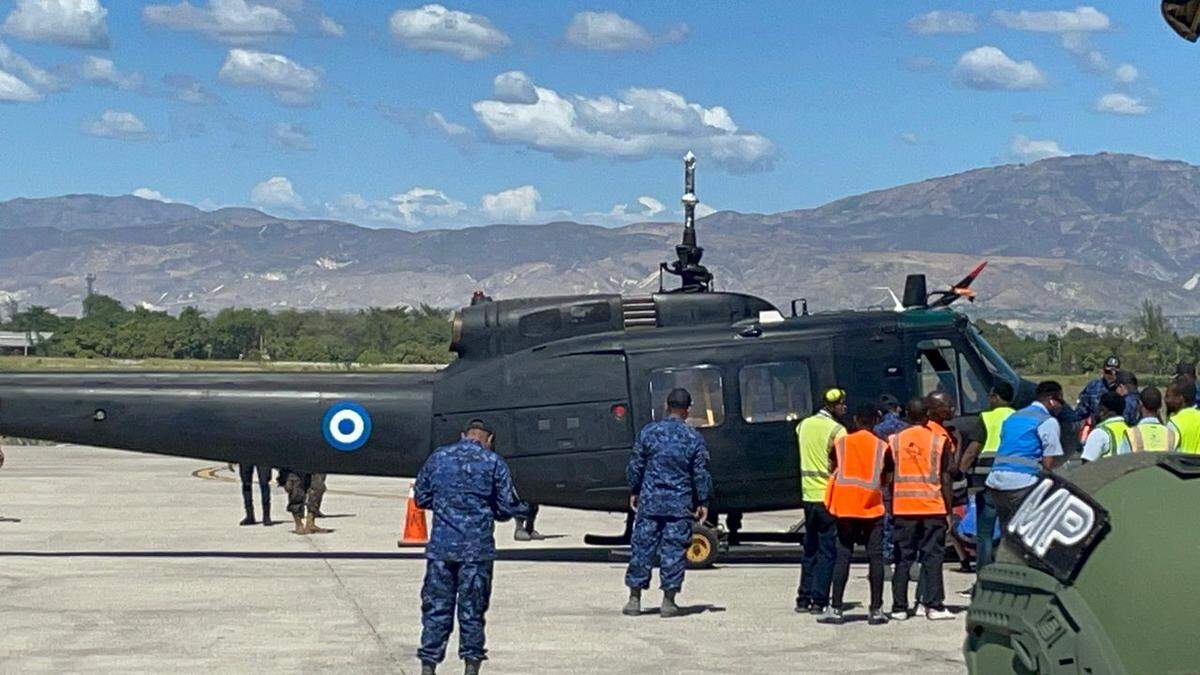
Rubio’s visit and assurances of a U.S. commitment to the international armed mission in Haiti coincided with the arrival of two aircraft at Port-au-Prince’s Toussaint Louverture Airport transporting both personnel and equipment for the mission.
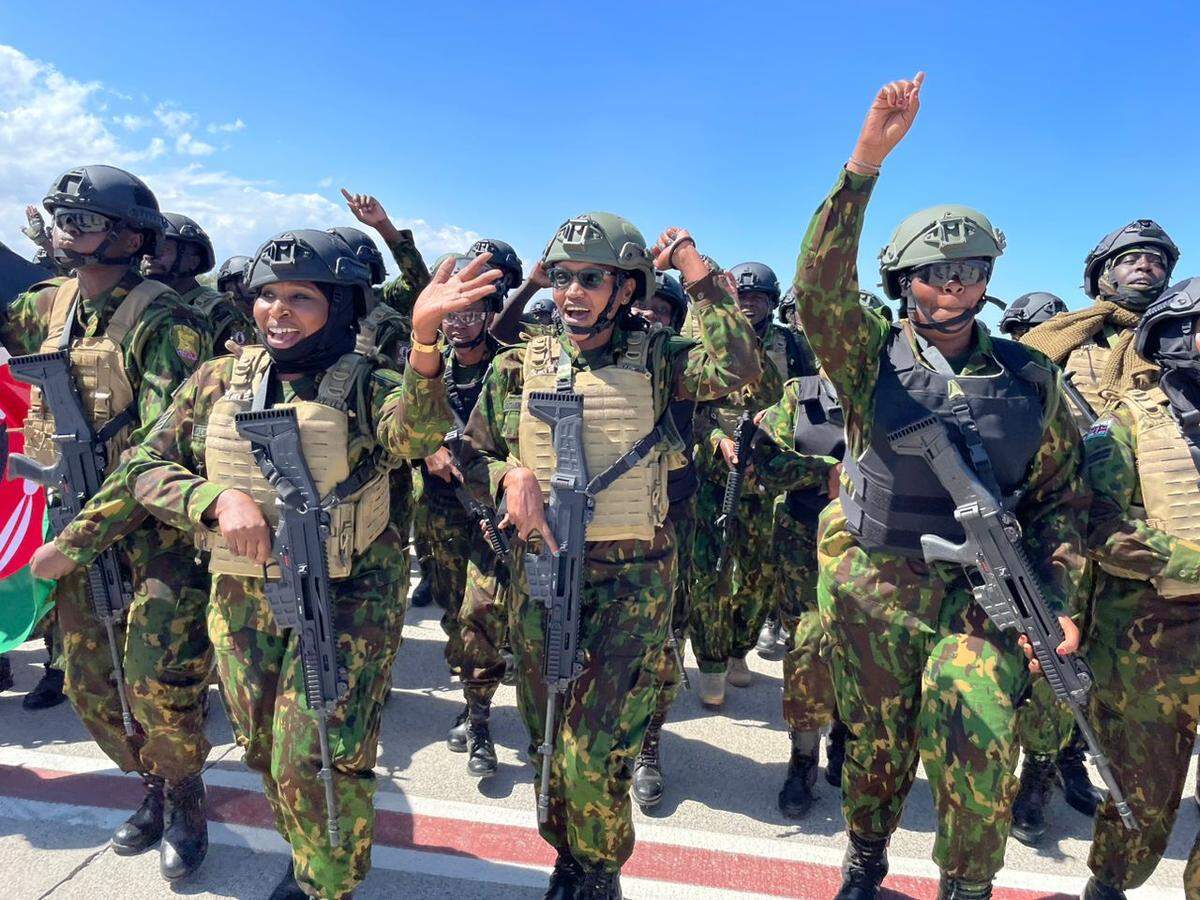
The first aircraft was a Kenya Airways jetliner with 144 police officers aboard. The fourth contingent from the East Africa nation, it included 24 women, the first Kenyan female officers to join the mission. The second aircraft carried three military helicopters from El Salvador for its 70 soldiers in Haiti to use for medical and casualty evacuations. The Salvadoran contingent arrived earlier this week.
The new deployments bring the mission to roughly 1,000 security personnel from a half-dozen countries. While still less than the 2,500 originally envisioned, the additional police and soldiers who arrived this week add significant muscle to the mission, whose small footprint, lack of financing and equipment have made it difficult to battle powerful gangs and hold ground after carrying out joint operations with the Haiti National Police.
Both U.S. and Kenyan officials had been on an information blitz ahead of Thursday’s deployment amid reports that a $15 million contribution to a U.N.-controlled trust fund to support the mission had been frozen as part of Trump’s 90-day freeze on virtually all U.S. foreign aid. The money was part of $110.8 million in cash deposits in the fund — a tiny fraction of the more than $620 million the Biden administration had disbursed for the mission.
“The United Nations is sitting on $100 million in their fund, the United States has provided $15 [million] of the $100 million for that fund. Only $13 million of that is currently frozen. That means they still have $85 million plus the one point something million they spent that we already have in there available for the mission,” Rubio said. “That’s clear, and that’s not an impediment to the mission continuing beyond the U.N. fund.”
Ahead of its departure from office this month, the Biden administration had deployed at least 22 military aircraft to Haiti to buttress the mission. It had also allocated an additional $120 million, a source familiar with the financing told the Miami Herald. Contracts, set to expire next month, have also been extended until September.
Rubio said the Trump administration has signed about $40 million in waivers in order for the mission to continue. According to the U.S. Embassy in Port-au-Prince, the waivers include logistical contracts to support forward operating bases, a vehicle-maintenance contract to support the security mission’s armored fleet, a medical-services contract for the Haiti National Police, transportation services for State Department equipment deliveries, and contracts that support experts with the Haiti National Police. A number of police advisers contracted to provide support to the mission and the police by the State Department’s Bureau of International Narcotics and Law Enforcement Affairs were issued stop-work orders last week. While some of the advisers have returned, others have been let go after contracts were canceled by the U.S. government, sources told the Herald.
“We will continue to support the mission,” Rubio said. But, he added, “the solution for Haiti is in the hands of the Haitian people, in the hands of the Haitian elite. But we will help. We can’t ignore the problems.”
Rubio also used his visit to the Dominican Republic to make a pitch to his former colleagues in the U.S. Congress to support the extension of the duty-free trade preference program known as HOPE/HELP, which he said can help create light manufacturing jobs and investment opportunities once peace is restored in Haiti.
“I was one of the sponsors of that draft bill. Now another senator is working on that. The idea is to continue with that law so that those opportunities can be there for Haiti and its future. It is an issue of importance. We care about it,” he said.
A call to Kenya president
On Thursday, amid his scheduled visit with Abinader, Rubio called Kenyan President William Ruto to thank him for his support to Haiti and to reinforce the U.S. commitment. As they spoke, the Kenyans were en-route to Haiti.
“It’s a credit to Kenya, who’s come halfway around the world and are willing to stand up and do something about it, when countries in our own hemisphere, they’re not willing to do anything about it,” Rubio said about the Haiti crisis. “I won’t go through and list all of them and start some diplomatic fight my two-and-a half weeks into my term here. But I’m just telling you there’s some rich countries out there and they’re not doing nearly enough about it, and they could be doing more. So, I encourage them to do more.“
Abinader echoed Rubio’s sentiments, but added that given the humanitarian and security crises in Haiti, the leadership of the U.S. is fundamental. Last year at least 5,626 people were killed at the hands of gangs, self-defense groups and police operations, the U.N. said this week. Meanwhile gang control up to 90% of Haiti’s capital.
“Haiti is drowning while a significant part of the international community is watching from the sidelines without showing the commitment that this serious situation requires,” Abinader said. “We both know that we must not shirk our responsibility to have a firm determination.”
Rubio and Abinader said they tackled other issues involving energy security and the Dominican Republic’s cooperation in drug trafficking operations and extraditions. They also discussed the upcoming 10th Summit of the Americas in December in the Donminican region of Punta Cana. But Haiti was and its growing gang violence was a top discussion item.
“The DR’s commitment to regional stability is firm... This is a situation that requires a coordinated, solid response from the entire international community,” Abinader said. “We have highlighted the urgent need to have greater financial support for the multilateral support led by Kenya, the goal being to expand its operational capacity and ensure effective actions.”
Rubio did not go into details about what a newly envisioned Kenya-led mission should look like. Nor did he say whether the Trump administration will support a request by Haiti ‘s transition government to have the mission transformed into a formal United Nations peacekeeping force, which would have its financing covered by assessed U.N. contributions rather than voluntary disbursements from individual nations.
In October, as gangs continued to gain ground and new neighborhoods came under their control, the head of Haiti’s Transitional Presidential Council, Leslie Voltaire, formally asked the U.N. Security Council to bring a peacekeeping mission back to Haiti. At the time gangs had forced more than 700,000 people to flee their homes and controlled key access roads in and out of the capital and the neighboring Artibonite region.
Both Russia and China, which have veto power in the Security Council, have said they do not support a peacekeeping mission for Haiti. And they have not contributed to the U.N.-controlled trust fund for the mission.
The mission currently has security personnel from Jamaica, Belize, the Bahamas, Guatemala and El Salvador. The arrival of the latest contingent of Kenyans comes at a critical time.
All week, concerns of a gang attack have been growing as the country approaches three critical dates: Friday, Feb. 7, which is historically the day that a new president usually takes office; Feb. 29, which will mark the one-year anniversary since the official public creation of the powerful Viv Ansanm gang coalition, and March 7, the date that Voltaire, the current head of the Transitional Presidential Council, is expected to pass the baton to Fritz Alphonse Jean in the rotating presidency.
Since last week, gang members have been taking positions in the mountains of Kenscoff, a rural farming community above Port-au-Prince. They’ve massacred farmers, emptied out towns and set up supply lines of food and water. The gangs’ goal, local officials say, is to take over the last remaining swaths of the capital, including the wealthy enclaves of Fermathe, Pétion-Ville and the parts of Kenscoff not under their control.
Local authorities, who have been unable to reach many of the communities currently under siege, have refrained from giving an exact figure on the death toll. But local residents say that at least 150 people have been killed. They’ve also said the gang members number anywhere between 1,000 and 3,500.
This story was originally published February 6, 2025 at 1:16 PM.