Haiti’s goal to elect new president by 2026 endangered by political setbacks, UN says
The head of the United Nations says there is a possibility that Haiti’s crisis-wracked political transition, already in its fourth year since the 2021 assassination of the country’s president, may not meet its election timeline to restore democracy and put a new president in office by February 2026.
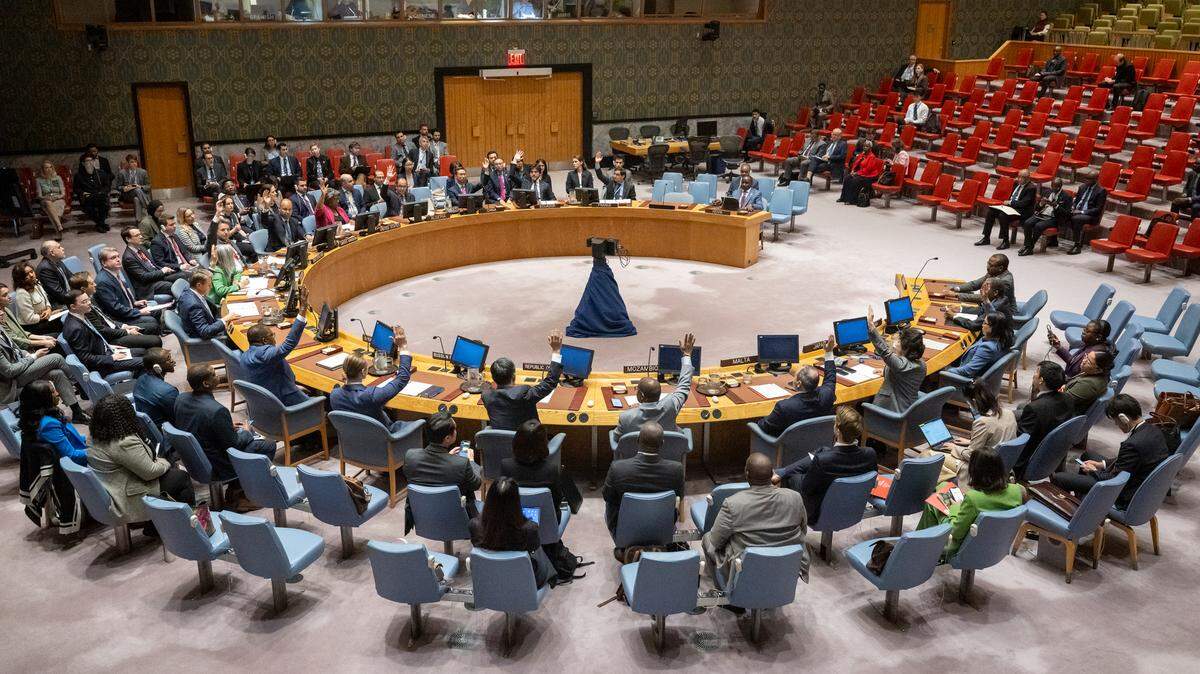
U.N. Secretary-General António Guerres made the observation in his latest report to members of the U.N. Security Council, who met on Wednesday as part of their regular quarterly updates on the deteriorating crisis in Haiti.
Guterres said that while a nine-member Transitional Presidential Council, made up of representatives of Haitian political parties and civil society groups, had made some progress by naming a provisional elections entity to stage a constitutional referendum and general elections this year, the transition’s road map for returning Haiti to political stability with an elected parliament, local mayors and president is threatened by political setbacks.
Outside of the ongoing violence by armed gangs, the process is being overshadowed by last November’s reshuffling of government ministers, triggered by disagreements over power-sharing, and corruption allegations involving three members of the ruling council. All are fueling waning public confidence in the political transition and contributing to a climate of rampant violence by armed gangs, he said. The gangs’ widespread and indiscriminate acts of violence led to Haiti’s bloodiest year in 2024, with more than 5,600 people killed by armed groups and over 1 million displaced.
With progress on the transition map “worryingly slow,” there is a risk that Haiti could fail to complete the steps outlined in a governance pact that was agreed upon in March 2024 to put a new president in office next year, Guterres said.
“Simply put, the goal of restoring democratic institutions by February 2026 is in jeopardy,” he said. “Disagreements among authorities and stakeholders on power-sharing and ways to strengthen transitional governance have hindered progress. Ongoing allegations of corruption risk further eroding public trust in the political transition.”
If the elections do not take place on time, the question becomes what happens to the current transitional government. The council has been target of calls for a reconfiguration following its lack of action on the corruption allegations, dissatisfaction with many of its decisions and the escalating gang violence.
Guterres called on Haiti’s leaders to uphold the principles that they agreed upon and to prioritize dialogue and inclusivity in attaining the transition’s objectives.
In March, as a newly united coalition of armed gangs launched coordinated attacks across Port-au-Prince, foreign diplomats led by the U.S. and Caribbean Community leaders met in Jamaica to help the country’s factious leaders craft a new path forward toward restoring political stability.
A governance pact led to the creation of the ruling council, made up of seven voting members and two observers. Acting as the nation’s executive authority, they were tasked with appointing a new prime minister and caretaker government, welcoming a Kenya-led Multinational Security Support mission to help fight gangs and paving the way for elections, which hadn’t taken place in nearly a decade.
“Despite an environment of violence, political instability and an acute economic crisis, Haiti has made notable progress, which should be welcomed,” Haiti’s new foreign minister, Jean-Victor Harvel Jean-Baptiste, told the Security Council. “The Provisional Electoral Council is now completed.... This is a crucial step toward the holding of elections in Haiti. The upcoming national consultations on constitutional reform are also a reflection of our commitment to meet the aspirations of the Haitian people to have more inclusive and effective institutions.”
Earlier this month, the Working Group on the Constitution, led by former lawmaker Jerry Tardieu, submitted a report summarizing proposals received from various groups on what changes should be made to the constitution — but doesn’t propose a new constitutional text. It has recommended that a new constitutional assembly be held to draft the new text to add legitimacy to the process.
The transitional authorities have yet to react to the working group’s recommendations, nor have they publicized a date for either a referendum vote or general elections, which usually require a lead time of between five and 16 months due to logistics and security challenges.
Even under better times, Haiti has struggled to pull off elections. The current security situation has raised doubts about how any vote can take place in the current environment, and the unresolved issue surrounding the corruption allegations facing the ruling council also risk undermining the transition’s goals.
On Wednesday, as Security Council members condemned the brutal acts of violence and called for more financial assistance for the under-funded Kenya-led security mission, they shared Guterres’ concerns about the country’s ability to restore democratic institutions.
“We see that the Transitional Presidential Council has failed to convince the Haitians of its legitimacy and effectiveness,” Russian Federation representative Vassily Nebenzia, said. “The prospects for holding general elections within the agreed time frame are illusory.”
Nebenzia said Haiti’s killings and other acts of violence, which include gang attacks on three U.S. commercial jetliners in November, put the Caribbean nation on par with nations struggling with internal armed conflicts.
“It is not by chance that crime and lawlessness are raging in the country, it is something that the vacuum of power results in, which manifests itself in the lack of democratically elected authorities in the country and has lasted for several years already,” he said.
It was unfortunate, Nebenzia added, that the temporary governing structure “created according to the foreign templates are not coping with the tasks assigned to them and have already used up the trust placed on them.”
The three members of the presidential council suspected of corruption _ Smith Augustin, Louis Gérald Gilles and Emmanuel Vertilaire — have maintained their innocence and mounted legal challenges. The three are accused with asking the chairman of the board of the state-owned National Bank of Credit for $758,000 in exchange for him keeping his job. In December, the country’s Anti-Corruption Unit recommended that criminal charges be pursued against the three council members for abuse of office, bribery and corruption. Although an investigating judge summoned them for questioning, the council members refused to appear.
James Kariuki, the United Kingdom’s deputy permanent representative to the U.N., said Haiti’s violence and political instability are having a profound effect on Haitians.
“At least one Haitian was killed, kidnapped or injured every hour as a result of gang violence in 2024,” he said. “Gangs continue to use executions, kidnappings and sexual violence as tools of oppression against civilians.”
Geng Shuang, China’s representative., said the “incessant fights among parties and factions, announced acts of abuse of power and corruption” are rendering the goal of completing the transition “elusive.”
“The long standing absence of legitimate authorities and vacuum inside governance have plundered Haiti into vicious external support and jeopardize the confidence of the Haitian people and the international community’s prospects,“ he added.
Geng said “it is heart wrenching to see innocent people suffer as a result,” of the gang violence.
Guterres noted that the upsurge in violence has also caused the U.N.’s political mission in Haiti to shut down an increasing number of services. The mission’s main cable connecting Haiti to the internet has been repeatedly cut by armed gangs over the past three months, compromising cellular and wifi connectivity for up to three days at a time, his report said. Also, the closure of the Toussaint Louverture International Airport in Port-au-Prince and the ransacking and burning down of one of the last critical-care hospitals, Bernard Mevs, has forced the mission to go down to a skeleton staff.
“The transitional government should prioritize governance over competing personal and political interests,” Dorothy Camille Shea, the U.S. representative on the Security Council, said. “Now is not the time for political infighting.”
Shea reiterated U.S. calls for the transitional council to set conditions for free and fair elections.
“We strongly encourage Haitian efforts aimed at addressing corruption allegations and promoting transparency and accountability,” she said. “These measures are essential for the transition government to maintain the trust of the Haitian people.”
This story was originally published January 23, 2025 at 5:30 AM.