‘A hospital is not a war zone’: Haiti prime minister tours gang-ravaged medical facility
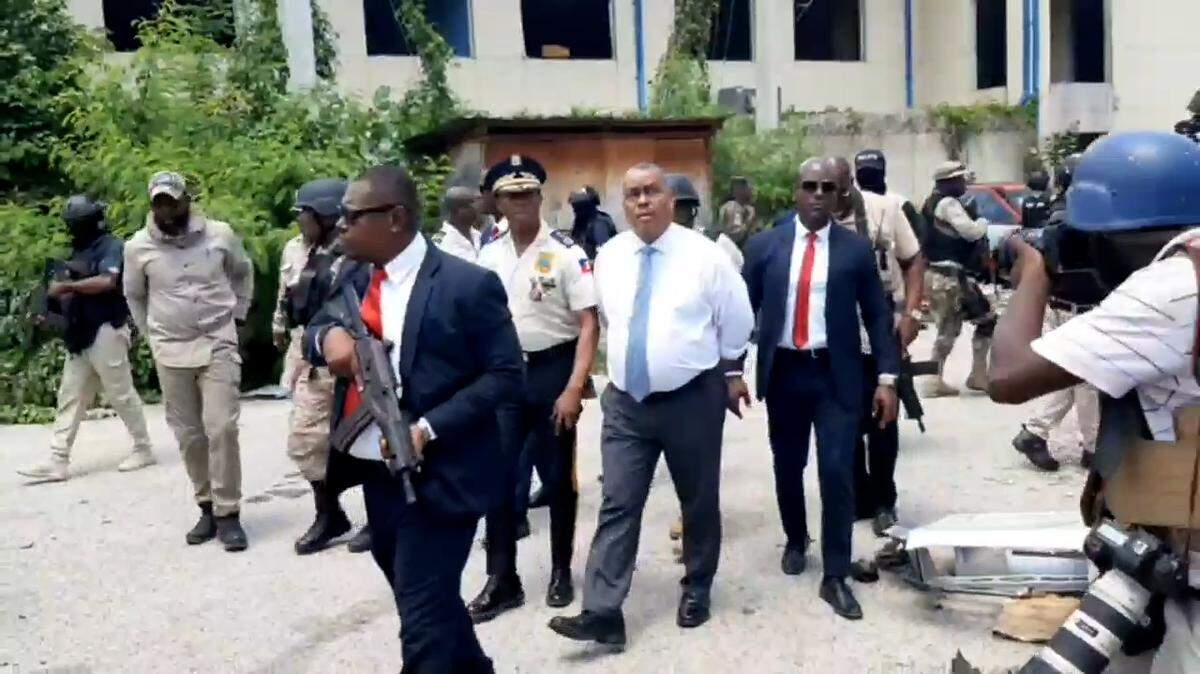
The day after the Haitian police triumphantly announced they had reclaimed control of the largest public hospital after a four-month siege by powerful gangs, the country’s prime minister decried the destruction.
“A hospital is not a war zone,” Prime Minister Garry Conille said Tuesday while touring the battered grounds of the green-and-white facility not far from the presidential palace and the French embassy in Port-au-Prince. “Even under the worst circumstances, hospitals are protected.”
Conille, a gynecologist by training, walked the gang-ravaged premises of the Hospital of the State University of Haiti under heavy security. As he and Haiti National Police Chief Rameau Normil inspected the structure, Conille could not hide his shock as he pointed out the bullet holes riddling the walls and the toppled furnishings on the floor.
All were harsh reminders of the constant gun battles that have blanketed Port-au-Prince since Feb. 29 and made both the hospital and its adjacent, still-under-construction 534-bed replacement facility, off limits.
“We will take back our spaces,” Conille said, reiterating his support for the Haitian police while promising to give the beleaguered force “everything it needs.”
On Monday, Normil announced a rare victory: Police, he said, had reclaimed the General Hospital, as it is commonly called, from gangs after successfully launching an operation the night before. He made the announcement while standing alongside the commander of the Kenya-led Multinational Security Support mission, Godfrey Otunge, in their first joint press conference.
The developments were preceded by a cleanup operation of downtown Port-au-Prince, including the area around the General Hospital that got under way last week. The campaign was launched by Magalie Habitant, a controversial figure and one-time director of the National Solid Waste Management Services during the administration of President Jovenel Moïse. In an interview with Port-au-Prince-based radio station Magik 9 ahead of Conille’s surprise visit, Habitant pushed back on claims that contacts with armed groups allowed her and her crews to access the area freely after months of violent clashes. She said the cleanup was a private initiative supported by members of the business community, whom she declined to name, along with members of the Transitional Presidential Council and the ministry of public works.
Whether the calm holds in order for the hospital to resume operations remains to be seen. In an interview with the Miami Herald, Dr. Jude Milcé, the hospital’s executive director, said “it’s a must” that the hospital, whether in the form of its old structure or new construction, reopen. Before the siege the hospital served about 5,000 outpatients a month, performed 50 surgeries daily and treated between 200 and 300 emergencies daily, he said. It also is a training hospital for the country’s future doctors.
“The old building was functioning but under difficult circumstances,” Milcé said. “When the bandits came, the situation became even worse. The first thing we are going to try and do if the area really is stabilized is an evaluation of the damages to see what we can do in the old structure.”
The General Hospital is among dozens of medical facilities that stopped operating or were burned down after armed gangs united on Feb. 29 and launched deadly attacks to try to topple the previous government.
Located across the street from the presidential palace, a prime target of the gangs, the hospital was soon forced to close its doors and evacuate its patients. Meanwhile, the area surrounding it and its new replacement building had become a no-go zone.
Recalling his early days in Haiti before he went on to become a United Nations development specialist, Conille said the General Hospital used to receive around 1,500 patients a day. Nowadays it’s zero.
Badly destroyed in Haiti’s 2010 earthquake, Haiti’s largest public hospital faced it share of troubles even before the armed attacks. Still, staff and patients had long pinned their hopes on the new facility.
Milcé, who learned about Tuesday’s visit by the prime minister in the media, said until he’s able to tour the grounds of both the old structure and the new building he cannot say when Haiti’s poor will once more get access to healthcare. He first made a request to police eight days ago to visit the area and he was told it wasn’t possible.
Construction on the new General Hospital was supposed to resume in April after an agreement was reached late last year with the Spanish firm in charge of the building. The firm, according to a source familiar with the discussions, had preconditioned its resumption of work on the condition that there would be full security on the site of the hospital and a deployment of an armed international force in Haiti. Based on those conditions, the firm had anticipated it would take 18 months for the new General Hospital to be ready. However, with no idea of the current state of the new building and of the damage done recent months, it is difficult to say what will happen now, those involved say.
France and the United States have been trying to build the new General Hospital for the past 14 years, but both governments have faced a series of delays over contract disputes with the contractor and financing. The representative of the French Agency for Development, anxious to get an idea of the damages, recently flew a drone over the area to see if he could get some answers.
The French Agency for Development has provided nearly $44 million and the U.S. Agency for International Development $35 million, of which $10 million was paid out just two years ago toward the construction costs. Haiti, meanwhile, has disbursed $23 million of the $27 million it said it would provide. Despite the large investments, the fate of the facility is up in the air.
Among those who joined Conille on the visit Tuesday was Louis Gérald Gilles, one of the members of the newly named presidential council. France’s ambassador to Haiti, Fabrice Mauriès, was also hoping to visit the facility. Even before Conille and Gilles’ visit, the French embassy had also requested a visit to the site for Mauriès and a representative of USAID to see what it will take to get the new facility up and running.
“We think that the next useful step is for an expert mission to be mandated on the spot in order to assess the situation and the conditions for the resumption of the work of the new General Hospital of Haiti,” a spokesperson for the French Agency for Development told the Herald.
This story was originally published July 9, 2024 at 9:07 PM.