In Haiti visit, UN General Assembly head tells leaders: ‘Prioritize the Haitian people’
As a political impasse continues to leave Haiti without a clear path to a functioning democratically elected government, a United Nations leader is challenging the country’s political class and civil society leaders to think about their people.
The country’s deepening spiral, made worse by the July 2021 assassination of President Jovenel Moïse, has left its nearly 12 million citizens without any elected leaders and a multifaceted crisis where raging gang violence, sexual assault and kidnappings by armed gangs are growing, hunger is deepening and the economy is in shambles.
“The situation in Haiti is not hopeless,” Dennis Francis, the Trinidadian diplomat who was elected by the United Nations General Assembly in June as president of its 78th session, told the Miami Herald at the conclusion of his visit to Haiti, which ended Tuesday. The leaders, Francis said, “have to find a way to work together in the interest of the country.”
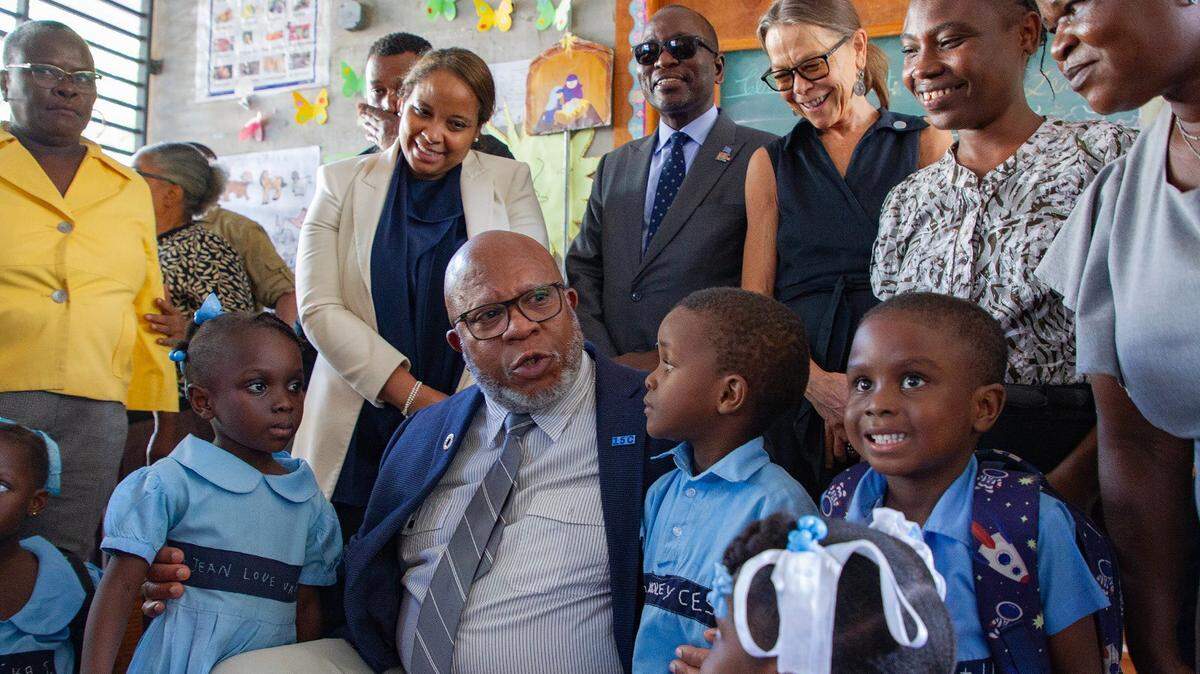
This is the challenge Francis, 66, posed as he visited Port-au-Prince over two days this week — his third overseas trip since assuming the leadership role in September of the U.N.’s main policy-making body, the General Assembly, and his first to Haiti in more than 40 years.
“They all spoke about the need to fix Haiti,” he said. “I emphasized to them that the question of fixing Haiti resides in their hands. The international community cannot fix the problem, the solution to the problems in Haiti have to be Haitian solutions to the problems, and the international community, the U.N. and others will hold their hands and accompany them on that journey to provide assistance and support where necessary.”
During the visit, Francis met with Prime Minister Ariel Henry along with his ministers in charge of justice, foreign affairs and women’s affairs. He also sat down with representatives of political parties and civil society groups, who after more than two years of negotiations remain at a political impasse over how to govern the country and get it to long-overdue elections.
In the encounters, Francis reflected upon the importance of Haiti, which has no elected officials currently, returning to constitutional order and reinstating its most basic public services to meet the needs of the country’s population. He also stressed the urgent need for Haitians to identify “concrete avenues in which the international community can support Haitian-led solutions to restore and maintain the country’s stability and sustainable development.”
“In fact, I challenge them,” Francis said. “I said to them, you know, ‘You are the political elites in Haiti. You are concerned about the fact that the existing regime is not a democratically elected one. And it is your impression that they are very comfortable holding on to power.”
“But I said to them, ‘When are you going to prioritize the Haitian people? That is where your concern needs to be. Because if this country is to develop and you want to give the young Haitian children any hope for living out their lives in dignity, and enjoying the dignity and honor of having a job, being able to look after their families, there is no other way to do it, you have to honor the people,’” he said. “And you have to make the people the national priority. Not the elites, not the politicians, not those who have access. The country belongs to the people, all of the people.”
Haiti’s political impasse is increasingly giving way to frustrations both at home and abroad as the country’s crisis worsens by the day, and the prospect of outside help arriving with the deployment of a Multinational Security Support Mission, led by Kenya, remains blocked by a court order. Despite a resolution by the U.N. Security Council giving the mission legal backing and a vote by Kenya’s parliament last week authorizing the deployment of 1,000 of the East African nation’s security officers to be deployed to assist Haiti, the High Court in Nairobi delayed a decision until late January on an opposition group’s challenge to the effort.
Members of the international community, while recognizing the urgent need to help Haiti take down gangs, continue to call on Henry and the country’s political and civic forces to come to a political consensus on how to govern in order to help find a solution out of the crisis.
On Tuesday, the 15-member Caribbean community, which has been trying to help with negotiations, said a Nov. 8-14 visit by its Eminent Persons Group to Port-au-Prince did not result in a political deal as it had hoped. Prior to the visit by the group, made up of the former prime ministers of The Bahamas, Jamaica and St. Lucia, there was talk about the prospects of a tentative agreement following discussions led by former British diplomat Jonathan Powell, who succeeded in getting Henry to agree to make concessions to share power.
But those prospects faded, the regional bloc known as CARICOM said, when the former prime ministers arrived in Haiti and found that it was immediately apparent in discussions “that the earlier intransigent position of some sections of the opposition group insisting on the resignation of the prime minister as a pre-condition for meaningful discussions still prevailed.”
Until now, that position has not been supported by the United States or others in the international community, whose diplomats have said that if Haitians want leadership change, they must do so at the ballot box.
During his visit, Francis did not address the demands for Henry’s resignation. But he was frank and told Haitians to stop squabbling, according to two people who were present during the meetings.
“It’s my sense in the conversations that they’re very devoted to their country,” Francis said about the Haitians he met with. “That is an important, necessary requirement…. I really felt a great sense of hopefulness because there is a resilience. There is a survival instinct. There is character in the Haitian people. And I think the basic ingredients are there for this country to stand up and take its place among the community of nations and function properly as a mature democratic state.”
Francis is among several high-level U.N. diplomats who have visited Haiti in recent months. The U.N. Security Council has passed three resolutions concerning Haiti since the summer and a committee is currently deciding on designating new names to a sanctions list after agreeing last year to target individuals involved in Haiti’s gang crisis and instability.
In July, U.N. Secretary General António Guterres visited Port-au-Prince as part of an effort to get the Caribbean Community and others to support the Haitian government’s request for an outside security force to help the police tackle gangs, and shore up support for the U.N.’s humanitarian efforts. As U.N. chief, Guterres is tasked with carrying out Security Council resolutions, which are binding.
The General Assembly, meanwhile, has its own resolutions. Though they are non-binding, it’s where all members of the U.N. have an equal say on a full spectrum of issues before it, not just peace and security.
Francis is hoping to use his stature and his role for the next year to bring attention to the issues he cares about, Haiti among them.
“I am from Trinidad and Tobago. Haiti is a member of CARICOM, an integral member of CARICOM. And the people of the Caribbean are deeply concerned and worried about what has taken place and is taking place in Haiti,” he said. “We have an extraordinary respect for the Haitian people, because it’s not lost on us that Haiti led the way in declaring its independence, hundreds of years ago, it was the first one in the Western Hemisphere.”
‘The U.N. has not forgotten and will not forget’ Haiti
Francis last visited Haiti in 1979. At the time, the country was still under dictatorship and Francis had just graduated from the University of the West Indies in Jamaica.
When he became president of the General Assembly, he wanted Haiti to be his first overseas trip, he said. However, he ended up having to travel to Seoul, South Korea, in September for a meeting of the Council of Former Presidents of the General Assembly and then this month to the Cook Islands in the Pacific.
With so many issues vying for the world’s attention, Francis said he wanted to send a clear message to Haiti and its people.
“I felt it was important to deliver a message to the Haitian government and people and that message is that with all of the crises going on in the world, with the war in Ukraine, the situation in Gaza, the conflicts in Africa, the international community, the U.N. has not forgotten and will not forget,” he said.
“As I said to the people in Port-au-Prince... Haiti is not politically immature,” he said. “It might be immature as a democracy, as a young democracy, but young democracies work and they work because people make them work. The politicians make them work. And that is what has to happen in Haiti.
“People must step up to the plate, make responsible decisions that are based on the welfare and the well-being of the people, and what is good and right for the Haitian economy and for the Haitian people.”
This story was originally published November 22, 2023 at 2:03 PM.