
Violence, China’s influence in Latin America require urgent U.S. attention, experts say
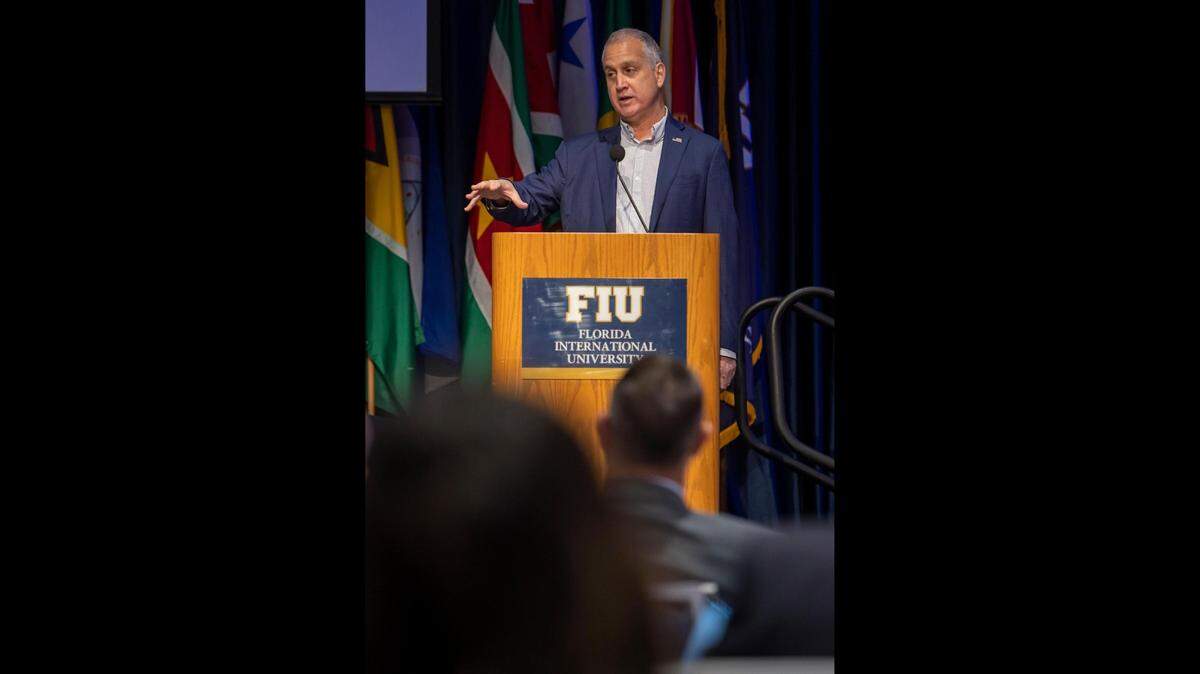
The United States should prioritize its relationship with Latin America and the Caribbean at a time violence and security concerns are growing, driven by gangs and transnational criminal organizations as well as by China and Russia, which are vying to increase their influence in the region, policy experts and former and current U.S. officials said Tuesday.
Colombia, a close U.S. ally, was also at the center of the discussions at the annual Hemispheric Security Conference at Florida International University.
In his remarks, Florida U.S. Rep. Mario Díaz-Balart blasted the policies of the South American country’s president, Gustavo Petro, a former guerrilla, and threatened to push to put U.S. aid to Colombia on hold.
“Colombia is among the most important allies of the United States in the entire planet…. And now, we see backsliding in a country that is important for our national security interests,” said Díaz-Balart, who chairs a subcommittee in the House Appropriations Committee that decides on the U.S. foreign policy budget.
“We have some important decisions to make there,” he said. “Do I just tie that funding to a lot of strings? Or do I eliminate it until we are able to have further conversations with this president to figure out if, in fact, he’s going to continue going down the same pathway?”
“Unfortunately, we have not had a very consistent U.S. policy” towards the region, he added.
Echoing a frequent criticism in policy and diplomatic circles, Ambassador Paula Dobriansky, former undersecretary of State for Global Affairs, said that the United States should put its relationship with Latin America and the Caribbean “front and center.”
“I’d like to see a U.S. elected president making his first trip to the region,” said Dobriansky. “It’s disheartening; we have not prioritized the region.”
Speaking from the White House via video conference, Juan Gonzalez, the National Security Council’s senior director for the Western Hemisphere, seemed to have provided in passing an example to those arguing the United States is not paying enough attention to its relations with Latin American countries.
Asking why it took President Joe Biden more than a year to grant a meeting to former Colombian President Ivan Duque but less time to give one to Petro, Gonzalez said that during his first year in office, President Biden was “exclusively focused on the U.S. and the American people.”
Gonzalez said the administration’s position to set aside disagreements with Petro to forge a relationship has paid off, claiming that cooperation with Colombia has been unaffected.
Deputy Assistant Secretary of Defense Daniel Erikson stressed that the United States wants to strengthen cooperation and is still seen as a “relevant partner” in the region. But Gen. Laura Richardson, the head of the U.S. Southern Command, also said the U.S. needs to do more to counter China’s influence in the region.
“We don’t want this region to fall victim to” China’s Communist Party, Richardson said. “We need to help our democratic partners to provide for their people at a speed of relevance.”
Richardson called for better collaboration between the United States’ own agencies to better engage with countries in the region. “We also need to invest more to provide a positive and timely alternative” to China regarding critical infrastructure projects in these countries, she said.
Dobriansky believes the United States should seek to expand trade with countries in the Western Hemisphere. The Biden administration has launched a new economic initiative, the Americas Partnership for Economic Prosperity, with 11 countries, but the main goal is to build on existing trade relationships, not necessarily seek new trade agreements.
Other presenters pointed out other threats that need immediate attention.
María Paula Romo Rodríguez, former government minister of Ecuador, said homicide rates in that country have skyrocketed in the past two years, in part because of the expansion of criminal organizations during the COVID-19 pandemic. She urged policy makers to pay attention to the more than 100,000 children that lost one or both caregivers to the pandemic in the region, who could be at risk of being recruited by criminal organizations.
Presenters agreed that the United States should do more to combat violence in the Caribbean in general, where homicides rates have notably increased in the past two years, driven mainly by guns smuggled from the United States.
“The United States should join the Caribbean on its war on guns,” said Samantha Chaitram, a fellow at Caribbean Policy Consortium.