Haitian authorities plead for calm, promise better protection for cops after gang attacks
Haitian authorities vowed Friday to continue the fight against criminal armed gangs who this week plunged the volatile Caribbean nation into a new crisis after their “targeted” armed attacks left 14 cops dead in less than two weeks.
Urging officers not to be manipulated by those seeking to fuel further instability, Haiti National Police Chief Frantz Elbè called for “calm and serenity.” He also announced a series of measures to reinforce police substations throughout the country and better equip officers, many of whom expressed anger over the deaths by taking to the streets Thursday in violent protests.
Since July 2021, when Prime Minister Ariel Henry took charge of the country, some 78 police officers have been murdered, an average of five officers a month, Haiti’s National Human Rights Defense Network said.
“We will not give up. We will not back down from the bandits,” Elbè said during a press conference from police headquarters in Port-au-Prince. He said the “solution is coming together, hand in hand and unity among the different sectors of the country … and unity in the larger police family.”
In a separate address to the nation hours later, Henry gave his condolences to the families of the officers and said “we will not let gangs...divide us.”
“The government understands your pain,” he said, adding that he’s asked the police chief and top brass to meet with police groups and submit a report to him within 24 hours with recommendations.
Henry acknowledged that police deserve protection and his embattled government has its work cut out, starting with meeting disgruntled police officers’ demands for the equipment to do their jobs. He promised to take measures so that “these acts are not repeated again.”
“What is happening is unacceptable,” Henry said. “The offsprings of the country who choose to defend the country while others are fleeing abroad deserve another kind of treatment.”
Henry and Elbè’s comments came on a day in which most of the streets of the normally crowded Haitian capital were empty. They were devoid of most cars — and police presence — as officers went on a de facto strike to protest the recent killings and ineffectual government response.
Despite the strike, specialized units of the police launched an early morning operation against one of the country’s most powerful gang leaders, Vitelhomme Innocent, whose increasingly expanding territory includes the area not far from the U.S. Embassy and the Police Academy. Innocent’s gang, which has been singled out by the FBI for kidnappings, has been linked to several recent cop killings, including the head of the Police Academy.
Protesters target prime minister
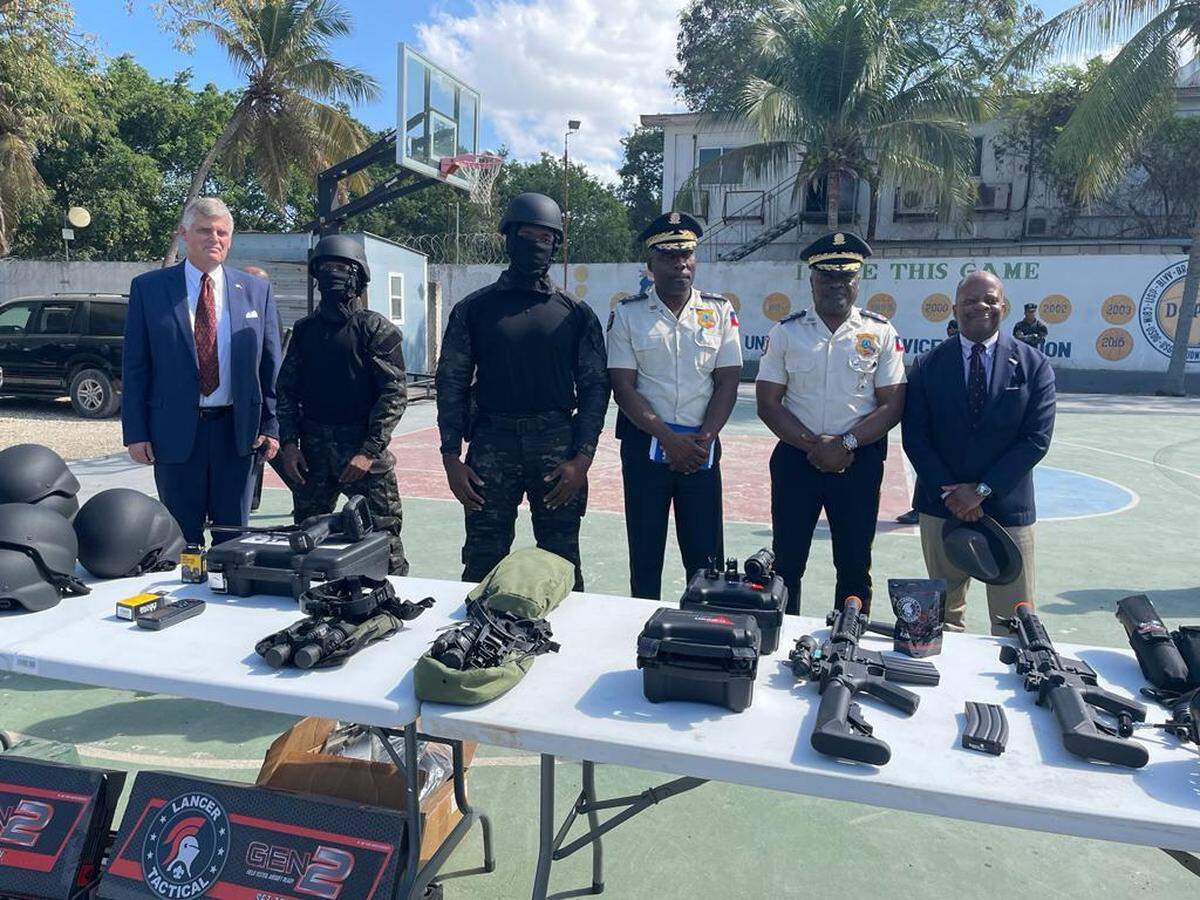
Elbè spoke briefly about the anti-gang operation Friday as he joined U.S. Chargé d’affaires Eric Stromayer and Todd Robinson, assistant secretary for the Bureau of International Narcotics and Law Enforcement, on a visit to the training grounds of the country’s new SWAT, which the United States is helping to train. Robinson flew to Haiti on Thursday, and was at the airport meeting with Henry when protests broke out shortly after their flight landed.
Robinson, who was in Haiti overnight, came to provide support to the Haiti National Police and to deliver security equipment. Like others in the international community, Robinson expressed concerns about both the killings and the violent reaction.
On Thursday, crowds took to the streets in three regional departments of the country: the North, the Artibonite Valley and the West, where the capital and the Toussaint Louverture International Airport are located.
Police in the Artibonite took to the streets in search of the corpses of fallen comrades, who had been taken away by the gang. In metropolitan Port-au-Prince, however, events turned violent as the keys to vehicles were seized, official buildings ransacked and police stations abandoned.
Disgruntled rank and file members of the beleaguered force took to the streets along with armed individuals claiming to be cops but dressed in plain clothes and ski masks. Timing their demonstrations to the arrival of Henry back into Haiti, they scoured several locations around the capital in search of him, hoping to block his re-entry as he returned from an international conference in Argentina.
As Henry and Robinson met inside the airport away from the chaos, armed men ransacked the departure area, triggering panic inside, and pushed their way through the gates of the VIP Lounge, trying to get inside.
Meanwhile, a second group of protesters made their way to the police headquarters where they fought their way inside, hoping to catch the prime minister there. A third group also targeted the prime minister’s offices and the private residence where Henry has been staying since taking the helm of the country after a three-way power struggle following the July 7, 2021, assassination of President Jovenel Moïse.
This attack was by far the most violent, and the most worrying. Protesters fired a Molotov cocktail at the residence, and shot up the home while also breaking the windows.
The latest crisis comes as a three-month request by Haiti’s interim government for a specialized international force to help the national police take on armed gangs remains unfulfilled. Last week, the head of the United Nations political office in Haiti, Helen La Lime, reiterated the request for the deployment of an outside force, noting that with just 9,000 on-duty officers, the Haitian national police was struggling to confront the unprecedented levels of gang violence in the country.
“The police are using the armored vehicles that they purchased, and that continue to arrive in Haiti, to launch operations against gangs, some of which are more successful than others,” she said. “But the challenge remains maintaining and consolidating the gains made after operations.”
At the root of the anger are two recent attacks on police that occurred over a six-day span, and unmet demands by officers for better equipment and support.
The first attack occurred in the Pernier neighborhood of Petionville and came during what a government official told the Miami Herald was an “unauthorized mission” to avenge the death of a fallen gang leader. But some officers blamed the deaths on the failure of reinforcements that didn’t arrive in time.
Five days later, more officers would die, this time in the Artibonite Valley. A police substation in Liancourt suffered three successive gang attacks Wednesday over a span of about four hours. Four of the six officers who died were killed while getting treated for their injuries, the area’s police director said.
“The bandits will pay for this,” Elbè said.
During the press conference, the Haiti National Police director listed the recent attacks that have occurred since the year started, including two officers who were killed in the capital’s Carrefour Feuilles neighborhood during a routine traffic check on January 10. Everyone has been wounded by what has occurred, and plunged “into a great sadness,” he said speaking directly to officers. He acknowledged police demands for better working conditions and protection, saying they are fair.
International concern
In the aftermath of the protests and the cascade of armed attacks against the police, foreign governments and the United Nations have expressed their deep condolences — and privately, their worries.
The embassies of Mexico and Spain in Port-au-Prince announced their closure for Friday due to the demonstrations, while The Bahamas ordered the immediate departure of all of its diplomatic personnel. The only Caribbean nation with an embassy in Haiti, The Bahamas, through its foreign ministry, said its chargé d’affaires, reported being stopped by police and relieved of their vehicles and weapons during Thursday’s protest.
“The security situation appears less stable over the past three days in the country, and we’re taking steps out of an abundance of caution,” the communique said.
France, expressing deep concern about the “worsening” security environment, said that in light of the recent violence, an agreement among Haiti’s various political factions seemed more necessary than ever.
“France encourages people of all political tendencies to engage in dialogue with a view to reaching a crisis-resolution agreement, which seem more necessary than ever,” the embassy said in a statement.
United Nations Secretary-General António Guterres offered his condolences to the families of the condemned while calling on “the authorities to do everything possible to identify the perpetrators of these heinous crimes and to prosecute them.”
“The U.N. team in Haiti has strongly condemned the targeted and deliberate attacks by members of armed gangs who have resulted in the deaths of several police officers on duty,” Guterres’ spokesman Stéphane Dujarric said.
This story was originally published January 27, 2023 at 7:30 PM.