High-level Canadian delegation visits Haiti as U.S. seeks to convince Canada to lead force
As U.S. Secretary of State Antony Blinken arrived in Ottawa Thursday hoping to convince Canada to take the lead in helping Haiti confront criminal gangs blocking the flow of fuel and food from its seaports, Canadian officials announced that they were conducting an assessment mission in the Caribbean country.
Canada’s Minister of Foreign Affairs Mélanie Joly said a high-level Canadian delegation is currently in Port-au-Prince to consult with Haitians and others in the international community on how Canada can help restore access to essential goods and services amid escalating gang violence and a deepening humanitarian crisis.
“The Varreux terminal needs to be unblocked. It is fundamental that Haiti be able to supply itself with gas and as well with clean water,” Joly said Thursday afternoon during a joint press conference with Blinken.
There was no indication from the two officials that any agreement had been reached about sending foreign forces to Haiti to help shore up the Haitian national police and help them get a grip on gangs, which are not only blocking the flow of fuel but also kidnapping individuals. Blinken said a proposal before the U.N. Secuirty Council to get contributions of personnel, equipment and other resources “for a potential mission” that would be limited in scope and time, remains “a work in progress.”
“The purpose is to reinforce [the Haiti National Police’s] capacity to finally get a grip on the security situation and to deal with the problem gangs dominating certain critical parts of Port-au-Prince,” Blinken said.
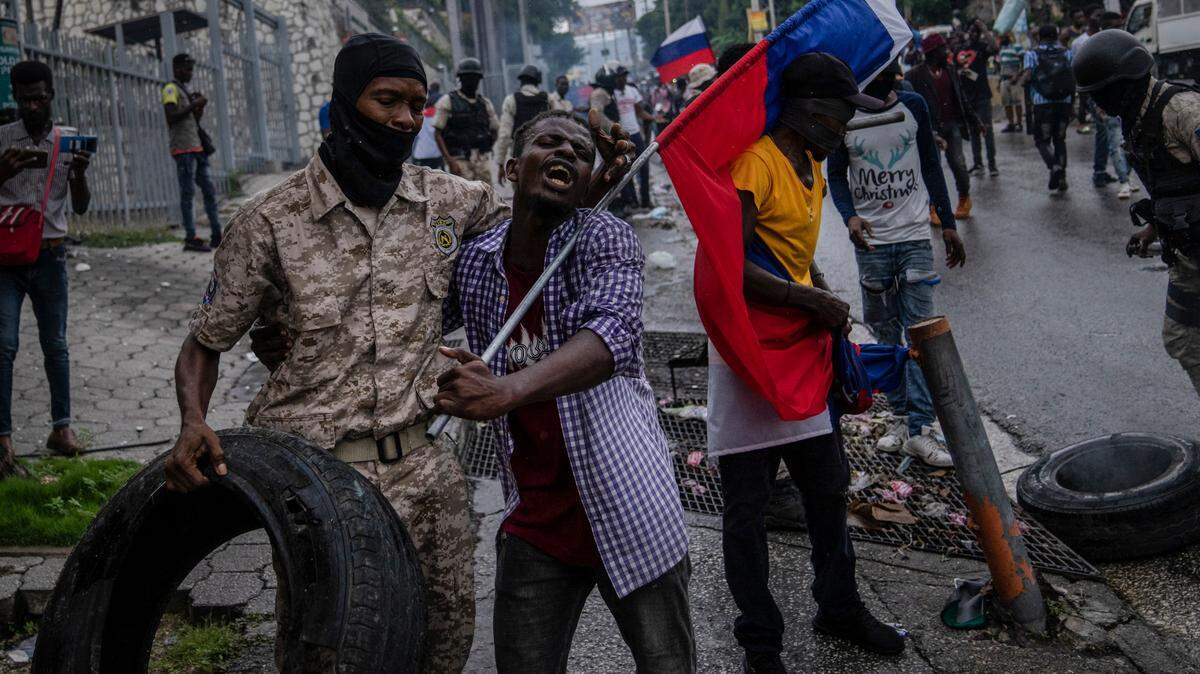
Since mid-September, a powerful gang alliance known as the G-9 Family and Allies, has been blocking the flow of petroleum from the country’s main fuel terminal, Varreux. The blockade is leading to fuel shortages countrywide, and food and drinking water are becoming scarce amid a resurgence in cholera.
Joly said the blockade, which is part of the crises Haiti currently faces — humanitarian, security and political — is the reason why a five-member delegation was sent to Haiti to assess the situation and how Canada can best help.
“The goal is be able to have information coming from the team ... on these three crises,” said Joly, noting that in addition to meeting with Blinken, she also has spoken to the head of the African Union, who is visiting Canada, and her Caribbean colleagues.
READ MORE: U.S. wants to find a country to lead Haiti military intervention by early November
The five-member delegation includes Brigadier General Eric Laforest and Daniel Jean, former deputy minister of foreign affairs. There is also a member of the Royal Canadian Mounted Police in the group, which is headed by Jean, who is a former national security and intelligence adviser to the prime minister.
“Canada and the international community are concerned about the violence in Haiti, in particular against women and girls,” Joly said. “Canada will not remain idle while gangs and those who support them terrorize Haiti’s citizens and we will continue to support law-abiding Haitians to put an end to the crisis in their country.”
READ MORE: Haiti journalist victim of armed attack
Earlier this month, Haiti’s interim government launched an international appeal for help and requested the deployment of a specialized armed force to help the police take back control of the ports and access roads from the gangs. The issue is a sensitive one in Haiti, where many Haitians are asking when help will arrive and others are opposed to the idea of foreign troops.
The Haitian government’s request has the backing of United Nations Secretary General António Guterres and the United States, which, along with Mexico, has penned a resolution in the United Nations Security Council to deploy a multinational force made up of foreign police officers and soldiers to help the Haiti National Police, a force that has been unable to take back control from the gangs.
“For many years, the United States and Canada have worked together around donors conferences, to provide additional assistance to the Haitian people, as well as the Haitian national police,” Assistant Secretary of State Brian A. Nichols told reporters Wednesday just as the Canadian delegation was arriving in Port-au-Prince. “At this crucial moment with security and health situations in Haiti at a very critical phase, we expect to deepen those conversations. ... Haiti is a priority for both countries.”
Similar to the U.S., Canada has been a financial supporter of Haiti, providing almost 2 billion Canadian dollars since 2010 to assist in strengthening Haitian institutions, including the national police.
While Joly and Canadian Prime Minister Justin Trudeau have been very vocal about the escalating crisis in Haiti, neither has said publicly if Canada would lead a military intervention. Joly stressed on Thursday the need to have any solution be “by and for Haitians” in order for it to have the needed legitimacy.
“No decision will be taken without the involvement of the Haitians themselves,” she said.
In addition to meeting with regional partners such as the 15-member Caribbean Community, CARICOM, and the United Nations, the delegation will also meet with various politicians, civil society representatives, activists, members of the private sector and local diplomats as well as members of the Haiti National Police.
As others have in the international community, the Trudeau government has called on Haiti’s leaders to find a political accord among themselves in order to address its multidimensional crisis and take the country to elections.
“There needs to be fair elections happening and we need to make sure that the environment for these elections to happen is the right one,” Joly said. “But to do that we need to address the security and the humanitarian issues.”
This story was originally published October 27, 2022 at 12:44 PM.